FDA eSTAR is the FDA’s electronic submission template used for 510(k), De Novo, and selected medical device submissions. The United States Food and Drug Administration introduced the FDA eSTAR program. This program is a part of what the United States Food and Drug Administration is doing to make things easier for people who make medical devices. The FDA eSTAR program makes it simpler for medical device manufacturers to get permission to sell their products in the United States.
As of October 1, 2023 the FDA eSTAR program is required for most medical device manufacturers who want to get permission to sell their products in the United States. This is a change because now everything has to be done on the computer. The FDA eSTAR program helps medical device manufacturers send in submissions. It also makes things more transparent. Helps the United States Food and Drug Administration review submissions more quickly. This is good for both the medical device manufacturers and the United States Food and Drug Administration.
Looking for Global Medical Device Regulatory Consulting?
Accelerate global market access with DDReg Pharma's Medical Device Regulatory Services. Our experts provide end-to-end support for device classification, regulatory strategy, technical documentation, 510(k), CE Marking, MDR/IVDR compliance, QMS implementation, global product registrations, local representation, and post-market surveillance across 120+ countries.
Explore Medical Device Regulatory Services →Understanding FDAs eSTAR For Medical Devices
FDA eSTAR is an interactive PDF-based submission template developed to guide medical device manufacturers through the preparation of regulatory submissions. It includes structured questions, prompts, and automated checks to help manufacturers provide complete and accurate regulatory information.
The Medical Device eSTAR format improves submission consistency and enables FDA reviewers to evaluate applications more efficiently.
Key Features Include in FDAs eSTAR:
- Guided Prompts and Questions –Each section of the eSTAR template includes instructions and guided questions that help manufacturers provide relevant technical, regulatory, and device-specific information.
- Standardized Format –The eSTAR Medical Device Submission format follows a standardized structure that improves consistency across submissions and supports efficient FDA review.
- Integration with FDA Review Processes –The template integrates with FDA review processes through the Submission Memo and Review Template (SMART) system, supporting improved evaluation and communication.
Detailed eSTAR Structure & Checklist
The FDA eSTAR Submission template follows a structured format designed to guide manufacturers through all required sections of a medical device submission.
A typical FDA eSTAR Submission includes:
- Administrative Information
- Applicant and manufacturer details
- Contact information
- Submission type and device details
- Device Description and Classification
- Device identification
- Intended use and indications for use
- Device classification and regulatory pathway
- Predicate Device Information
- Identification of predicate devices
- Substantial equivalence information
- Comparison between new and existing devices
- Technical Documentation
- Device design and specifications
- Materials and manufacturing information
- Performance testing data
- Software and Cybersecurity Information (Where Applicable)
- Software documentation
- Cybersecurity risk assessment
- Verification and validation information
- Biocompatibility and Performance Testing
- Biological evaluation
- Bench testing
- Electrical safety and performance testing (where applicable)
- Labeling and Packaging Information
- Device labeling
- Instructions for use
- Packaging and storage requirements
eSTAR Submission Checklist
Before submitting an FDA eSTAR Submission, manufacturers should verify:
- Complete administrative information
- Correct device classification
- Appropriate predicate device selection
- Complete medical device technical documentation Submission
- Required testing reports included
- Labeling compliance reviewed
- All mandatory eSTAR fields completed
- Submission validated before FDA upload
Procedure for Preparing eSTAR Submission
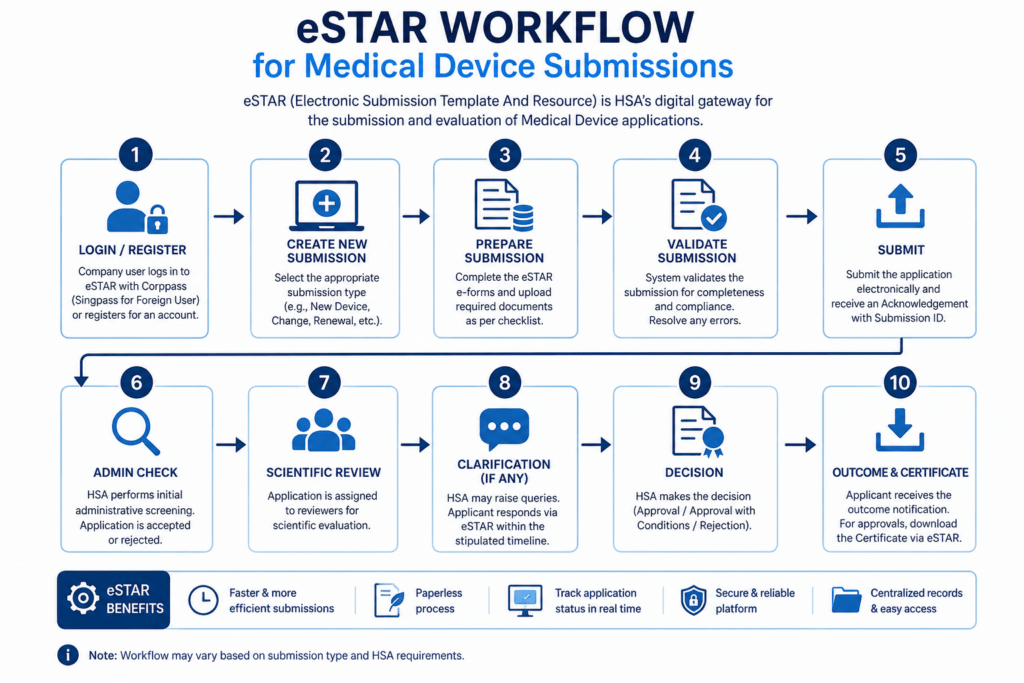
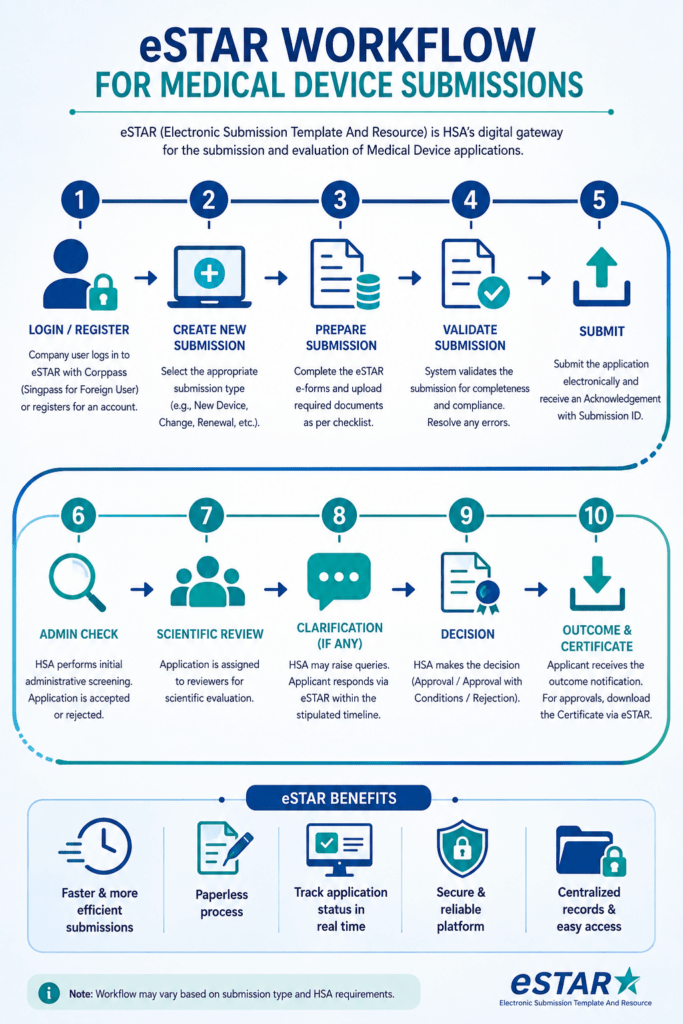
An FDA 510(k) eSTAR submission involves completing the template providing required technical documentation responding to guided prompts validating submission completeness and submitting through the FDA electronic submission system.
Manufacturers should ensure that all information is accurate, complete and aligned with FDA expectations to reduce review delays and regulatory deficiencies.
Advantages of eSTAR submission
The FDA eSTAR Submission process provides several advantages that support a more efficient medical device review and approval pathway.
- Elimination of Refuse to Accept (RTA) Review –The eSTAR template reduces the risk of Refuse to Accept (RTA) issues by ensuring required sections and information are completed before submission. The automated checks help identify missing information, allowing submissions to move more efficiently into substantive FDA review.
- Streamlined Regulatory Submissions –The standard Medical Device eSTAR format makes submissions easier to organize and cuts down on mistakes. Helps FDA reviewers look at applications faster.
- Reducing Burdens –The FDA eSTAR Submission way lowers the amount of work by making paperwork simpler, making things clearer, and making submissions more the same each time.
Common eSTAR Errors and How DDReg Prevents Them
Although the FDA eSTAR platform improves submission quality, manufacturers may still face technical deficiencies that can delay FDA review.
Most Frequent Technical Deficiencies in eSTAR Submissions
Common issues include:
- Missing mandatory fields in the eSTAR template
- Incorrect device classification information
- Incomplete predicate comparison details
- Missing performance testing documentation
- Inconsistent information across sections
- Incorrect labeling information
- Unsupported technical claims
- Incomplete software or cybersecurity documentation
How DDReg’s Internal Review Process Reduces eSTAR Technical Holds and RTA Issues
DDReg supports manufacturers through structured submission readiness reviews, including:
- Completeness assessment of eSTAR sections
- Technical documentation review
- Regulatory consistency checks
- Verification of testing and performance data
- Labeling and claims review
- Pre-submission quality assessment
This method helps cut down on missing information make submissions lower possible RTA issues.
FDA 510(k) Program Updates and eSTAR Alignment
The FDA is still making the 510(k) review process better by making submissions more consistent improving how quickly they are reviewed and updating regulatory steps.
The use of FDA 510(k) eSTAR helps the FDA reach its goal of getting organized submissions that let reviewers check device safety and performance quickly.
Companies need to match their plans with changing FDA rules about:
- Electronic submission requirements
- Submission completeness checks
- Updated device guidance documents
- Cybersecurity expectations
- Artificial intelligence-enabled medical device considerations
How to Submit an eSTAR on CDRH Protal
Accessing the CDRH Portal – The Center for Devices and Radiological Health (CDRH) serves as the primary platform for online medical device submissions. Applicable submissions may also be completed through the Electronic Submission Gateway (ESG) for CBER submissions.
As of October 1, 2023, all 510(k) submissions, unless exempted, must be submitted electronically using the FDA eSTAR format. Additionally, beginning October 1, 2025, De Novo classification requests, unless exempted, are also required to be submitted electronically using eSTAR. These changes reflect FDA’s continued transition toward standardized electronic submission processes for medical device regulatory strategy reviews.
The FDA eSTAR Submission format may also be used voluntarily for De Novo requests and Q-submissions (Pre-Sub).
Linking eSTAR to Wider 2025–2026 FDA Changes
The adoption of FDA eSTAR aligns with FDA’s broader initiatives to improve digital regulatory processes, submission consistency, and review efficiency.
Key regulatory trends expected during 2025–2026 include:
- Expansion of electronic submission requirements
- Greater use of structured submission formats
- Increased focus on data quality and completeness
- Continued digital transformation of FDA review processes
- Improved regulatory assessment workflows
Manufacturers should establish effective electronic submission strategies to remain prepared for evolving FDA expectations.
Cybersecurity Documentation in eSTAR
For applicable medical devices, manufacturers should include cybersecurity documentation addressing:
- Cybersecurity risk management
- Threat modeling
- Software validation
- Vulnerability management
- Security controls
- Post-market Surveillance cybersecurity monitoring
DDReg supports manufacturers with regulatory documentation review and cybersecurity-related submission requirements.
Conclusion
The FDA eSTAR platform is an improvement in the way medical device companies submit their products for regulation. It gives manufacturers a fast and consistent method to follow.
The Medical Device eSTAR process makes it easier to create quality submissions by offering step-by-step guidance on what to document, using automated checks to catch errors, and making sure everything aligns with the rules.
When manufacturers use the FDA eSTAR Submission method, they are better able to handle the changing requirements from the FDA. They increase their chances of getting approval to sell their medical devices.If you need professional support, explore our Medical Device Regulatory Services to streamline your submission process and improve your chances of a successful FDA review.
In addition to providing regulatory services and pharmacovigilance services for global customers, DDReg Pharma offers specialized clinical regulatory services to assist with Clinical Trial Applications in the USA. For further information, connect with our experts.
Read more from our experts here: FDA Launches REMS Public Dashboard to Enhance Transparency and Data Access
Frequently Asked Questions (FAQs)
The FDA eSTAR system is an interactive electronic submission template developed by FDA to help manufacturers prepare structured medical device submissions with guided requirements and regulatory information.
FDA eSTAR is mandatory for all 510(k) submissions and De Novo requests unless an exemption applies. For other submission types, such as Q-Submissions, PMA applications, and IDE submissions, eSTAR availability depends on the submission type and FDA requirements.
An FDA eSTAR Submission includes administrative information, device details, classification information, predicate comparison, technical documentation, performance testing data, labeling information, and other required regulatory information.
The Medical Device eSTAR format improves submission efficiency through standardized sections, guided prompts, and automated checks that help reduce errors and improve FDA review readiness.