South Korea is becoming a major player in the global pharmaceutical space from a combination of rapid industry growth and highly developed regulations. For pharmaceutical businesses, this means South Korea offers both opportunities and challenges.
The Ministry of Food and Drug Safety in South Korea (MFDS), previously the Korean Food and Drug Administration, is the primary regulatory body for medicines in South Korea. The MFDS reviews and approves regulations governing the pharmaceutical industry and monitors the safety of drugs in the market.
The MFDS has the mandate to ensure that the drugs meet the internationally accepted standards and are safe and effective for the patients. South Korea is a preferred market for both local and international pharmaceutical companies.
However, the regulatory framework is daunting for most foreign companies. Understanding and navigating foreign regulatory compliance is a prerequisite to successful market entry. This blog will examine the South Korean regulatory compliance framework.
Planning to Register Your Products in South Korea?
Successfully navigate South Korea's MFDS regulatory requirements with DDReg Pharma's end-to-end Regulatory Affairs Services. Our experts support regulatory strategy, dossier preparation, MFDS submissions, product registration, and lifecycle management for pharmaceutical products, medical devices, cosmetics, and other regulated healthcare products.
Explore South Korea Regulatory Services →Steps for MFDS DRUG REGISTRATION IN SOUTH KOREA
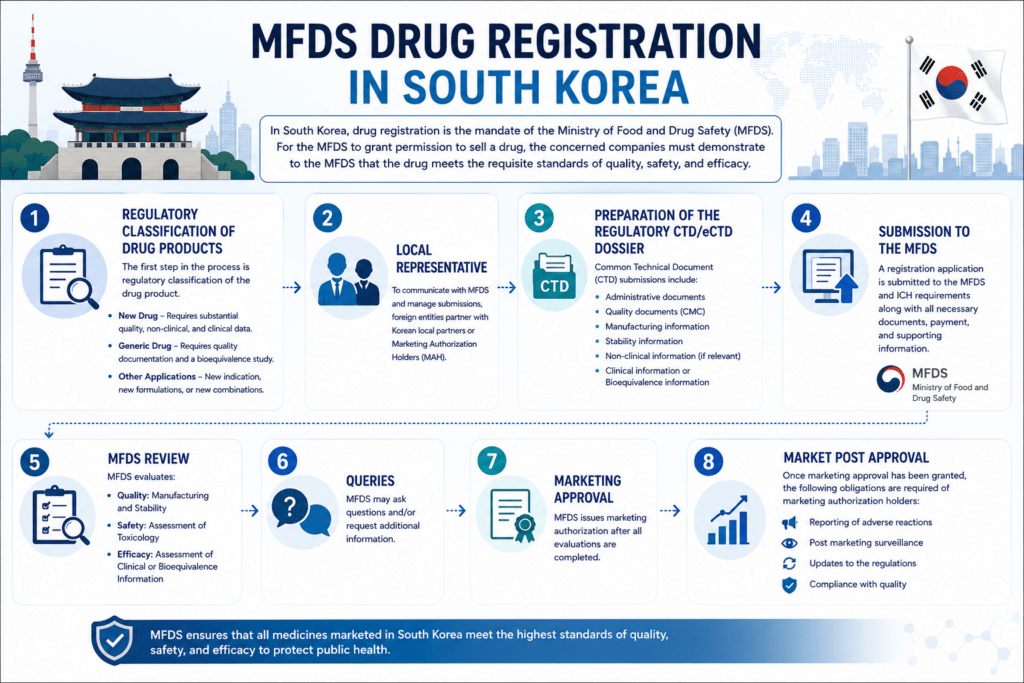
In South Korea, drug registration is the mandate of the Ministry of Food and Drug Safety (MFDS). For the Ministry of Food and Drug Safety (MFDS) to grant permission to sell a drug, the concerned companies must demonstrate to the MFDS that the drug meets the requisite standards of quality, safety, and efficacy.
- Regulatory Classification of Drug Products – The first step in the process is regulatory classification of the drug product. The regulatory classification requirements for:
- New Drug – Requires substantial quality, non-clinical, and clinical data.
- Generic Drug – Requires quality documentation and a bioequivalence study.
- Other Applications – New indication, new formulations, or new combinations.
- Local Representative –To communicate with MFDS and manage submissions, foreign entities partner with Korean local partners or Marketing Authorization Holders (MAH).
- Preparation of the regulatory CTD/eCTD Dossier –
Common Technical Document (CTD) submissions include:
- Administrative documents
- Quality documents (CMC)
- Manufacturing information
- Stability information
- Non-clinical information (if relevant)
- Clinical information or Bioequivalence information
- Submission to the MFDS – A registration application is submitted to the MFDS and ICH requirements along with all necessary documents, payment, and supporting information.
- MFDS Review
MFDS evaluates:
- Quality: Manufacturing and Stability
- Safety: Assessment of Toxicology
- Efficacy: Assessment of Clinical or Bioequivalence Information
- Queries – MFDS may ask questions and/or request additional information.
- Marketing Approval – MFDS issues marketing authorization after all evaluations are completed.
- Market Post Approval –
Once marketing approval has been granted, the following obligations are required of marketing authorization holders:
- Reporting of adverse reactions
- Post marketing surveillance
- Updates to the regulations
- Compliance with quality
The Drug Approval Process in South Korea
South Korea has a structured system for classifying pharmaceuticals, determining regulatory requirements and approval pathways. This classification system categorizes pharmaceutical products and their ingredients; further, these drug products can be divided into three categories.
- Firstly, new drugs, as defined by unique chemical structures or original composition, require extensive clinical and non-clinical data in order to demonstrate safety and efficacy.
- Second, Certain pharmaceuticals with improved efficacy or novel active ingredient compositions require additional data submission.
- Thirdly, generics, which are bioequivalents of reference drugs. Their classification system serves as a framework that determines which level of documentation and tests will be needed in order to obtain regulatory approval.
South Korea, in accordance with the classification system of pharmaceuticals, has developed three main drug-approval pathways.
- New Drug Application (NDA)/ Biologics License Application (BLA): This pathway requires extensive documentation, including preclinical and clinical trial data, safety data and quality assessments.
- Generics: This pathway applies to generic equivalents of brand name drugs, requiring demonstration of bioequivalence rather than full clinical trials.
- Biosimilars: This pathway is designed for biosimilars which are equivalent to existing approved biological products, requiring more documentation to demonstrate similarity.
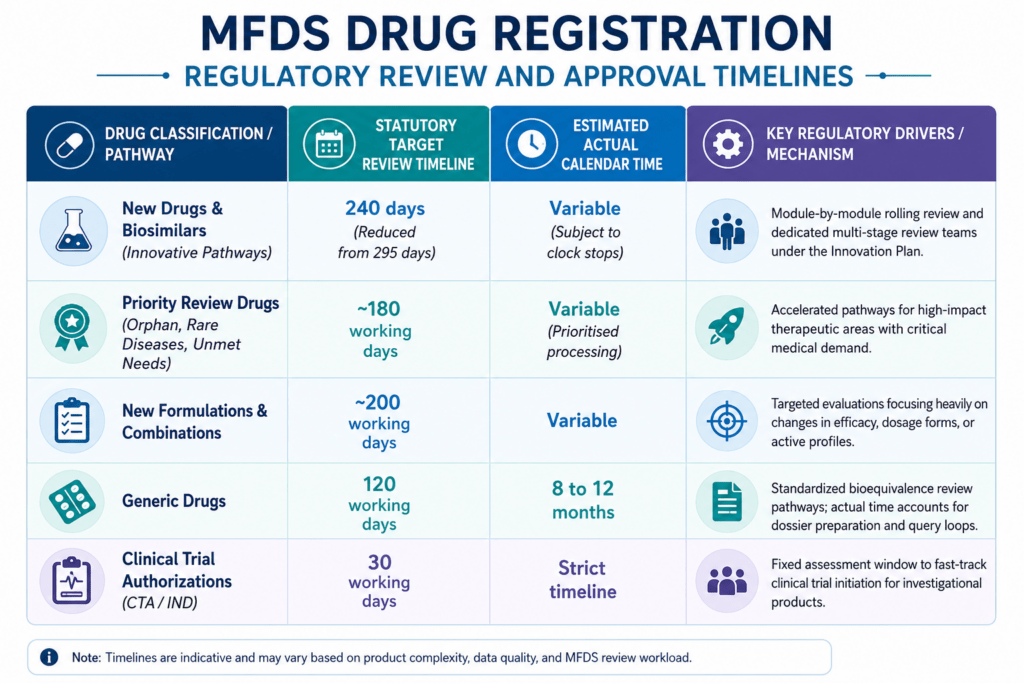
MFDS Drug Registration Regulatory Review and Approval Timelines
MFDS Drug Registration in South Korea Regulatory Requirements & Submission Process
The classification system and approval routes as detailed above require pharmaceutical companies to satisfy unique regulatory requirements and digital transformation processes for each category of drug.
The path to obtaining regulatory approval in South Korea dictates the requirements for submitting drug applications. In the case of New Drug Application (NDA) and Biologics License Application (BLA) submissions, the risk-benefit evaluation of a drug requires the review of safety and efficacy data, assessments of Chemistry, Manufacturing, and Controls (CMC), and a review of Good Manufacturing Processes (GMP).
While reviewing an application, the MFDS aligns with ICH Guidelines to assesses the regulatory compliance of Good Clinical Practice (GCP) at the clinical trial sites. In addition, the MFDS expects that the sponsoring company will ensure compliance with Good Laboratory Practice (GLP) and Good Manufacturing Practice (GMP) within their respective domains of obligation.
Pharmacovigilance Requirements and Safety Monitoring
Pharmacovigilance is a system that actively monitors the safety of a drug once it has been authorized for sale. South Korea has developed a strong system of pharmacovigilance and monitoring that consists of an obligation to report adverse drug events, as well as the establishment of the Korea Institute of Drug Safety and Risk Management (KIDS), which aids in recognizing and preventing drug-related problems and protects the national health.
In current regulations, the Marketing Authorization Holders (MAHs) of a product must delegate the responsibility of pharmacovigilance to a qualified person and ensure that this person receives training regularly. Adverse events must be reported in accordance with the local regulations and global standards, and must include information on the patient and the reporter to establish a system to monitor and respond to adverse events during the product life cycle.
Required Documents for MFDS Submission
Expected Korean food and drug safety management system modifications will emphasize quicker drug approvals, improved quality, and digital changes.
Important changes include:
- Quicker Drug Approvals: A new prioritization process will provide more comprehensive support and promote faster reviews and approvals.
- AI and Digital Health Convergence: New drug development regulations will cover AI and digital health.
- GMP and Data Integrity: Inspections will become more frequent and quality management systems will be required. Regulatory support for both biosimilar and biologic products will be improved.
- Safety and Market Control: Safety and market control regulations will be stricter. Regulatory review and approvals will become faster due to the increased use of digital submissions.
Pricing and Market Access Strategies
Pharmaceutical companies pursuing commercial opportunities in South Korea have to consider its unique pricing and reimbursement systems in addition to demonstrating safety, efficacy, and conducting the required pharmacovigilance services in South Korea.
Understanding the South Korean National Health Insurance (NHIS) system is key to market access. The NHIS directly impacts which drugs receive insurance coverage, as well as the drug’s reimbursement price.
Pricing negotiations with the NHIS are essential to securing reimbursement for a drug. The NHIS seeks to program a therapeutic breadth of health coverage while working within a constrained budget. To win a negotiation for desired pricing and reimbursement, companies must defend the drug as both economically and clinically cost-effective.
Challenges and Opportunities in the South Korean Market
Despite the opportunities, pharmaceutical companies face several challenges in the South Korean market in drug registration. These include stringent regulatory requirements, intense competition, and pricing pressures. The regulatory environment is rigorous, requiring significant investment in compliance and regulatory affairs. Additionally, the market is highly competitive, with many domestic and international players vying for market share. However, there are also growth opportunities, particularly in areas like biosimilars and personalized medicine. The government’s support for innovation and R&D, along with a highly educated workforce, positions South Korea as an attractive location for pharmaceutical investment. The demand for innovative treatments, especially in areas like oncology and rare diseases, provides opportunities for companies to develop and market new therapies.
Why Choose DDReg Pharma for South Korea Regulatory Services
- MFDS Regulatory Expertise: Comprehensive understanding of South Korea drug registration processes and requirements.
- Comprehensive Regulatory Services: CTD/eCTD services from preparation, submission, review, responses to approval.
- International Regulatory Experience: Guidance and assistance in penetrating and/or accessing the Korean pharmaceutical market.
- GMP and Compliance Services: Assurance and protection that manufacturing and quality documentation are following MFDS standards.
- Time-Efficient Approval Strategies: Regulatory strategies that aim to decrease approval time and minimize failures.
For South Korea regulatory services that are reliable, compliant, and time-efficient, choose DDReg Pharma.
Conclusion
The South Korean pharmaceutical market is both promising and complex. Its robust healthcare system and dedication to medical research add to the careful consideration needed to navigate South Korea’s pharma market.
To be successful, firms will need to combine deep market understanding with regulatory knowledge and planned market access. A market with the potential that South Korea possesses will require pharma firms to understand the regulations and develop innovative market access solutions to be the first movers.
Complexity in South Korea’s regulations needs to be addressed. For unique solutions in regulatory requirements and pharmacovigilance, reach out to DDReg to guarantee market access.
DDReg has provided its customers with regulatory and pharmacovigilance services in South Korea and support in facilitating the submission of applications including NDA, ANDA, biosimilars, and more. Reach out to DDReg for expert and tailored guidance on your application. Read more from our expert here: How Global Collaboration Can Prevent Drug Shortages in Healthcare
Frequently Asked Questions (FAQs)
The Ministry of Food and Drug Safety (MFDS) is responsible for reviewing and approving pharmaceutical products in South Korea.
The review and approval time for registration is dependent on the product, the required data, and the MFDS review. Typically, the review of new drug applications takes longer than that of generic drug applications.
Yes, foreign organizations are required to engage a local Korean representative to perform all regulatory communications and submissions tasks on their behalf.
Submissions to the MFDS are typically in the Common Technical Document (CTD) format, including sections for quality, safety, and efficacy.