
South Korea has long been one of Asia’s most sophisticated pharmaceutical regulatory environments. The Ministry of Food and Drug Safety has built a regulatory framework that draws from both US and European models, operates with genuine scientific rigour, and has, over the past decade, progressively aligned with ICH guidelines across quality, safety, efficacy, and multidisciplinary topic areas. For pharmaceutical companies targeting the Korean market, currently valued at over USD 30 billion and growing, MFDS registration is a substantive regulatory undertaking that requires preparation.
The regulatory reforms that have been implemented in the requirements for clinical data, ongoing conformity with new ICH guidelines, revisions to the biopharmaceutical product’s approval process, and MFDS’s new method of reviewing regulatory approval have altered the registration process in ways that can both make registration more complicated and for sponsors who are well-prepared, ease the process to marketing authorization.
Additionally, MFDS introduced a new rapid approval and review process starting on June 1, 2026. including eligible new medicines and biosimilars. MFDS introduced a new expedited approval and review process effective June 1, 2026, covering eligible new drugs and biosimilars, with a target approval period of 240 days under the new framework.
Official Source – MFDS — Overview of Pharmaceutical Approval Process
Need Support with MFDS Drug Registration in South Korea?
Navigate South Korea's evolving MFDS requirements with expert support for regulatory strategy, new product authorization, eCTD submission, CMC, labeling, and post-approval lifecycle management.
Explore South Korea Regulatory Services →What is MFDS Drug Registration?
MFDS drug registration is the regulatory process through which pharmaceutical products are reviewed and approved for marketing in South Korea. The Ministry of Food and Drug Safety (MFDS) is responsible for the evaluation of pharmaceutical products to determine whether their safety, quality, and effectiveness have been properly established. The approval framework is governed by the Pharmaceutical Affairs Act and related regulations and notifications.
What Does MFDS Regulate?
The Ministry of Food and Drug Safety (MFDS) is the principal regulator of the pharmaceutical industry within South Korea. MFDS supervises the approval and monitoring of pharmaceutical products which includes the assessment of their safety, quality and effectiveness in addition to post-approval and manufacturing regulatory functions. T MFDS’s pharmaceutical review functions involve the National Institute of Food and Drug Safety Evaluation (NIFDS), which conducts scientific evaluations of drug applications. MFDS’s current approval framework identifies drug products and pharmaceutical ingredients and classifies drug products including new drugs, pharmaceuticals requiring data submission, and generic drugs.
Types of Pharmaceutical Products Regulated by MFDS
Korea’s pharmaceutical regulatory framework operates on a marketing authorisation model broadly consistent with international regulatory systems. Products are classified according to their characteristics and evidence requirements.
- New Drugs – A new drug refers to a pharmaceutical containing a new material whose chemical structure or original composition is different from a pharmaceutical previously approved in Korea, or a multiple preparation containing a new material as an active drug substance, as designated under the applicable Korean framework. New-drug applications require comprehensive evidence addressing quality, safety, and efficacy.
- Pharmaceuticals Requiring Data Submission – A pharmaceutical requiring data submission is not classified as a new drug but requires safety and efficacy evaluation. Examples can include pharmaceuticals involving new effectiveness, new composition, changes in strength, or a new route of administration.
- Generic Drugs – Generic drugs are pharmaceuticals considered equivalent to a reference drug in terms of active ingredient, dosage form, and strength. MFDS identifies bioequivalence studies, GMP documentation, and CMC data among the key requirements for generic drug approval.
- Biosimilars and Biopharmaceutical Products – Biological products and biosimilars are subject to product-specific regulatory requirements and should be assessed according to the applicable MFDS pathway. The 2026 regulatory changes are particularly relevant to biosimilars because eligible biosimilars are included within the scope of the new expedited approval and review process introduced by MFDS.
Structural Overview of MFDS Regulatory Framework
The Ministry of Food and Drug Safety (MFDS) is the primary regulatory authority for pharmaceuticals in South Korea, operating under the Pharmaceutical Affairs Act (약사법) and its subordinate regulations. MFDS’s pharmaceutical review functions are primarily executed through the National Institute of Food and Drug Safety Evaluation (NIFDS), which conducts scientific assessment of drug registration applications.
Korea’s pharmaceutical regulatory framework operates on a marketing authorisation model broadly consistent with the EU approach. Products are classified as new drugs, new combination drugs, new formulations , generic drugs, and biosimilars, each with distinct documentation requirements and review processes.
Korea is a full member of ICH (joining in 2016), and MFDS has progressively implemented ICH guidelines since then. CTD format is standard for all new drug applications. MFDS accepts Module 2 CTD summaries in either Korean or English, with Module 1 regulatory documents required in Korean.
Official Source – MFDS — Pharmaceutical Affairs Act
MFDS Drug Registration Requirements in South Korea
The exact requirements for MFDS drug registration depend on the product classification and regulatory pathway.
For new drugs, MFDS identifies safety and efficacy data, specifications and test methods, Drug Master File (DMF) information, manufacturing and marketing documentation for imported pharmaceuticals, and information concerning active pharmaceutical ingredient manufacturers among the relevant application information. GMP evaluation is also part of the approval framework.
For generic drugs, MFDS identifies bioequivalence studies, GMP documents, and CMC data as key application requirements.
Depending on the product, companies should therefore assess:
- Quality and CMC documentation
- Safety and efficacy data
- Clinical data
- Bioequivalence data, where applicable
- Manufacturing information
- GMP documentation
- DMF information, where applicable
- Product-specific regulatory requirements
- Korean administrative and product information
A global dossier should be assessed against Korean requirements before submission rather than assuming that an existing US or EU dossier can be transferred without regulatory gap assessment.
MFDS Generic Drug Registration in South Korea
Generic drug registration in South Korea follows a different regulatory pathway from new-drug registration.
MFDS identifies bioequivalence studies, GMP documents, and CMC data as part of the required application documentation for generic drugs.
The registration strategy should therefore consider:
- Reference drug
- Active ingredient
- Dosage form
- Strength
- Bioequivalence requirements
- CMC documentation
- GMP documentation
- Manufacturing-site requirements
- Applicable administrative documentation
For international companies, confirming the applicable Korean requirements before preparing the final dossier can help identify evidence gaps before submission.
Key Changes in MFDS Drug Registration for 2026
2026 has introduced important developments in the Korean regulatory environment.
Revised Approach to Foreign Clinical Data Acceptability
One of the most significant ongoing shifts in Korean drug registration has been MFDS’s evolving approach to the acceptability of foreign clinical data for innovative medicines. Korea historically required domestic clinical studies (bridging studies or Phase 3 local trials) as a condition of registration for many new drugs, justified by the perceived need to demonstrate product safety and efficacy in Korean patients specifically.
The ICH E5 guideline, which governs the acceptability of foreign clinical data, has been progressively embedded in MFDS’s review approach, but implementation has not always been consistent. In 2025-2026, MFDS has taken a more explicitly codified position on foreign data acceptability, aligned with its international partners’ approach:
- Multinational clinical trial data from ICH-region studies are accepted as the primary evidence base for innovative medicine applications .
- Korean bridging data (typically pharmacokinetic bridging studies, ethnic sensitivity assessments, and limited domestic safety data) is required where the disease population or pharmacogenomic factors relevant to Korean patients differ materially from the multinational trial population .
- MFDS has clarified guidance on when a full Korean Phase 3 study is required (generally limited to cases where significant population-level differences in disease characteristics or treatment response are expected, not as a universal requirement) .
For international sponsors with completed multinational Phase 3 trials, this clarification meaningfully reduces the additional regulatory clinical development services burden for Korean registration. The strategic implication is that Korean regulatory services timelines and clinical costs for innovative products are now more comparable to those of other major markets, provided the sponsor accurately characterises the ethnic and pharmacogenomic considerations and addresses them appropriately in the submission.
Expansion of the Expedited Approval and Review Pathway
This is a major 2026 update that should replace the older timeline-focused messaging in the original article.
Official source: MFDS — New Expedited Approval and Review Process
MFDS introduced a new expedited approval and review process effective June 1, 2026. The announced programme applies to eligible new drugs and biosimilars and establishes a 240-day target for approval under the new process.
The 240-day target should not be interpreted as a universal MFDS approval timeline.
Sponsors should first determine:
- Whether the product qualifies for the expedited pathway
- Which approval route applies
- Whether the submission meets the relevant requirements
- Whether the dossier is sufficiently complete
- Whether additional information requests may affect the review
This creates a strategic opportunity for companies developing innovative medicines and biosimilars for the Korean market to evaluate pathway eligibility earlier in the development and submission-planning process.
Updated MFDS New Drug Review Procedure
MFDS also revised its new-drug product approval and review procedure on MAY 2026. It says the revised procedure applies to new-drug applications submitted from October 1, 2026.The authority announced the revised procedure together with pre-approval checklists.
For sponsors preparing a Korean submission, this reinforces the importance of reviewing the latest MFDS procedures and checklists during submission preparation rather than relying solely on legacy submission practices.
Biosimilar Registration Framework Updates
South Korea has a substantial and growing domestic biologics and biosimilar industry, and MFDS has invested significantly in developing a rigorous biosimilar regulatory framework. In 2026, MFDS updated its biosimilar guidelines to more closely align with EMA’s stepwise comparability approach and ICH Q11 principles for biological characterisation.
Key updates include:
- More detailed guidance on the structural and functional comparability studies required in the analytical similarity assessment.
- Revised requirements for clinical pharmacokinetics and pharmacodynamics data in biosimilar applications.
- Clarification of the conditions under which clinical efficacy studies may be waived for biosimilars with robust analytical similarity packages.
- Updated guidance on extrapolation of biosimilar indications where the reference product is approved in multiple indications.
For international biosimilar developers, Korea’s alignment with EMA’s methodological approach means that biosimilar programmes designed to EMA standards are increasingly compatible with MFDS registration requirements, reducing the marginal cost of Korean registration for companies already pursuing EU biosimilar approval.
MFDS Drug Registration: 2026 Key Updates
| 2026 development | What it means |
|---|---|
| Expedited approval and review process | Eligible new drugs and biosimilars may use the new pathway |
| 240-day approval target | Applies to eligible products under the expedited process; not a universal MFDS timeline |
| Revised new-drug review procedure | Sponsors should use the latest MFDS procedures and checklists |
| Increased pathway assessment | Companies should evaluate eligibility before submission |
Digital Health and Software as a Medical Device (SaMD) Integration
MFDS has been among the Asia-Pacific’s most active regulators in developing frameworks for digital therapeutic and Software as a Medical Device (SaMD) through its broader medical device regulatory system and international harmonization activities.
While this is technically a medical device consideration rather than drug registration in itself, the intersection of digital therapeutics with pharmaceutical products, including combination drug-device products and prescription digital health solutions, is increasingly relevant under MFDS oversight.
Companies developing drug-device combinations or pharmaceutical products with companion diagnostic or digital monitoring components should engage with MFDS early, as review may involve coordination between the relevant drug and medical device evaluation functions, depending on product classification.
Step by Step Korean Drug Registration Process
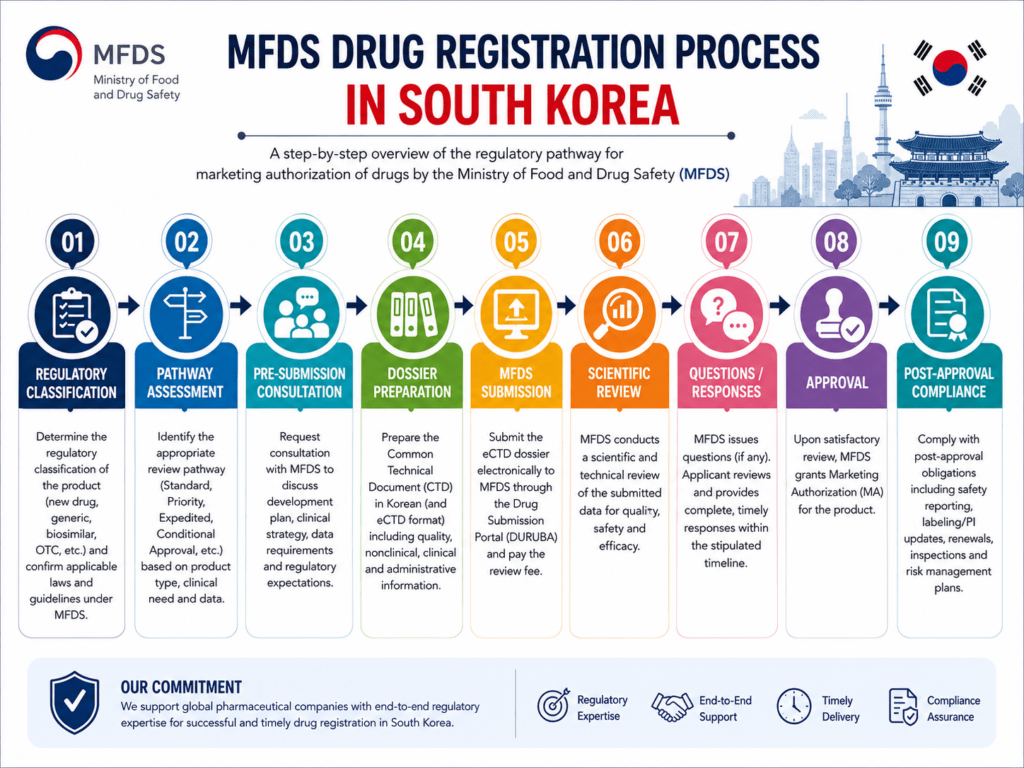
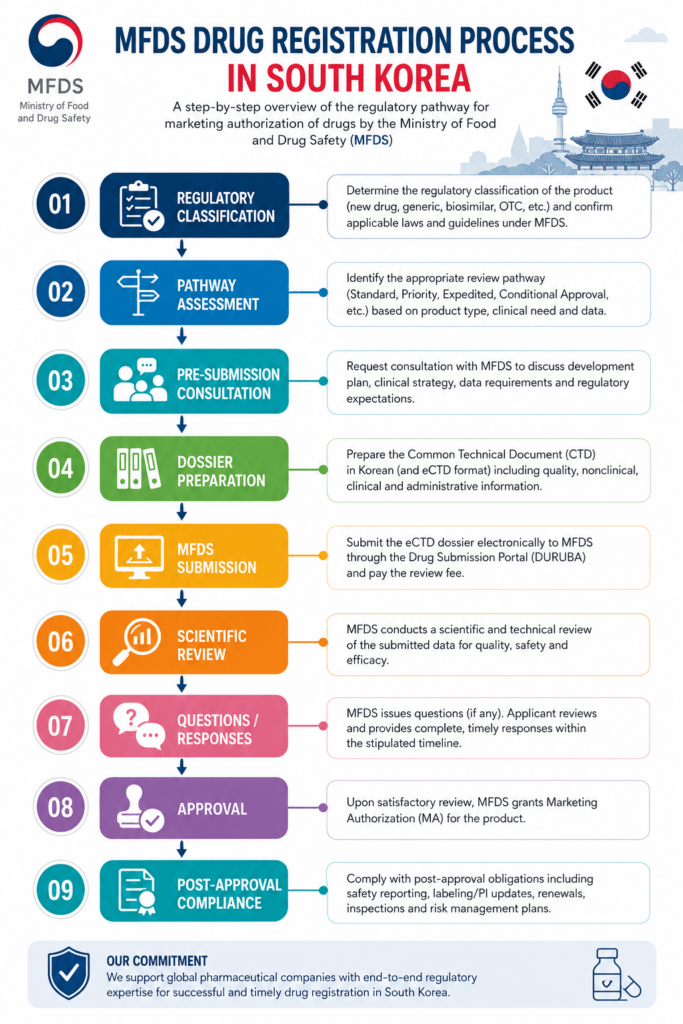
- Pre-Submission Consultation (사전검토): MFDS’s pre-consultation system allows sponsors to engage with NIFDS reviewers before formal submission to discuss data packages, application strategy, and potential deficiency areas. Pre-consultation is not mandatory, but for innovative medicines, particularly biologicals, combination products, and products with complex clinical data packages, it is strongly advisable. MFDS pre-consultation requests must be submitted in Korean (with supporting documents acceptable in English), and the turnaround for consultation responses is typically 30 to 60 calendar days. The investment in pre-consultation routinely pays back in reduced review queries.
- Application Submission Through EZDRUG : Formal applications to MFDS are submitted through the EZDRUG electronic submission system (의약품안전나라). The system has been progressively upgraded in recent years, and as of the current implementation status, it supports electronic submissions aligned with CTD/eCTD principles, depending on product type and pathway. MFDS accepts Module 1 Korean-language documents through EZDRUG, with Modules 2-5 in CTD format acceptable in English (with specified sections in Korean). Module 1 Korean-specific documents include the Korean-language prescribing information (PI/SmPC equivalent), the Korean packaging and labelling draft, and the Korean administrative section with applicant and manufacturing information.
Pre-Review and Review – MFDS’s published approval workflow includes submission, pre-review, scientific review, approval, and issuance of the approval outcome. A product manager can coordinate the application through stages including eCTD submission, supplementation, approval, and revision.
During review, MFDS may assess areas including:
- Quality
- Safety
- Efficacy
- Clinical evidence
- Bioequivalence
- Manufacturing
- Product-specific requirements
Additional Information Requests – MFDS may request additional information or clarification during the review process.
The applicant’s ability to identify, coordinate, and respond to these requests efficiently can influence the overall regulatory timeline.
Approval – Following satisfactory completion of the review, MFDS issues the applicable approval outcome.
MFDS Review Timeline for Drug Approval
New drugs: 320 working days from acceptance
This should not remain as the sole current 2026 timeline, because MFDS has introduced a new expedited approval and review framework.
From June 1, 2026, eligible new drugs and biosimilars can fall under the new expedited approval and review process, which has a 240-day approval target.
The important distinction is:
240 days = target under the new expedited pathway for eligible products, not a universal MFDS approval timeline.
Therefore, companies should determine the applicable pathway before using a review-time estimate for regulatory planning.
The overall elapsed time can still be affected by:
- Application completeness
- MFDS review questions
- Additional information requests
- Applicant response time
- Manufacturing/GMP requirements
- Product complexity
- Applicable expedited or priority pathway
MFDS Drug Registration Fees
MFDS charges regulatory fees for pharmaceutical approval and related regulatory activities.
The applicable fee depends on the relevant application and regulatory activity. Companies should therefore verify the current MFDS fee schedule when preparing a registration budget rather than relying on a single generic drug-registration fee.
Regulatory budgeting should also account for activities beyond the official regulatory fee, including:
- Dossier preparation
- Translation
- Local regulatory support in South Korea
- GMP-related activities
- Bioequivalence studies, where applicable
- Clinical requirements, where applicable
- Post-approval regulatory activities
Need Pharmacovigilance Support After MFDS Approval?
Stay compliant with South Korea's drug safety requirements through expert support for ICSR reporting, RMPs, PSURs, signal management, and MFDS & KIDS compliance.
Explore South Korea Pharmacovigilance Services →Pharmacovigilance Obligations Under MFDS Registration
Korea’s pharmacovigilance framework has been substantially developed in recent years, with MFDS’s pharmacovigilance functions operating within the drug safety evaluation system under the National Institute of Food and Drug Safety Evaluation (NIFDS) and progressively aligning with applicable ICH E2 series guidelines.
- Korean Adverse Event Reporting Timelines – Holders of Korean marketing authorisations must report serious unexpected adverse drug reactions to MFDS within 15 calendar days. Periodic safety reports, Korea’s equivalent of the PSUR/PBRER, are submitted on schedules aligned with the marketing authorisation’s approval history, with the submission timing and international birth date (IBD) used to align Korean PSUR schedules with global reporting timelines. Korea’s pharmacovigilance system operates a spontaneous reporting database, and MFDS analyses signal data independently, with the capacity to initiate safety reviews and require label updates outside the PSUR cycle.
- Risk Management Plans for Korean Registration – MFDS requires Risk Management Plans for innovative medicines, biosimilars, and products with identified safety risks. The Korean RMP format follows a structure broadly aligned with the EU RMP, with a Korean-specific annex addressing local post-market safety activities, Korean pharmacoepidemiological data, and any Korean-specific risk minimisation measures. Companies with EU RMPs in place should note that adapting to Korean requirements, while not wholesale redrafting, involves substantive localisation work, particularly for the Korean-specific annex and integrating Korean safety data sources.
Common Challenges in MFDS Drug Registration
For international pharmaceutical companies, some of the most common challenges include:
- Incorrect Regulatory Classification – Selecting the wrong product category can result in an inappropriate evidence strategy and unnecessary regulatory questions.
- Differences Between Global and Korean Requirements – A dossier prepared for another major market may require additional assessment or adaptation for Korea.
- Clinical and Bridging Data Strategy – Sponsors need to determine whether their international clinical package adequately addresses Korean requirements and whether additional evidence is needed.
- CMC and Manufacturing Requirements – Gaps in manufacturing, specifications, analytical methods, stability, or other quality documentation can create additional review questions.
- GMP Readiness – Manufacturing compliance should be assessed before submission rather than being treated as a post-submission issue.
- Regulatory Query Management – Efficiently managing MFDS questions requires coordination between regulatory, clinical, CMC regulatory advisory, manufacturing, and pharmacovigilance solutions provider teams.
- Changing Regulatory Pathways – With new expedited review mechanisms introduced in 2026, companies should assess pathway eligibility early rather than relying on historical approval assumptions.
How to Prepare for an MFDS Submission: Pre-Submission Checklist
Before submitting a pharmaceutical application in South Korea, companies should consider the following:
Regulatory Strategy
- Confirm the product classification
- Identify the applicable approval pathway
- Assess eligibility for expedited review
- Identify Korean-specific requirements
- Assess potential clinical or bridging requirements
Quality and CMC
- Confirm CMC documentation
- Review specifications and analytical methods
- Confirm stability data
- Verify manufacturing information
- Assess GMP readiness
- Confirm API information and DMF requirements, where applicable
Clinical
- Confirm clinical data package
- Assess the applicability of foreign clinical data
- Identify potential bridging considerations
- Review product-specific clinical requirements
Generic Products
- Confirm reference product strategy
- Assess bioequivalence requirements
- Verify CMC documentation
- Confirm GMP documentation
Submission
- Review administrative documentation
- Confirm applicable Korean-language requirements
- Conduct a regulatory gap assessment
- Perform dossier quality checks
- Prepare for potential MFDS questions
- Assess eligibility for an expedited pathway
Why Choose DDReg for MFDS Drug Registration in South Korea?
DDReg has extensive experience supporting international pharmaceutical and biopharmaceutical companies with MFDS drug registration, including innovative medicine applications, biosimilar submissions, and regulatory strategy.
From regulatory documentation preparation and dossier compilation to pre-submission support, regulatory gap assessment, post-approval lifecycle management, and pharmacovigilance programme establishment, DDReg’s team provides specialist support calibrated to the regulatory requirements of the South Korean market.
Our support can help companies:
- Understand the applicable MFDS pathway
- Assess regulatory requirements
- Identify submission gaps
- Prepare regulatory documentation
- Support new drug and generic registrations
- Support biosimilar regulatory strategies
- Prepare for MFDS interactions
- Manage regulatory responses
- Support post-approval regulatory requirements
- Integrate Korean regulatory requirements with global regulatory strategies
Conclusion
MFDS drug registration in 2026 continues to evolve as South Korea strengthens its position as an important pharmaceutical market and regulatory jurisdiction.
The regulatory environment combines established requirements for quality, safety, efficacy, clinical evidence, manufacturing and GMP with newer mechanisms designed to improve regulatory efficiency. The introduction of the new expedited approval and review process from June 1, 2026, including a 240-day approval target for eligible new drugs and biosimilars, is particularly important for companies evaluating Korean market-entry strategies. At the same time, MFDS’s revised new-drug approval and review procedure issued in July 2026 reinforces the importance of using current regulatory procedures and submission checklists when preparing an application. For international pharmaceutical companies, successful Korean registration therefore depends not only on having a strong global dossier but also on selecting the appropriate MFDS pathway, identifying Korean-specific requirements, assessing expedited-review eligibility where applicable, and preparing the submission well before filing.
Frequently Asked Questions
The requirement for mandatory local Korean clinical trials has been substantially relaxed under the current MFDS framework, consistent with ICH E5 principles on foreign clinical data acceptability. MFDS now accepts multinational Phase 3 data as the primary evidence base for most innovative medicines, with Korean-specific bridging data (typically PK/PD studies and ethnic sensitivity assessments) required where population-level differences are clinically meaningful.
MFDS targets 320 working days from acceptance for new innovative drug applications. In practice, total elapsed calendar time, including additional information request response periods (which pause the MFDS review clock), typically ranges from 18 to 30 months for complex innovative products. Priority Review designation for rare disease or unmet medical need applications targets 180 working days, which can compress total timelines significantly.
Foreign manufacturers must either hold MFDS GMP certification or be covered under a bilateral MRA. The EU-Korea pharmaceutical MRA provides recognition of EU GMP certification, while Japan-Korea GMP cooperation has progressively expanded mutual recognition of inspection outcomes. US manufacturers do not currently benefit from a US-Korea GMP MRA and must obtain MFDS GMP certification through the MFDS inspection process.
MFDS drug registration is the regulatory process through which pharmaceutical products are evaluated for quality, safety and efficacy before approval for marketing in South Korea. MFDS's approval framework covers new drugs, pharmaceuticals requiring data submission and generic drugs.
Requirements depend on the product and regulatory pathway. They can include quality and CMC documentation, safety and efficacy data, clinical data, bioequivalence data, GMP documentation, manufacturing information, DMF information and other product-specific requirements.
There is no single timeline applicable to every pharmaceutical application. MFDS introduced a new expedited approval and review process effective June 1, 2026, with a 240-day approval target for eligible new drugs and biosimilars.
Yes. MFDS introduced a new expedited approval and review process in 2026 for eligible new drugs and biosimilars. MFDS also operates other expedited mechanisms for designated products.
Foreign clinical data may form part of an MFDS application, but the acceptability of the data and the need for additional or bridging evidence should be assessed according to the product and applicable Korean requirements.