
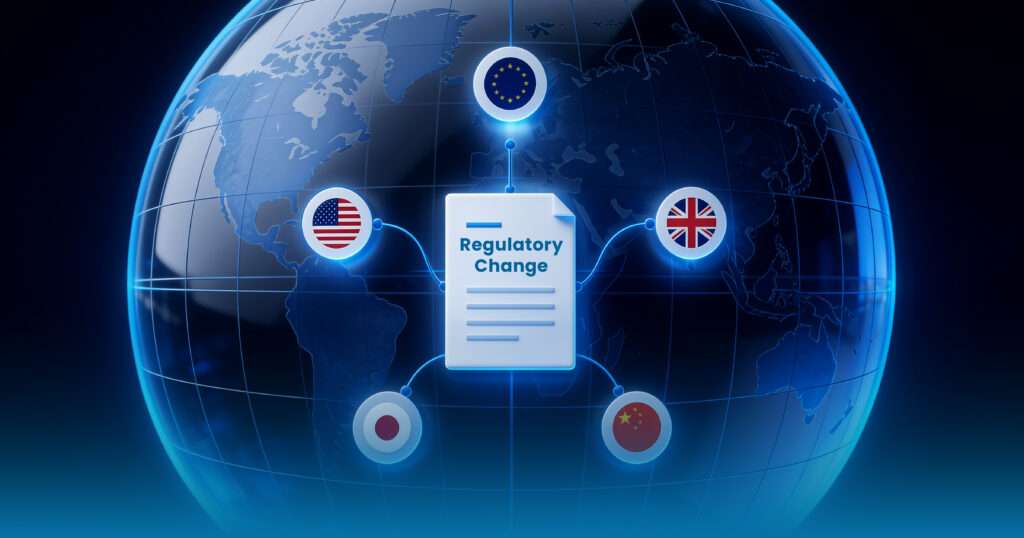
A Regulatory Guideline Changed in One Country — Does It Affect Other Markets?
When there is a change to a regulation in one country, the first question a global regulatory team usually asks is whether they need to revise their submissions everywhere else. Typically, the answer is no. The regulation of pharmaceuticals is always going to be specific to a particular jurisdiction. A new guideline from the FDA, EMA, MHRA, PMDA, Health Canada, TGA and others, will typically be applicable according to the respective regulator’s legal jurisdiction, date of enforcement, scope, and associated transitional provisions. However, this does not mean the change can be ignored in countries outside the respective jurisdiction.
A regulatory change can have implications for global clinical development, Chemistry, Manufacturing and Controls (CMC), the structure and content of the Common Technical Document (CTD) and associated national regulatory submissions, labeling, pharmacovigilance, post approval changes and the evidence the regulators expect for future regulatory submissions. For a product that is intended to be marketed globally, the practical question is not whether the guideline will be applicable elsewhere, but rather in what ways the regulatory change will impact the development and regulatory submission strategies. That distinction is more critical now as the regulation of pharmaceuticals continues to become more harmonized, even though the differences in how countries implement the regulations will remain.
Does a Regulatory Change in One Country Automatically Apply to Other Countries?
No, regulatory changes in one jurisdiction typically do not result in changes to the applicable regulations in other jurisdictions. For instance, the issuance of a new guidance by the FDA does not negate the EMA’s requirements. Similarly, the MHRA, Health Canada, PMDA, and TGA do not necessarily adopt EMA’s procedural changes.
Even with ICH guidelines, which are internationally harmonized, regional or national implementation is necessary for these guidelines to become part of the respective regulatory authority’s framework. Therefore, the dates, interpretations, and statuses of a guideline differ from one region to another.
This necessitates that global regulatory teams differentiate:
- The applicability of a guideline in one jurisdiction,
- The scientific principle of the guideline having international applicability, and
- The adoption or citation of the same principle by another regulatory authority.
In that case, while a change may not have legal implications in other jurisdictions, it may still require the reassessment of other submissions for practical reasons.
Does a Regulatory Change in One Country Automatically Apply to Other Countries?
No, regulatory changes in one jurisdiction typically do not result in changes to the applicable regulations in other jurisdictions. For instance, the issuance of a new guidance by the FDA does not negate the EMA’s requirements. Similarly, the MHRA, Health Canada, PMDA, and TGA do not necessarily adopt EMA’s procedural changes.
Even with ICH guidelines, which are internationally harmonized, regional or national implementation is necessary for these guidelines to become part of the respective regulatory authority’s framework. Therefore, the dates, interpretations, and statuses of a guideline differ from one region to another.
This necessitates that global regulatory teams differentiate:
- The applicability of a guideline in one jurisdiction,
- The scientific principle of the guideline having international applicability, and
- The adoption or citation of the same principle by another regulatory authority.
In that case, while a change may not have legal implications in other jurisdictions, it may still require the reassessment of other submissions for practical reasons.
Why One Country's Regulatory Change Can Still Affect Your Global Filing Strategy
Pharmaceutical development is rarely designed with one market in mind. There are many elements of a global submission, including, but not limited to, clinical studies and the development of safety and stability data.
Changes in major markets can create binding requirements and expose gaps in the global data package. For example, if one regulatory agency develops a new requirement to support a manufacturing process, and the same process is used to support filings in additional jurisdictions, that company may deem it more efficient to obtain and provide the evidence globally rather than support multiple standards.
The same reasoning applies to:
- Clinical endpoints
- Statistical methods
- Comparability data
- Impurity management
- Stability pledges
- Packaging
- Safety reports
- Pharmacovigilance
- E-Submission mandates
- Lifecycle-management offerings.
A local regulatory change can become a global regulatory services change, even if the change is not a global legal requirement.
ICH Harmonisation Does Not Mean Identical Country Requirements
The International Council for Harmonisation (ICH) has led to convergence on pharmaceutical development requirements in the largest markets.
ICH guidelines provide a common scientific framework for several areas including quality, safety, efficacy, clinical and multidisciplinary standards, and submissions in pharmaceutical development, stability, and lifecycle management.
The ICH Common Technical Document (CTD) is a prime example. Modules 2 through 5 provide a largely harmonized structure for quality, nonclinical, and clinical documents. Module 1, however, is still region-specific and contains local requirements for administrative and product information. For example, the EMA’s eCTD guidance specifically provides EU Module 1 requirements in the context of the ICH eCTD guidance.
An ICH guideline can create a common scientific standard, but how that standard is adopted in a regulatory framework is still the prerogative of each regulatory body. ICH Q12 was developed to aid the management of post-approval CMC changes, but it acknowledged that there are differences in regulatory practices and how the guideline is implemented in various countries. Harmonisation thus refers to a more considerable degree of alignment, rather than lack of diversity in regulatory practices.
For global regulatory teams, country-specific implementation guidance is just as important as the ICH guideline itself.
What Types of Regulatory Changes Can Affect Other Countries?
Changes in regulations that involve a universally accepted practice or relate to a component shared internationally tend to have the potential to impact other countries.
The most common areas include:
Clinical Regulations: Changes in the design of clinical trials, Good Clinical Practice (GCP), selection of clinical trial endpoints, patient populations, statistics, decentralized clinical trials, E-Systems, and changes in the expectations of evidence may impact international clinical development.
CMC and Quality Regulations: Changes in the requirements relating to manufacturing sites, testing and analytical methods, specifications, stability, process validation, impurities, comparability, control strategies, and the overall management of the pharmaceutical product lifecycle may impact a shared Module 3 dossier.
Changes in Regulations relating to the Electronic Submission: Changes in the CTD/eCTD format, rules of validation, and changes in metadata and controlled vocabularies and/or submission platforms may require regulatory operations to alter their submission systems and related processes.
Changes in Regulations on Labeling: Changes in wording of a product’s safety information, the inclusion or modification of warnings and/or contraindications, changes in the product information or package leaflets, or changes in the prescribing information may require a global labeling review.
Changes in Regulations on Pharmacovigilance: Changes in requirements for the reporting of new information, signal and risk assessments, management of risks, and the reporting of aggregate post-marketing information may establish new obligations for the global safety system.
Changes in Regulations on Post-Approval: Changes in the classification of variations, changes in the requirements for the reporting of variations, the management and control of manufacturing changes, and changes in expectations for the management of the product lifecycle may impact the way the same change is implemented in various regulatory markets.
How to Determine Whether a Regulatory Change Affects Your Other Filings
The most effective way to determine if a change in regulation impacts your filings is conducting a formal impact assessment. The goal is to avoid assuming that the change will either have a global impact or will not impact your filings at all.
You should start by answering the following six questions:
- What is the nature of the change?
You should determine if the change impacts a legal requirement, regulator expectation, procedure, technical requirement, or a recommendation. - When is the change first applicable?
Changes in regulation may be discontinued or superseded. You should check the publication date, effective date, transition periods, - Which products and submission types are included?
When considering broader requirements, the product type can impact new drug safety development more than with generic drugs, biologics, biosimilar products, advanced therapies, and clinical trials, as well as variations and renewals. - Is the affected information part of a global data package?
If a cross-market study is conducted, and/or a Module 3 and Safety and Core Data Support is provided are available for multiple countries, a cross-market impact is almost certain. - Do any other regulators refer to the same scientific standard?
Do not assume the same level of implementation. Examine relevant requirements of ICH, WHO, and regional and national guidelines. - Will the change introduce inconsistency in other markets?
A local change would create inconsistencies across all markets in the approved dossiers, processes, specifications, and commitments. The discrepancies must be managed. This should be documented in a regulatory impact assessment, outlining the products and markets affected, the changes needed, when they are due, and what actions must be taken.
Global Regulatory Change vs Local Regulatory Change
Regulatory Change Typically Impact:
- ICH Guideline enters final stage Impacts globally, but regionally specific
- National Authority publishes national guidance Legal impact primarily local
- Key Authority modifies existing criteria May impact global development
- Changes to regional eCTD specification Impact on submission format for the region
- Emergence of a global safety signal multi-national impact on labeling and pharmacovigilance
- Changes to local administrative requirements Generally impact only local market
- Changes to global manufacturing requirements Impacts all markets and requires assessment
- Changes to local variation classification Changes to local variation reporting
The distinction is important because a global change doesn’t always require the same regional change, while a local change can impact global regulatory strategy.
Real-World Examples of Regulatory Changes with Cross-Country Impact
The existing examples illustrate converging regulation and the implementation of legislation on a jurisdictional basis.
ICH E6(R3)
Principles and Annex 1 of ICH E6(R3) were approved by ICH at the beginning of 2025 and the European Union finalized and published the new Guideline in July 2025. The FDA published the Guideline in September 2025. Annex 2 reached ICH Step 4 in June 2026 and will be published in the EU in January 2027. The focus of the regulation is global, but the timeframes for implementation differ.
For a multinational clinical trial, waiting for all markets to reach the same formal stages of implementation will not be feasible. The sponsors of the trial will determine whether the clinical trial procedures, computerized systems, and quality, as well as the decentralized systems and data governance, will be aligned globally.
EU Variations Framework
From January 15, 2026, a revised EU variation classification system applies. EMA has updated its forms and procedural guidance to reflect the changes, including those related to the management of Type IA variations. Changes to the EU classification system do not automatically impact post-approval change management in the US, Japan, Canada, or other countries.
Nevertheless, if a Marketing Authorization Holder (MAH) implements the same change to manufacturing in other jurisdictions, the regulatory teams are still required to evaluate the variation classification in the EU and negotiate the change management for all impacted jurisdictions.
UK Clinical Trial Regulations
As of April 28, 2026, the amended UK Regulations on Clinical Trials will be applicable, including the new provisions on the approval of Clinical Trials, modifications, GCP, pharmacovigilance, and related provisions.
Even though the provisions are UK-specific, a sponsor of a multinational Clinical Trial will need to assess if the UK-specific changes will trigger modifications concerning the global provisions for the Clinical Trial, safety, IMP, and documents.
eCTD Version 4.0
Staggered regulatory changes can be observed in a clear manner in the realm of electronic submissions.
The FDA announced its support for eCTD version 4.0 in September 2024. Japan, on the other hand, has continued the preparation of its national eCTD version 4.0 implementation framework, including the release of a new implementation package in June 2026. The standard as such is internationally harmonized, but as to the regional applicability, the frameworks, validation rules, and timelines differ from one regulatory authority to the next.
How Regulatory Changes Affect Global Clinical, CMC and Dossier Strategy
The impact of regulatory changes is strongly dependent on the specific stages of the product lifecycle to which the changes are applicable.
Clinical Development
Regulatory changes in the clinical domain can impact the design of studies well in advance of the submission of a marketing application.
Expectations will affect:
- Design of studies
- Choice of primary and secondary endpoints
- Choice of statistical methodologies
- Monitoring activities
- Degree of decentralization
- IT systems
- Informed consent processes
- Willingness to accept diverse participants
- Data policy
- Adverse event reporting
- Standard operating procedures
The cost can be substantial if a country specific clinical requirement is revealed after the start of a pivotal study.
For studies with multiple countries, significant changes in regulations should be assessed for ongoing studies and future planned study submissions.
CMC and Manufacturing
Changes in CMC can be cross-country complex because a single manufacturing process can support multiple registrations.
Changes in the following can be viewed differently by different Regulatory Authorities:
- Manufacturing site, equipments, Batch size, Formulations
- Manufacturing related analytical method and related specifications
- API
- Container/Closure
- Stability
- Process
- Parameters of the stability
- Control strategy
Tools that are defined by ICH Q12 will assist in dealing with CMC changes post approval for different markets but will still be dependent on the different country regulatory frameworks. Thus, even with a universal scientific rationale, a country specific approach to regulatory requirements is necessary.
CTD/eCTD Submission
While the CTD has streamlined documentation for key regions of the world, it has not eliminated the need for country specific eCTD submissions.
Global teams must still manage:
- Country specific Module 1
- Local forms
- Local certificates
- Local labeling
- Regional administrative documents
- eCTD
- Validation
- Submission
- Changing
- Controlling the process
- Post Approval Life cycle management.
One impact of a submission specification regulatory change in one region may obviate a change to the scientific dossier but require substantial changes to the publishing system.
Labeling and Safety
A label change in one country should result review in all markets, particularly if the change was prompted by safety concerns.
If a new safety issue requires a warning in one country, regulatory and pharmacovigilance solutions teams should determine:
- If the safety issue is relevant in other countries
- If the company’s core safety information needs to be changed
- If the safety information needs to be communicated to local country stake holders
- If the safety issue was communicated to other countries
- If the risk management documentation needs to be changed
- If safety information communication needs to be provided to health care professionals.
This does not mean that the safety information communicated in one country will be directly communicated to all other countries. It means that the evidence will be assessed and the appropriate regulatory actions will be taken in accordance with local requirements.
Post-Approval Changes
Post-approval regulatory differences are one of the most challenging issues in operating globally.
For example, a change in manufacturing may be:
- Able to be immediately implemented in one country
- Subject to notification in another country
- Require prior approval in another country
- Subject to an approved change-management protocol in another country.
The manufacturing team may be prepared to implement the change globally, while regulatory approvals continue to be out of sync. This can result stock-management issues and disruptions to the supply chain.
What Pharma Companies Should Do When a Guideline Changes
A regulatory change should prompt a controlled evaluation, not an immediate change across the globe.
The steps that can be employed are:
- The regulatory change should be documented in the regulatory intelligence system.
- Confirm scope and effective date via the regulator’s primary source.
- Draw comparisons between new requirements and existing company practices.
- Identify impacted products, countries, studies, dossiers, and commitments.
- Consider the effect of the change on global source documentation versus local submission content.
- Identify and interpret requirements across major regulatory jurisdictions.
- Assign clinical, CMC, safety, labelling services, quality, and regulatory responsibilities as related.
- Record reasoning for inaction.
- Revise regulatory submissions and implementation plans as required.
- Keep a watchful eye on the other regulators for similar adoptions, clarifications, or related guidance.
A strong regulatory system should record what was changed and what was assessed by the system to determine that a reviewed regulatory update had no market or product impact.
How Regulatory Intelligence Helps Manage Cross-Country Impact
Regulatory intelligence has the effect of converting disparate regulatory updates into cohesive business decisions.
An advanced regulatory intelligence system does more than report regulatory changes. It connects each regulatory change to:
- Product portfolios
- Development programs
- Registered markets
- Pending submissions
- Commitments
- Networks
- Safety systems
- Dossier submission
- Implementation schedules.
This systematic approach allows impacted teams to rapidly categorize changes into one of the three groups:
No impact: the change is local and does not impact the company or the company’s interests.
Monitor: although no change is required at this time, the prevailing scientific or regulatory trends may continue to other jurisdictions.
Action required: the change settles the terms for a regulatory submission, a study, an alteration to the process of manufacturing or safety, a change to the safety or regulatory commitment, any alteration to the content of a dossier or label.
That classification allows us to avoid two costly approaches: treating all local updates as if they are relevant globally or ignoring significant signals due to a lack of global impact.
Common Mistakes When Managing Global Regulatory Changes
One of the mistakes made by many is to consider the term ICH harmonization as a synonym to the uniformity of requirements across all ICH member states. This is not the case. Another example is to consider the term “foreign” to be synonymous to “other” by copy pasting a regulatory action from one “foreign” market to another “foreign” market without first confirming the local reporting categories and rules of implementation.
Some of the other mistakes made by many include the following:
- Using secondary regulatory summaries in place of the original sources
- Missing implementation dates or transition periods
- Reviewing only approved products
- Failing to involve the relevant teams
- Assuming harmonization of regulatory categories across regions
- Failing to justify regulatory divergence across regions
- Treating regulatory intelligence as a reporting activity.
Most of the time, the regulatory changes are not the main concerns. The lack of regulatory control across regions after a change is the much greater concern.
2026 Trends in Global Pharmaceutical Regulatory Convergence
While global drug regulatory harmonization is on the path of greater collaboration in 2026, it is also clear that there will not be a total global drug regulatory harmonization.
The International Recognition Procedure in the UK exemplifies regulators using assessments from trusted bodies and retaining the ability to make decisions at the national level. While some degree of duplication can be avoided, reliance does not bypass local eligibility, documentation, or assessment requirements.
Continued ICH implementation
ICH initiatives will continue to dictate the global development of clinical, quality, safety and technical standards. E6(R3) is an especially clear example for the years of 2025 and 2026, as the scientific framework will be harmonised and standards will be implemented at different times in different regions.
Modernised post-approval changes management
ICH Q12 continues to promote more structured, science-based and risk-based management of the regulatory lifecycle. The revised EU variations framework will be applicable as of January 2026.
Increased regulatory digitalisation
The movement of regulatory frameworks will be towards more digital, structured, and lifecycle-related management.
Modernised clinical trials
The UK clinical trials framework was significantly revised in April of 2026 and ICH E6(R3) will also revise the expectations related to the quality of trials, proportionality of risk, data governance, and the integration of technology within different modern trial designs.
Regulatory cooperation on Artificial Intelligence
The joint publication of the Good AI Practice in Drug Development guiding principles by the FDA and EMA in January 2026 illustrates the collaboration of regulatory bodies on the more flexible application of high-level scientific principles. The trend is clear, the convergence of scientific principles is happening at a faster rate than the convergence of legal and procedural principles. For regulatory bodies this means that the need for consolidated global regulatory intelligence will be greater than ever.
Conclusion
Just because one country changes a regulatory rule doesn’t mean all countries do. Of course, this is relative. For a drug made in many countries, the ripple effect of that rule change must be considered.
The best strategy is to neither go down the path of making every change globally nor treat every one of them as singular. Companies need to look at the scientific reason for the change and then consider if the data and processes are global and if so, be sure to look at the different country requirements and determine the course of action.
As we move into 2026, with an increasing global focus on regulatory harmony and digitalization of lifecycles, the ability to analyse a single regulatory change with a structured impact assessment across multiple countries will be a critical skill for all global pharmaceutical regulatory services teams.
Frequently Asked Questions
No. Though ICH countries may harmonize guidelines, regulatory authorities determine through their national or regional systems, when to implement guidelines. This can lead to different timelines or approaches through which guidelines can be implemented.
Yes. The same change in manufacturing or quality can be reported to different authorities at different times. In one country, a manufacturing change may be allowed to be reported after the change, while in another country, prior approval may be required.
Not necessarily. A company should first assess if that change impacts global data or process, manufacturing, clinical or safety data, or if it only impacts country specific data.
Regulatory intelligence refers to a company's ability to detect impact, need for response, and required level of responsiveness to a change. This detection prevents the creation of inconsistent dossiers, delayed filings, non-compliant implementations, and needless work across various markets.