A medicinal product can be commercially ready from a regulatory, manufacturing and supply-chain perspective and remain vulnerable from a pharmacovigilance perspective. A physician mentions an adverse reaction to a field representative. A patient contacts medical information. A distributor receives a quality complaint that also contains safety information. A patient-support programme records a clinical event. New literature raises a potential safety concern. None of these situations is unusual. The risk arises when the organization has not clearly established who receives the information, how quickly it reaches pharmacovigilance, who assesses it, and how the resulting action is documented.
Commercialization therefore does not start pharmacovigilance. Instead, it significantly expands the number of people, systems, partners and channels feeding into the PV system. For Marketing Authorization Holders (MAHs), effective pharmacovigilance launch readiness means proving that the safety system can function under real operating conditions before the first commercial interactions begin.
Regulatory scope: Pharmacovigilance requirements vary by jurisdiction. This article primarily uses the EU Good Pharmacovigilance Practices framework because it provides detailed requirements for MAH oversight, QPPV responsibilities, PSMF management, risk management and inspection readiness. Companies launching in multiple territories should also assess applicable local requirements.
Why Pharmacovigilance Readiness Must Precede Product Launch
Product launch changes the safety environment around a medicinal product. Before commercialization, pharmacovigilance activities may primarily involve regulatory submissions, clinical development data, scientific surveillance and internal safety teams. After launch, safety information can originate from a much wider network.
Typical sources include:
- Healthcare professionals and patients
- Medical information teams
- Sales representatives and field personnel
- Product-quality complaints
- Distributors and licensing partners
- Patient-support programmes
- Market-research activities
- Post-authorization studies
- Scientific literature
- Company-managed websites and digital channels
A weak connection between any of these functions and pharmacovigilance can result in delayed reporting, incomplete cases or missed safety trends.
What changes at commercialization?
Commercialization changes pharmacovigilance from a relatively controlled pre-launch environment into a much broader real-world safety setting. Once the product reaches the market, more patients, healthcare professionals, sales teams, distributors, affiliates, medical-information functions and external partners begin interacting with it.
This increases both the volume and variety of safety information that may reach the MAH. Reports may come through spontaneous adverse-event reporting, product complaints, patient-support programmes, medical enquiries, digital channels or partner networks.
At the same time, the product’s real-world exposure starts to grow, which means the MAH must be prepared to detect new safety patterns, manage ICSR within applicable timelines, reconcile information across multiple sources and maintain effective oversight of vendors and affiliates.
Before Launch | After Commercialization |
Limited number of controlled safety sources | Multiple internal and external safety sources |
Greater reliance on regulatory and clinical pathways | Increased patient, HCP, distributor and commercial interactions |
Lower volume of spontaneous reports | Potential increase in spontaneous safety information |
Fewer external operational partners | Wider involvement of affiliates, CROs and distributors |
Defined development environment | More dynamic real-world safety environment |
The strongest pharmacovigilance launch strategy anticipates this shift rather than reacting to it.
Building the Foundation for MAH Pharmacovigilance Readiness
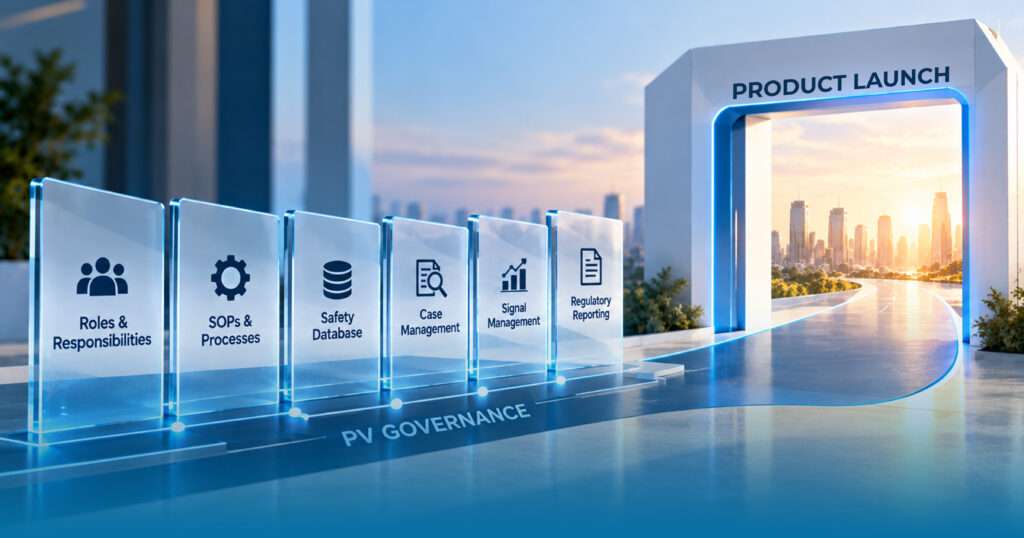
A launch-ready PV system is not created by one SOP, one safety database or one vendor contract. Readiness exists when governance, people, systems, procedures and third parties operate as one connected safety framework.
Before first commercialization, the MAH should be confident that the following core areas are functioning:
| Readiness Area | Expected Position Before Launch |
|---|---|
| Governance | Clear accountability, escalation routes and decision-making authority |
| QPPV oversight | Appropriate appointment, system visibility and backup |
| PSMF | Reflects the actual operating PV system |
| Safety data collection | Relevant intake sources are mapped |
| ICSR management | Intake, processing, follow-up and reporting work end to end |
| Literature surveillance | Appropriate monitoring is already active |
| Signal management | Product is incorporated into the surveillance framework |
| Risk management | RMP commitments are translated into operational activities |
| PV agreements | Responsibilities and timelines are clearly documented |
| Technology | Systems are appropriately configured and controlled |
| Training | Relevant internal and external personnel are trained |
| Reconciliation | Key safety-data sources are routinely checked |
| Compliance | Metrics, deviations and CAPAs are monitored |
| Inspection readiness | Evidence is current and retrievable |
It is in identifying gaps between what the organization believes is ready and what would happen if a safety issue appeared tomorrow. For example, an MAH may have a signed Safety Data Exchange Agreement with a distributor. But if the distributor’s customer-service team has never been trained to recognize a reportable event, the contractual framework exists while the operational safety pathway remains weak.
Pharmacovigilance Ownership Must be Clear Across the Organization
The MAH retains responsibility for its pharmacovigilance system even where individual activities are delegated to external providers or affiliates.
Within the EU system, the QPPV plays a central oversight role. QPPV responsibilities extend beyond case processing and include visibility over the functioning of the PV system, significant safety concerns, risk management obligations, system quality and compliance. However, successful launch governance requires several functions to work together.
Key ownership across the launch model
- Senior management provides appropriate resources, authority and organizational support.
- The QPPV maintains oversight of the PV system and should have sufficient access to relevant safety, compliance and risk-management information.
- PV operations manage case intake, processing, reporting, reconciliation and related activities.
- Medical or safety experts support clinical evaluation report, follow-up and benefit-risk assessment.
- Regulatory affairs coordinate labeling services changes, commitments and regulatory interactions.
- Quality assurance oversees deviations, CAPAs, audits and quality-system controls.
- Medical information acts as an important safety-data collection route.
- Commercial and field teams need to recognize potential safety information and transfer it promptly.
- Affiliates and distributors need clear reporting responsibilities and local escalation routes.
Safety Data Collection Must Extend Beyond Traditional PV Channels
One of the most important launch-readiness activities is mapping all realistic sources of safety information. The MAH should not assume that safety reports will arrive neatly through a dedicated PV mailbox.
They may first appear as:
- A medical information enquiry
- A product complaint
- An email to a sales representative
- A distributor conversation
- A patient-support programme entry
- A digital contact form
- A market-research response
- A published case report
The process should be simple enough that non-PV teams can follow it consistently. Commercial and customer-facing teams do not need to become pharmacovigilance solutions specialists. They need to know what information to transfer and how quickly.
ICSR Operations Should be Tested Before Day 1
A functioning safety database is only one component of ICSR readiness. The greatest launch risk often appears around exceptions.
The full process commonly includes:
Receipt → Validity Assessment → Duplicate Check → Triage → Coding → Follow-up → Medical review → Quality Review → Regulatory Submission → Acknowledgment Tracking → Archival.
A strong launch-readiness exercise therefore includes realistic scenario testing rather than assuming that a documented workflow will automatically work. The greater launch risk often lies outside this standard pathway. For example, a report may reach the wrong department, arrive outside normal business hours, be received through more than one channel, or require urgent follow-up because important information is missing.
For this reason, launch readiness should include realistic scenario testing. The MAH should confirm that teams know how to handle delayed transfers, duplicate reports, incomplete cases, failed submissions and additional information received after the initial report.
This testing helps demonstrate that the ICSR process is not only documented but can operate reliably under real launch conditions, reducing the risk of missed cases, late submissions and compliance failures.
Literature Monitoring should Continue Seamlessly into Commercialization
Literature monitoring should not be treated as an activity that begins only when commercial sales start. Within the EU framework, literature surveillance obligations can already apply during the marketing authorization process. The launch-readiness objective is therefore continuity, not activation.
The MAH should confirm that:
- Global search strategies are active
- Applicable local literature sources are covered
- Screening frequency is defined
- Duplicate management is controlled
- Potential ICSRs move into case processing
- Signal-relevant findings are escalated
- Responsibilities between global teams, affiliates and vendors are clear
For global launches, local literature can create a particular governance challenge. A central literature provider may cover major databases effectively but still miss local-language publications or jurisdiction-specific sources. These responsibilities should be mapped before the product enters each market.
Signal Detection needs a Defined Strategy from Launch
Early post-launch data may be limited, but signal detection still requires a defined operating framework. The product should already be incorporated into the MAH’s applicable signal-management process.
Depending on the product, surveillance may consider:
- Spontaneous reports
- Scientific literature
- Clinical and post-authorization studies
- Aggregate safety information
- Relevant safety databases
- Other sources of emerging evidence
The intensity of surveillance can be risk-based. A newly launched medicine with a complex safety profile may warrant closer review than a mature product with extensive post-marketing experience.
Turning the Risk Management Plan into Launch Operations
The risk management plan in pharmacovigilance is one of the clearest examples of where regulatory documentation and operational readiness need to meet. An approved RMP may define important risks, missing information, additional pharmacovigilance activities and risk-minimization measures. Each launch-relevant requirement should be translated into practical ownership.
| RMP Requirement | Operational Focus Before Launch |
|---|---|
| Important safety concern | Confirm how the safety concern will be monitored and escalated |
| Additional follow-up | Define who initiates, collects and assesses targeted follow-up |
| Additional PV activity | Assign an accountable owner, timeline and reporting pathway |
| Educational material | Confirm approval, distribution, target audience and documentation |
| Patient/HCP risk-minimization measure | Identify applicable markets, recipients and implementation controls |
| Effectiveness evaluation | Define how implementation and effectiveness will be assessed |
Each launch-relevant commitment should therefore move beyond regulatory documentation and into an accountable operating process. The responsible function, implementation timeline, evidence requirements and escalation mechanism should be understood before commercialization.
Where additional risk-minimization measures are required, launch teams may also need to coordinate local approvals, controlled distribution, healthcare-professional or patient materials and appropriate records demonstrating implementation. This is particularly important because approval of an RMP does not by itself demonstrate that the associated risk-management measures are operational.
Affiliates, CROs and Vendors Must Fit into the Same Governance Model
Pharmacovigilance activities are frequently distributed across affiliates, CROs, licensing partners, distributors, medical-information providers, patient-support programme vendors and specialist PV service providers in USA. Delegating an activity does not remove the need for MAH oversight.
The applicable PV Agreement or Safety Data Exchange Agreement should reflect the way the relationship operates and clearly establish responsibilities for areas such as:
- Safety-data exchange
- Case-transfer timelines
- Day 0 determination
- Follow-up responsibilities
- Regulatory reporting
- Literature activities
- Signal management
- Reconciliation
- Aggregate reporting
- Training
- Record retention
- Audit and inspection support
- Business continuity
- Subcontracting
Before launch, these arrangements should be tested from an operational perspective rather than assessed only by confirming that a contract has been signed. Ambiguity between contractual responsibilities and operational practice can become a significant compliance risk once commercial activity begins.
Safety Technology Must Support the Operating Model
Technology readiness should be assessed alongside procedural readiness. A safety database may be available while the surrounding pharmacovigilance operating model remains incomplete. Before commercialization, relevant systems should accurately represent the product, applicable markets and reporting responsibilities.
This may include confirming:
- Product and active-substance configuration
- Marketing authorizations and countries
- Reporting rules and regulatory destinations
- Appropriate user access
- Controlled terminology and dictionaries
- Electronic submission routes
- Acknowledgment monitoring
- Audit-trail availability
- Validation and change-control status
- Data migration and reconciliation
- Backup and business-continuity arrangements
Where technology is provided by an external vendor, the MAH should maintain appropriate oversight of whether the system supports its intended pharmacovigilance processes. Technology readiness should also consider what happens when the normal system is unavailable.
A system outage does not stop patients, healthcare professionals or partners from reporting safety information. The MAH therefore needs an alternative process for receiving, tracking and, where necessary, submitting information during a disruption.
Reconciliation and Compliance Monitoring Show Whether the System Actually Works
Even a well-designed PV process can fail in daily operations. Reconciliation helps identify these failures.
PV records may need to be compared with information from:
- Medical information
- Product-quality complaints
- Patient-support programmes
- Distributors
- Market-research activities
- Post-authorization studies
- Other relevant safety-data sources
The purpose is to detect information that reached another part of the organization but did not reach pharmacovigilance correctly. Launch is an especially important period for this because new relationships and processes are being used in real conditions for the first time. Compliance metrics should then show whether the system remains stable.
Useful measures can include:
- Case submission timeliness
- Late transfers
- Literature compliance
- Reconciliation completion
- Vendor performance
- Training completion
- Signal-management activities
- Deviations
- CAPA status
The objective is not to create a large dashboard; it is to detect deterioration before it becomes a regulatory or patient-safety issue.
Inspection Readiness Should Be Built into Launch Governance
Inspection readiness is not something an MAH should attempt to create after receiving an inspection notice. By then, documents can be organized, but operational history cannot be recreated.
As of 10 September 2026, Revision 2 of EU GVP Module III on pharmacovigilance inspections is effective, making current launch and outsourcing governance particularly relevant.
An inspector may review evidence including:
- The PSMF
- QPPV and backup arrangements
- SOPs
- Training records
- ICSR compliance
- Literature monitoring
- Signal-management documentation
- RMP implementation
- PV agreements
- Vendor oversight
- Reconciliation
- Audit findings
- Deviations and CAPAs
- Technology controls
However, the strongest inspection-readiness test is traceability. If the organization can reconstruct those pathways clearly, its system is much closer to real inspection readiness.
The PV Launch Readiness Framework: What Should Be Green Before Day 1?
Before first commercialization, the MAH should be able to view the entire operating model through one concise readiness framework. Not every minor outstanding action necessarily prevents commercialization. The important distinction is whether unresolved risks are understood and controlled.
A critical gap affecting safety intake, ICSR reporting, QPPV oversight, RMP implementation or system continuity should lead to a documented risk assessment and governance decision rather than an informal assumption that it can be corrected after launch.
Pharmacovigilance Launch Readiness Comes Down to Three Things
The most effective PV launch systems share three characteristics:
Visibility
The MAH knows where safety information can originate, how it enters the organization and how the evolving safety profile is monitored.
Accountability
Every important pharmacovigilance activity has a clearly defined owner, including activities delegated to affiliates, CROs and vendors.
Evidence
The organization can demonstrate that the process described in its procedures is the process operating. These principles provide a practical test for MAH pharmacovigilance readiness. A company does not need an unnecessarily complicated system, it needs a system in which safety information moves reliably, responsibilities remain clear and important decisions can be reconstructed, that is the difference between having pharmacovigilance documentation and having a pharmacovigilance system genuinely ready for commercialization.
How DDReg Supports Pharmacovigilance Launch Readiness
Preparing for commercialization often requires multiple PV workstreams to progress simultaneously.
DDReg supports pharmaceutical industry and life-sciences organizations across areas including:
- QPPV support
- Pharmacovigilance systems and SOPs
- ICSR processing and submission
- Literature monitoring
- Signal management
- Risk management
- PV agreements
- Vendor and quality oversight
- Inspection preparedness
A structured PV Launch Readiness Assessment can help identify gaps between regulatory requirements, documented processes and actual launch operations before those gaps become reporting failures, inspection findings or patient-safety risks.
Conclusion
Pharmacovigilance launch readiness is about more than having procedures in place. It requires clear accountability, connected safety pathways and evidence that the system can operate effectively from Day 1. By establishing governance, testing workflows, aligning partners and monitoring compliance before commercialization, MAHs can enter the market with a PV system prepared to manage real-world safety information.
DDReg supports MAHs in building this readiness through integrated pharmacovigilance expertise, from QPPV services support and PV system setup to ICSR operations, literature monitoring, signal management, risk management, vendor oversight and inspection preparedness. A structured PV Launch Readiness Assessment can help identify and address operational gaps before they become compliance or patient-safety risks.
Frequently Asked Questions
Launch-readiness activities should begin sufficiently before commercialization to allow dependencies involving the QPPV, PSMF, safety systems, RMP implementation, vendors, training and safety-data pathways to be resolved. Some PV activities may already be required during the marketing authorization stage.
The MAH should identify launch-relevant pharmacovigilance activities and risk-minimization measures, assign owners, establish implementation timelines and determine what evidence will demonstrate completion.
A major risk is failure at organizational interfaces. Safety information may reach an affiliate, distributor, commercial team or medical-information function but fail to reach pharmacovigilance promptly because responsibilities or transfer pathways are unclear.
A launch-readiness assessment should review the connected PV operating model, including governance, QPPV oversight, PSMF readiness, safety-data collection, ICSR processing, literature monitoring, signal management, RMP implementation, PV agreements, third-party oversight, technology, reconciliation, compliance monitoring and inspection preparedness.