

Entering South Korea as an API supplier requires more than meeting quality specifications. For APIs within Korea’s Drug Master File requirements, manufacturers must demonstrate compliance across manufacturing, quality controls, analytical methods, stability, and supporting documentation.
For overseas manufacturers, KDMF Registration in South Korea is therefore an important part of market-entry planning. Korea’s requirements have evolved, including the framework effective from December 2024 and subsequent changes affecting GMP assessment for imported APIs. Working from current MFDS requirements is therefore essential rather than simply transferring an existing US DMF, European ASMF, or CEP package.
With expertise in global eCTD regulatory submissions, DDReg can help API manufacturers assess KDMF applicability, identify gaps in existing global dossiers, align documentation with MFDS requirements, and develop a submission strategy for the Korean market.
Planning to Register Your API in South Korea?
Navigate South Korea's pharmaceutical regulatory requirements with expert support from DDReg Pharma. Get assistance with regulatory strategy, documentation, submission planning, and MFDS compliance to support your market entry.
Explore South Korea Regulatory Services →Why KDMF Matters for API Suppliers Targeting Korea
A DMF allows MFDS to evaluate critical information about an API without requiring the finished-product applicant to reproduce the manufacturer’s confidential manufacturing information in its own application.
For an API supplier, this creates a regulatory foundation for supplying the substance to Korean pharmaceutical manufacturers. Once the API is appropriately registered, the relevant registration information can support the Korean finished-product application while protecting commercially sensitive manufacturing information.
However, KDMF should not be viewed as an isolated regulatory filing. The API registration sits within a wider Korean market-access framework that can involve:
- API eligibility for DMF registration
- Manufacturing and quality documentation
- Overseas manufacturing-site registration, where applicable
- Korean submission and document requirements
- Finished-product application dependencies
- GMP evidence
- Post-registration changes and ongoing maintenance
For foreign manufacturers, coordinating these elements early can help avoid a situation where the API dossier is ready, but the associated Korean regulatory pathway is not.
What is a KDMF (Korea Drug Master File)?
A Korean DMF is the regulatory dossier submitted to MFDS for an API that falls within Korea’s designated DMF registration scope. The dossier contains information that allows MFDS to assess the identity, quality, manufacturing process, controls, specifications, analytical methods, packaging, storage, and stability of the API.
The current MFDS framework allows DMF information to be submitted using the Korean DMF requirements or, where applicable, in CTD format using the prescribed comparison framework. English-language documents can be submitted with a Korean summary of key information; documents in other foreign languages require the applicable Korean summary and translation requirements.
KDMF vs. DMF, ASMF and CEP
A US DMF, European ASMF or CEP can provide valuable supporting information, but none should automatically be treated as a substitute for a Korean DMF.
| Regulatory Mechanism | Main Regulatory Purpose | Korean Market Relevance |
|---|---|---|
| KDMF | API information reviewed under MFDS requirements | Directly relevant to Korean DMF registration |
| US DMF | Confidential API information submitted to FDA | May provide source material but does not replace KDMF requirements |
| ASMF | European mechanism for confidential API information | Useful as a technical foundation, but Korean requirements still need assessment |
| CEP | EDQM certification against a European Pharmacopoeia monograph | May support quality assessment where applicable, but does not automatically replace KDMF registration |
Who Needs to Register a KDMF?
KDMF registration is not a universal requirement for every API supplied to Korea. MFDS identifies specific categories of APIs that are subject to registration. Under the current regulation, these include certain new-substance APIs used in new drugs, APIs listed in the applicable MFDS annex, human-placenta-derived APIs, and specified herbal medicine API categories. The regulation also provides exclusions, including certain orphan-drug, biological, cell-therapy, gene-therapy, radiopharmaceutical and export-only situations, as well as pharmacologically inactive ingredients such as excipients and additives. For an overseas manufacturer, the answer should be established against the current MFDS designation and the intended Korean finished-product application.
A second point is equally important: KDMF registration and overseas manufacturing-site registration are related but separate regulatory requirements. Korea’s current rules require applicable overseas manufacturing sites to be registered, with the importer responsible for the relevant overseas-site drug registration process. The current rules specifically cover overseas facilities associated with imported APIs used as active ingredients or containing active ingredients.
KDMF Registration Routes in Korea
The Korean framework can involve more than one practical submission route.
- Standalone API DMF registration
An API can be submitted for registration under the applicable DMF procedure, with MFDS reviewing the required documentation and issuing the API registration documentation when the requirements are met. This route can be useful when the API registration needs to be established independently of a specific finished-product approval. - API registration linked to a finished-product application
Korean rules also provide for registration connected with a pharmaceutical product approval or notification. In defined circumstances, MFDS can review certain API registration information in connection with the finished-product application and may confirm submission of specified data rather than repeat the entire review of those data.
The appropriate route depends on the API, its regulatory status, the Korean product application, and the applicable MFDS requirements.
MFDS Dossier Requirements
The Korean DMF dossier is built around the scientific and manufacturing information needed to establish the quality and consistency of the API.
The current MFDS regulation covers areas including:
| Dossier Area | Key Requirements |
|---|---|
| Manufacturing Site & GMP | Manufacturing-site details and applicable GMP evidence, including qualifying certificates for imported APIs. |
| API Identity & Characteristics | Identity, structure, key characteristics, impurities, specifications, and controls. |
| Manufacturing Process | Process flow, materials, key steps, intermediates, and process controls. |
| Specifications & Methods | Specifications, analytical methods, and required validation/supporting data. |
| Stability | Data supporting storage conditions and retest/expiry period, as applicable. |
| Packaging & Storage | Container, packaging system, storage conditions, and handling requirements. |
| Batch Data & Testing | Applicable batch results, analytical methods, and required test materials. |
Step-by-Step KDMF Registration Process
A practical Korea DMF registration strategy can be organised into the following stages.
- Determine applicability and route
Confirm whether the API falls within MFDS KDMF requirements and identify the applicable registration route and applicant responsibilities. - Assess the manufacturing site
Review the site’s GMP status and applicable overseas manufacturing-site registration requirements. - Conduct a Korea-specific gap assessment
Compare the existing US DMF, ASMF, CEP, or CTD package against current Korean requirements and identify gaps requiring remediation. - Prepare the KDMF dossier
Compile the application, manufacturing information, analytical data, stability package, and supporting documents in the format required by MFDS. - Complete translations and submit
Prepare the required Korean summaries, translations, certifications, and administrative documents before submission to MFDS. - Manage review and questions
Respond to MFDS clarification requests or additional information requirements and provide supporting evidence where needed. - Complete registration and manage lifecycle
Once registered, maintain the approved information and establish appropriate change-control and lifecycle management processes.
KDMF Documentation Checklist
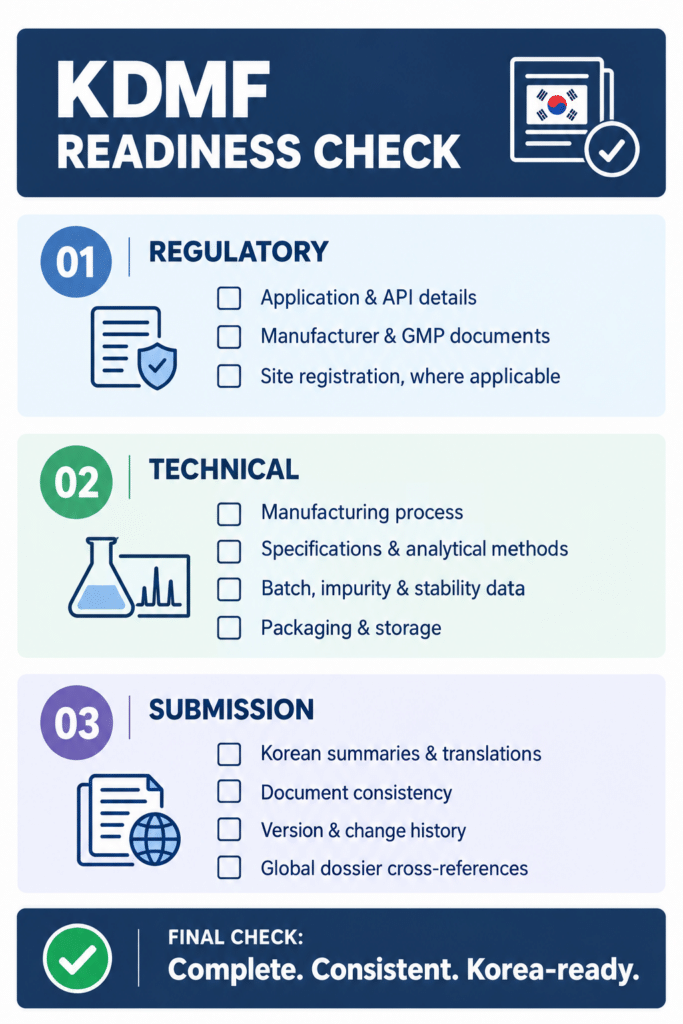
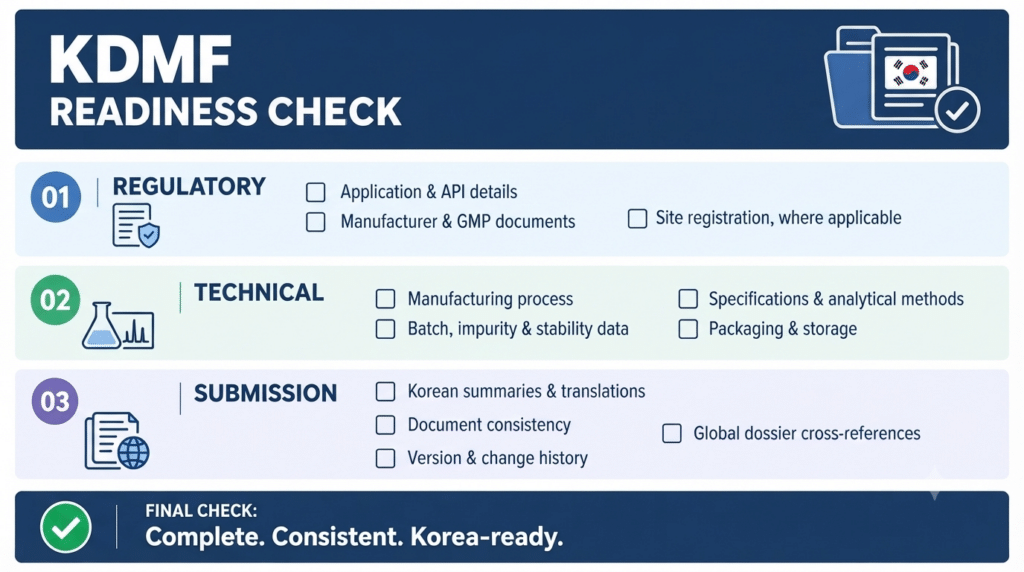
A checklist alone is not enough; the more important exercise is checking whether the information is internally consistent. Differences between the manufacturing process description, specifications, GMP documents, certificates and stability package can create avoidable review questions. Before submission, an overseas API manufacturer should confirm the availability and consistency of the following:
Requirements for Overseas API Manufacturers
For foreign API manufacturers, Korean registration has an additional layer: the regulatory package must work across jurisdictions.
An API manufacturer may already have a US DMF, CEP, ASMF, WHO-GMP certificate or another global regulatory package. That experience is valuable, but Korea still needs to be assessed on its own terms. This is especially important following the recent simplification of imported API GMP assessment. The updated process can reduce regulatory burden, but only when the submitted GMP evidence meets the applicable requirements.
KDMF Lifecycle Management
KDMF management continues after registration. Changes to the manufacturing site, process, starting materials, suppliers, equipment, batch size, specifications, analytical methods, packaging, storage conditions, or testing arrangements can affect the registered information and may require regulatory action.
For overseas API manufacturers, each change should therefore follow a controlled lifecycle process:
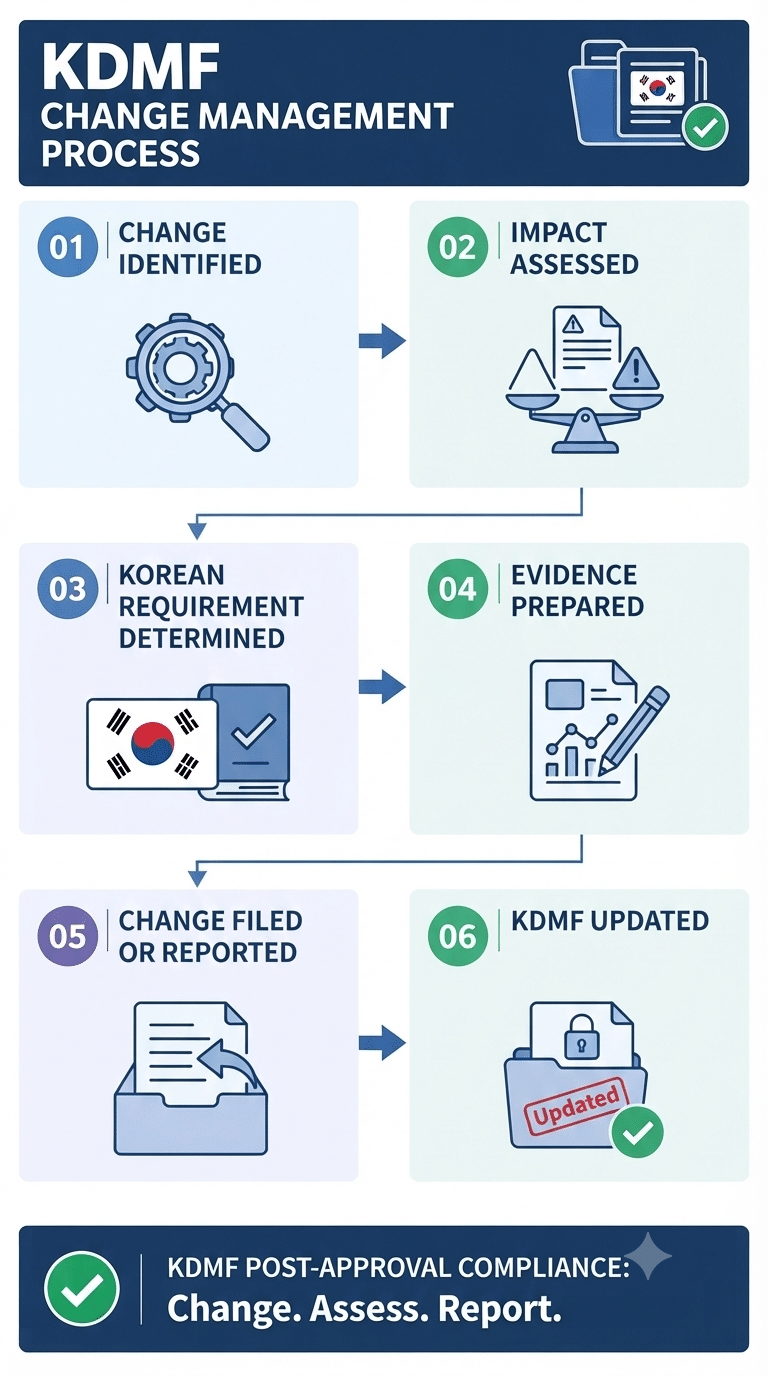
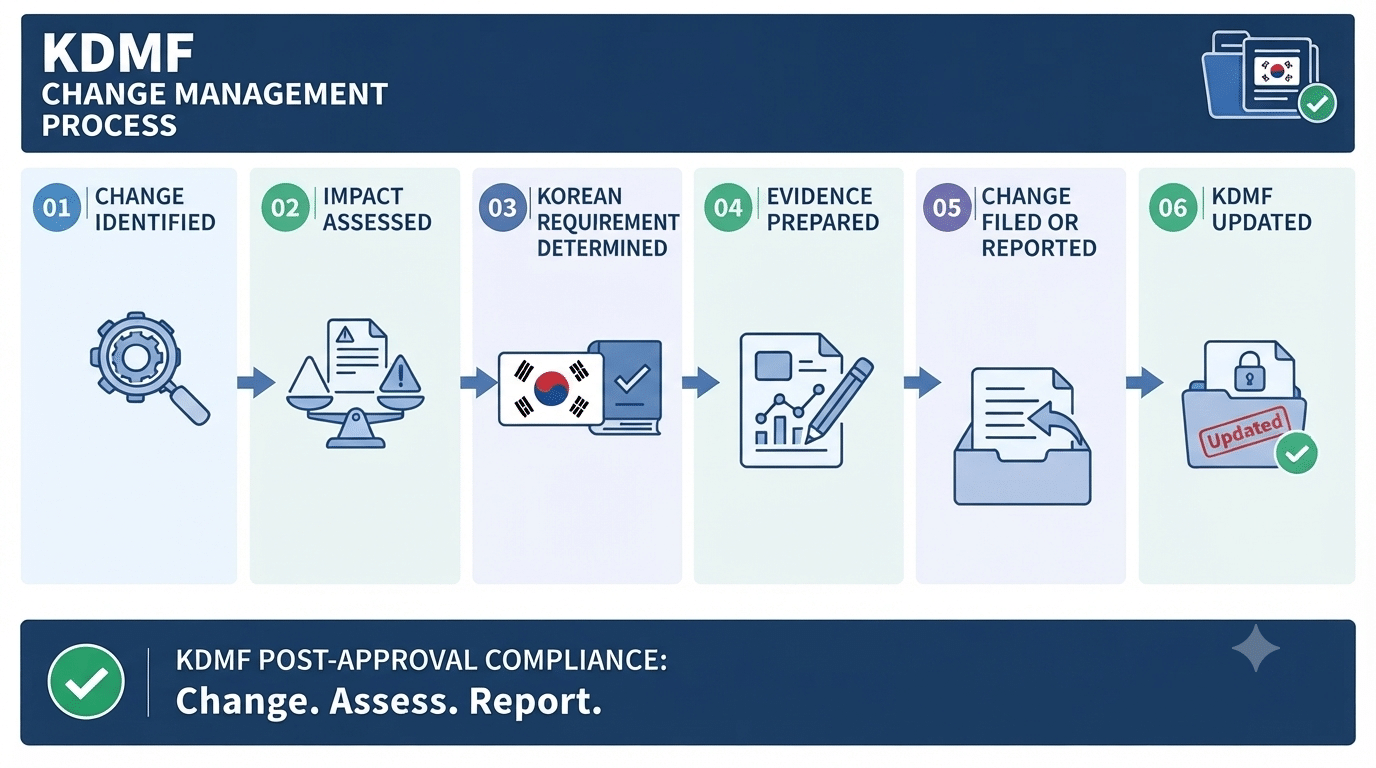
The applicable Korean requirements should be confirmed for each change, as some changes may require formal change registration while others may be handled through the relevant reporting mechanism. Maintaining this process helps ensure that the KDMF remains aligned with the actual manufacturing and quality information and prevents discrepancies during subsequent finished-product submissions.
How to Prepare for a KDMF Submission
The strongest preparation begins before dossier writing. A structured pre-submission review can help identify gaps early and keep the KDMF aligned with the Korean regulatory strategy.
| Preparation Area | What to Check |
|---|---|
| Confirm scope | Verify that the API is subject to Korean DMF registration requirements. |
| Build a Korea-specific gap matrix | Compare the existing API package against current MFDS requirements rather than assuming a global dossier can be submitted unchanged. |
| Align technical documents | Check consistency across the manufacturing process, specifications, analytical methods, batch data, stability information, GMP certificates, and manufacturing-site details. |
| Plan the evidence package | Identify any additional data, testing, or clarification needed before submission to reduce the risk of MFDS deficiencies. |
| Coordinate with the Korean product applicant | Align API reference information, submission timing, and regulatory responsibilities with the finished-product strategy. |
Regulatory Strategy for Foreign API Manufacturers Entering South Korea
A manufacturer may have an established US DMF, a European ASMF, a CEP and a strong GMP history and still need to make Korea-specific regulatory adjustments.
A practical strategy is to work through five connected decisions:
- Market eligibility
Confirm whether the API falls within the current KDMF scope. - Regulatory route
Determine the appropriate registration pathway and its relationship to the Korean finished-product application. - Evidence readiness
Assess the manufacturing, quality, analytical and stability package against MFDS requirements. - Site readiness
Address GMP evidence and applicable overseas manufacturing-site registration separately from the API dossier. - Lifecycle readiness
Establish change-control and regulatory-maintenance procedures before the first submission.
Common Gaps that can delay KDMF Registration
Several problems can create avoidable regulatory friction:
- Assuming a global dossier is Korea-ready — A US DMF, ASMF, or other global package may require Korea-specific updates.
- Missing scope or regulatory requirements — Not confirming KDMF applicability or relying on outdated MFDS requirements can create avoidable gaps.
- Inconsistent technical information — Differences across manufacturing processes, specifications, analytical methods, stability data, or site information can trigger review questions.
- Incomplete GMP and supporting documentation — Certificates, translations, Korean summaries, or required evidence may not meet current requirements.
- Confusing regulatory responsibilities — Overseas manufacturing-site registration is separate from KDMF registration and should be planned accordingly.
- Overlooking lifecycle and product-submission coordination — KDMF changes and API information should remain aligned with the Korean finished-product submission and ongoing lifecycle management.
Strengthen Your API Regulatory Documentation
From manufacturing process information to critical quality attributes and supporting CMC documentation, consistent technical data helps strengthen API regulatory submissions. Get expert guidance to identify documentation gaps and support your global regulatory strategy.
Discover CMC Regulatory Support →How DDReg Supports KDMF Registration
DDReg can support API manufacturers and pharmaceutical companies with the regulatory assessment and preparation needed for Korean DMF registration.
Support can include assessing whether an API falls within the applicable Korean registration scope, reviewing existing global API dossiers against MFDS requirements, identifying documentation gaps, supporting dossier preparation and submission strategy, reviewing GMP and manufacturing-site considerations, and helping coordinate API registration with the broader Korean product-registration pathway.
For overseas manufacturers, DDReg can also help translate an existing global regulatory package into a Korea-specific submission strategy rather than treating KDMF as a standalone document exercise. The focus is on creating a submission that is technically consistent, regulator-ready and aligned with the manufacturer’s wider Korean market-entry plans.
Conclusion
KDMF Registration in South Korea is not simply a document-submission requirement for API manufacturers. It is part of the regulatory foundation that allows eligible APIs to support pharmaceutical product registration in Korea.
For foreign API manufacturers, the key is to understand the current MFDS scope, select the appropriate registration route, prepare the required quality and manufacturing evidence, address GMP and overseas-site requirements, and establish lifecycle controls from the beginning.
Recent Korean reforms have simplified aspects of imported API GMP assessment and shortened the stated processing period for the relevant route, making the current environment more efficient than the older framework. But the benefit depends on having the right documentation and regulatory pathway in place.
A well-planned KDMF registration Korea strategy therefore starts before submission. It begins with understanding what MFDS expects, what existing global data can be reused, what needs to be adapted for Korea, and how the API registration fits into the finished-product and lifecycle strategy.
Frequently Asked Questions
KDMF registration is the process of registering applicable active pharmaceutical ingredients (APIs) with the Ministry of Food and Drug Safety (MFDS) in accordance with Korea’s drug-substance registration requirements. It allows MFDS to evaluate information on the API’s manufacturing process, quality, specifications, analytical methods, stability, and manufacturing site, where applicable.
No. KDMF registration does not apply universally to every API. Applicability depends on the API, its intended use, and the categories specified under Korea’s applicable drug-substance registration requirements. Manufacturers should first determine whether their API falls within the scope of KDMF registration before preparing a submission.
A US DMF, European ASMF, or CEP cannot automatically be treated as a substitute for a KDMF registration in Korea. Global API documentation may provide valuable supporting information, but the dossier must be assessed and prepared against the applicable MFDS requirements for Korea.
The review timeline depends on the registration route, dossier completeness, manufacturing-site requirements, and whether additional information is requested during review. Certain streamlined procedures for imported APIs have also reduced the processing time for the relevant GMP assessment route, so the applicable pathway should be confirmed before estimating the overall timeline.