

Canada’s biosimilar regulatory framework has matured significantly over the past decade, creating opportunities for biopharmaceutical companies to introduce high-quality alternative biologic therapies while maintaining strict regulatory standards for safety, efficacy, and quality.
For companies planning biosimilar registration in Canada, understanding the regulatory pathway is essential because biosimilars are not approved through the same route as conventional generic medicines. Due to the complexity of biologic products, Health Canada requires manufacturers to demonstrate a high degree of similarity between the proposed biosimilar and an already authorized reference biologic product through a scientifically justified comparability programme.
Planning to Register a Biosimilar in Canada?
Navigate Health Canada requirements with expert support for biosimilar regulatory strategy, NDS preparation, dossier development, submission management, review support, and post-approval compliance.
Explore Canada Regulatory Services →Unlike small molecule medicines, biologics are produced using living systems and possess complex structural and functional characteristics. Manufacturing differences, variations in biological systems, and post-translational modifications can influence product attributes. Therefore, biosimilar approval is not based on demonstrating that two products are identical, but rather that any differences identified do not result in clinically meaningful differences in quality, safety, or efficacy.
The Canada biosimilar approval process follows a totality-of-evidence approach, where analytical characterization forms the foundation of the assessment and additional non-clinical or clinical information is considered based on remaining scientific uncertainty. Health Canada evaluates biosimilar applications through a comprehensive review of quality, safety, and efficacy information before granting new product market authorization services.
For pharmaceutical and biotechnology companies, Successful Canadian biosimilar development depends on early regulatory planning, including reference product selection, analytical comparability strategy, New Drug Submission (NDS) preparation, regulatory interactions, and post-approval lifecycle management.
What is a Biosimilar in Canada?
A biosimilar in Canada is a biologic drug that has been demonstrated to be highly similar to a previously authorized biologic drug, known as the Canadian Reference Biologic Drug (CRBD).
Health Canada’s 2026 guidance explicitly defines the biosimilar as a subsequent-entry version of a Canadian-authorized originator biologic and identifies the CRBD terminology.This similarity allows the sponsor to rely, in part, on existing scientific information regarding the reference biologic drug while providing supporting comparative data for the biosimilar candidate. Because biologic medicines are complex molecules produced through biological processes, minor differences between products may naturally occur. These differences are evaluated through advanced analytical and functional methods to determine whether they have any impact on product performance.
The objective of biosimilar development is therefore not to independently repeat the entire clinical development programme conducted for the original biologic product. Instead, the manufacturer must demonstrate that the biosimilar has comparable structural, functional, and clinical characteristics to the reference product.
Biosimilars may include complex biologic medicines such as:
- Monoclonal antibodies
- Recombinant proteins
- Hormones
- Enzymes
- Growth factors
- Therapeutic peptides
The regulatory focus remains on demonstrating that the biosimilar maintains comparable quality, safety, and efficacy characteristics when compared with the CRBD.
Different Between Biosimilar vs Generic Drug in Canada
Although biosimilars and generic drugs both provide alternatives to previously approved medicines, they are regulated differently because of the fundamental differences between biologic and chemical medicines.
Generic drugs are generally chemically synthesized small-molecule medicines with a well-defined molecular structure, whereas biosimilars are complex biologic products produced using biological systems.
Biosimilars drugs, however, are complex biological products manufactured using living systems. Their molecular structure and manufacturing characteristics cannot always be completely defined using traditional chemical methods. Therefore, regulatory approval requires a detailed scientific comparison rather than simple identity testing.
Criteria | Biosimilar | Generic Drug |
Product type | Biologic medicine | Small molecule medicine |
Manufacturing | Produced through biological systems | Produced through chemical synthesis |
Molecular complexity | Highly complex | Comparatively simple |
Regulatory pathway | New Drug Submission (NDS) | |
Approval basis | High degree of similarity | Chemical equivalence and bioequivalence |
Reference product | Canadian Reference Biologic Drug | Reference listed drug |
Biosimilars are therefore not considered generic versions of biologic medicines. Health Canada regulates biosimilars through the NDS pathway because their approval requires extensive comparative evaluation of quality, analytical, functional, and clinical characteristics.
Latest Health Canada Biosimilar Guidance
Health Canada’s current biosimilar guidance was revised on May 19, 2026. The revised guidance updates information and submission requirements for biosimilar biologic drugs, including terminology and expectations for quality, non-clinical and clinical data. Sponsors should use the current guidance when planning a Canadian biosimilar submission.
Source – Health Canada — Guidance on information and submission requirements for biosimilar biologic drugs
Who Regulates Biosimilars in Canada?
The regulatory authority responsible for evaluating and approving biosimilars in Canada is Health Canada.
Within Health Canada, biologic medicines for human use are regulated by the Biologic and Radiopharmaceutical Drugs Directorate (BRDD) under the Health Products and Food Branch. BRDD evaluates biologic submissions through comprehensive scientific reviews covering product quality, safety, and efficacy.
- Health Canada’s role in the Canada biosimilar approval process includes evaluating:
- Manufacturing processes
- Analytical comparability data
- Biological activity
- Clinical pharmacology information
- Immunogenicity assessment
- Product labelling
- Post-market safety requirements
The primary regulatory guidance supporting Health Canada biosimilar requirements is the:
Guidance Document: Information and Submission Requirements for Biosimilar Biologic Drugs. This guidance outlines the scientific principles and submission expectations for sponsors seeking authorization of biosimilar products in Canada.
Canadian Regulatory Framework for Biosimilar Registration
Biosimilars in Canada are regulated as biologic drugs under the Food and Drugs Act and Food and Drug Regulations.
Unlike generic medicines, biosimilars are not eligible for authorization through the Abbreviated New Drug Submission pathway because of their inherent complexity and biological variability. Instead, biosimilar applications are submitted through the New Drug Submission (NDS) pathway. The regulatory framework is based on demonstrating a high degree of similarity between the biosimilar candidate and the CRBD.
The assessment relies on:
- Comprehensive analytical characterization
- Functional comparison
- Stability assessment
- Clinical pharmacology evaluation
- Safety and immunogenicity assessment
Health Canada’s approach recognizes that a biosimilar does not need to be identical to the reference product. Instead, differences may be acceptable when the sponsor provides sufficient scientific evidence demonstrating that they do not affect safety or efficacy.
Biosimilar Registration Pathway in Canada
The biosimilar registration pathway in Canada follows a structured scientific approach designed to demonstrate that a proposed biosimilar biologic drug is highly similar to the Canadian Reference Biologic Drug (CRBD).
Unlike conventional new biologic development, biosimilar development does not require repeating the entire clinical development programme of the reference product. Instead, Health Canada evaluates whether the sponsor has established similarity through a comprehensive comparability exercise supported by analytical, functional, clinical pharmacology, and safety information.
The success of a biosimilar submission in Canada depends on early regulatory planning, appropriate reference product selection, robust analytical characterization, and a well-structured New Drug Submission (NDS) and dossier submission.
The major steps involved in the Canadian biosimilar approval pathway include:
Biosimilar Registration Process in Canada: Step-by-Step
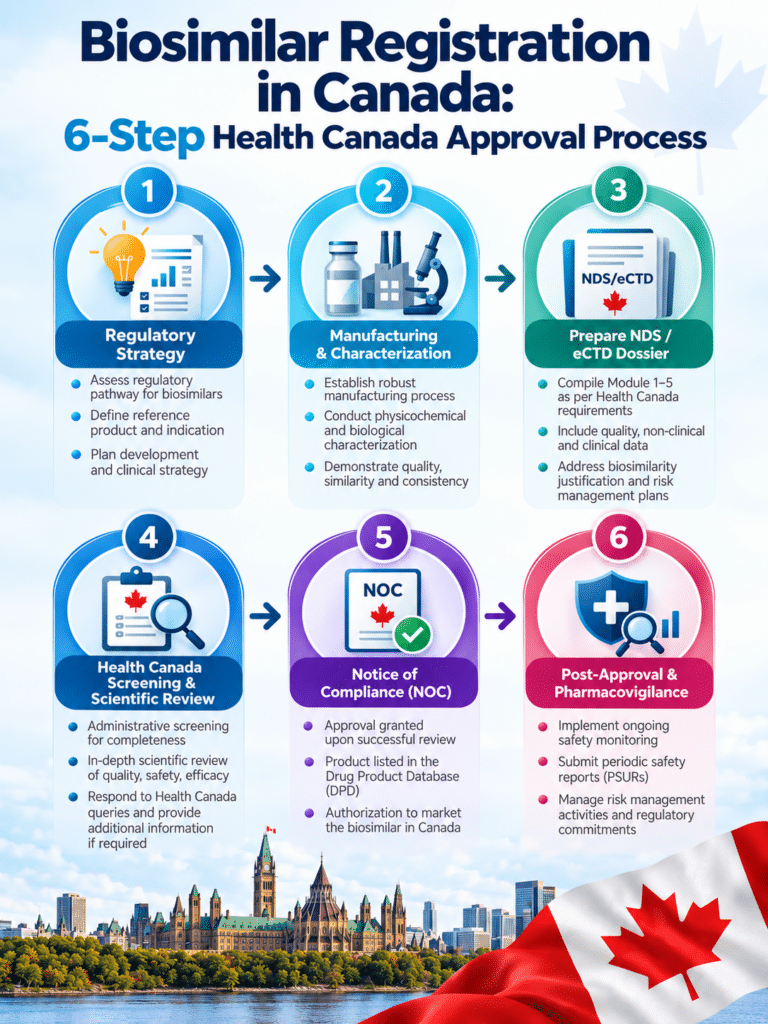
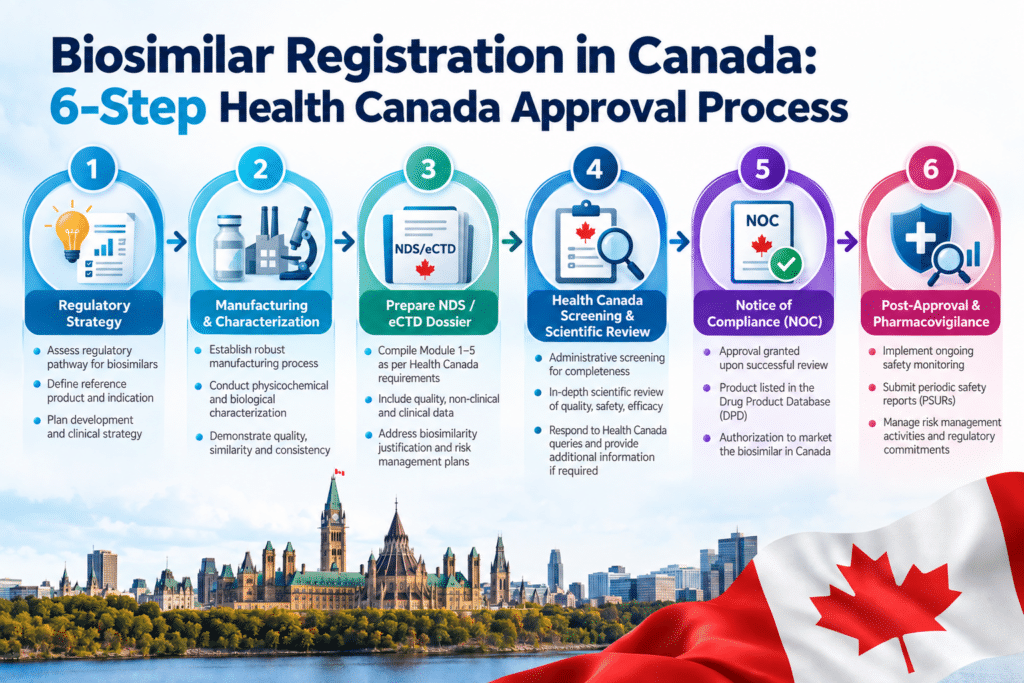
Step 1: Biologic Drug Development and Regulatory Strategy
The registration process begins during early product development, where manufacturers establish a regulatory strategy aligned with Health Canada expectations.
During this stage, sponsors define:
- Product characterization strategy
- Manufacturing process development
- Quality control approach
- Non-clinical development plan
- Clinical development programme
- Regulatory submission strategy
For biologics, early planning is critical because manufacturing processes directly influence product quality attributes and must be appropriately controlled throughout development.
Step 2: Manufacturing Process Development and Characterization
A key component of biologic registration in Canada is demonstrating that the manufacturing process consistently produces a high-quality product.
Because biologics are produced using living cells or biological systems, manufacturers must establish control over critical manufacturing parameters.
The quality package typically includes:
- Manufacturing process description
- Characterization of active substance and drug product
- Critical quality attributes
- Analytical methods
- Process validation
- Stability studies
- Batch consistency evaluation
Health Canada places significant emphasis on understanding how manufacturing processes influence product quality, safety, and biological activity.
Step 3: Preparation of New Drug Submission (NDS)
Biologic drugs in Canada are submitted through the New Drug Submission (NDS) pathway.
The submission follows the electronic Common Technical Document (eCTD ) format and provides Health Canada with all information required to assess the product.
The eCTD dossier includes:
Module 1: Administrative Information
Includes Canadian-specific information such as:
- Application forms
- Product monograph
- Labelling information
- Regulatory declarations
Module 2: Summaries and Overviews
Provides an overall scientific explanation of the development programme and justification for approval.
Module 3: Quality Documentation
Contains detailed manufacturing and analytical information, including:
- Product characterization
- Manufacturing controls
- Specifications
- Stability data
Module 4: Non-Clinical Data
Includes applicable pharmacology and toxicology information.
Module 5: Clinical Data
Includes clinical studies supporting safety and efficacy evaluation.
Step 4: Health Canada Scientific Review
Once the submission is accepted, Health Canada conducts a detailed scientific review.
The review evaluates:
- Quality – Health Canada assesses whether the product is consistently manufactured and meets established quality standards.
- Safety – Reviewers evaluate non-clinical and clinical safety information, including potential risks associated with the biologic product.
- Efficacy – Clinical data are assessed to determine whether the product provides the intended therapeutic benefit.
The review process may involve questions from Health Canada requiring sponsors to provide additional clarification or supporting information.
Step 5: Notice of Compliance (NOC) and Market Authorization
If Health Canada determines that the biologic drug meets regulatory requirements, the sponsor receives a Notice of Compliance (NOC). The NOC confirms that the product has satisfied Canadian requirements for quality, safety, and efficacy.
Following authorization, manufacturers must continue meeting regulatory obligations, including:
- Pharmacovigilance requirements
- Safety reporting
- Manufacturing compliance
- Post-market monitoring
Step 6: Post-Approval Lifecycle Management
Biologic registration does not end after approval. Manufacturers must continue monitoring product performance and maintaining regulatory compliance throughout the product lifecycle.
Lifecycle activities may include:
- Manufacturing changes
- Stability updates
- Safety monitoring
- Regulatory variations
- Periodic reporting
A strong lifecycle management strategy ensures continued compliance with Health Canada requirements.
Biologic vs Biosimilar Registration Pathway in Canada
Aspect | Innovative Biologic | Biosimilar |
Regulatory pathway | New Drug Submission (NDS) | New Drug Submission (NDS) |
Approval basis | Complete quality, safety, efficacy package | Demonstration of high similarity to CRBD |
Reference product | Not applicable | Canadian Reference Biologic Drug |
Clinical evidence | Full development programme | Reduced based on totality of evidence |
Focus | Establish safety and efficacy | Establish similarity |
Health Canada regulates biosimilars as biologic drugs and requires evidence demonstrating high similarity to an already authorized biologic product.
Need Help Preparing Your Biosimilar NDS?
Strengthen your Health Canada submission with expert support for CTD dossier preparation, CMC documentation, comparability data, regulatory writing, submission readiness, and deficiency responses.
Explore Regulatory Affairs Services →NDS Dossier Structure for Biosimilars
Module 1: Administrative Information
Module 1 contains Canada-specific regulatory information, including:
- Administrative forms
- Product monograph
- Labelling information
- Patent certification where applicable
- Regulatory declarations
This section ensures that the application meets Canadian administrative requirements.
Module 2: Summaries and Overviews
Module 2 provides the scientific interpretation of the complete submission package.
For biosimilars, this section is particularly important because it explains how the different evidence components collectively support the conclusion of biosimilarity.
The sponsor should clearly demonstrate how:
- Analytical data supports similarity
- Functional studies confirm comparable activity
- Clinical pharmacology supports comparable exposure
- Immunogenicity findings support safety conclusions
Module 3: Quality Documentation
Module 3 contains detailed quality information and is one of the most important components of a biosimilar submission.
It includes:
- Manufacturing process information
- Product characterization
- Analytical methods
- Critical quality attributes
- Batch analysis
- Stability data
- Comparability assessment
A well-prepared Module 3 allows Health Canada reviewers to understand the scientific basis supporting biosimilarity.
Health Canada Review Process for Biosimilar Applications
After submission of a complete biosimilar New Drug Submission (NDS), Health Canada conducts a detailed scientific review to determine whether the proposed product meets the requirements for authorization. The review process evaluates the complete evidence package submitted by the sponsor, including analytical comparability data, manufacturing information, clinical pharmacology studies, immunogenicity assessment, and other supporting documentation.
The objective of the review is to determine whether the sponsor has successfully demonstrated that the biosimilar is highly similar to the Canadian Reference Biologic Drug (CRBD) and whether any identified differences have a meaningful impact on quality, safety, or efficacy.
Health Canada evaluates biosimilar submissions through multiple scientific review areas:
- Quality Review –The quality assessment focuses on the manufacturing process, product characterization, critical quality attributes, analytical comparability, stability information, and overall control strategy. Since analytical similarity forms the foundation of biosimilar approval, Health Canada places significant emphasis on understanding the relationship between the biosimilar and reference biologic product.
- Clinical Review –The clinical assessment evaluates relevant clinical pharmacology data, safety information, immunogenicity findings, and any additional clinical evidence provided by the sponsor. The extent of clinical data required depends on the level of uncertainty remaining after analytical evaluation.
- Regulatory Review –The regulatory assessment evaluates submission completeness, administrative requirements, product information, labelling, and compliance with Canadian regulatory requirements. A well-prepared eCTD regulatory submission with a clear scientific justification can reduce review delays and improve communication with Health Canada reviewers.
Health Canada Screening Review and Submission Acceptance
Before beginning the complete scientific assessment, Health Canada performs an initial screening review to confirm that the application contains all required information.
During this stage, Health Canada evaluates whether the submission includes appropriate documentation, including:
- Administrative forms
- Product information
- Quality documentation
- Clinical and non-clinical information
- Manufacturing details
- Regulatory declarations
If significant information is missing, the sponsor may receive screening deficiencies requiring correction before the submission proceeds to full review. Early preparation and regulatory planning are therefore essential components of a successful biosimilar submission in Canada.
How Long Does Biosimilar Approval Take in Canada?
The timeline for the Canada biosimilar approval process depends on several factors, including product complexity, submission quality, regulatory questions, and sponsor response timelines.
Health Canada has defined review targets for New Drug Submissions; however, actual approval timelines may vary depending on the scientific complexity of the product and the number of review interactions required.
Factors that may influence the approval timeline include:
- Complexity of the biologic molecule
- Strength of analytical similarity data
- Manufacturing considerations
- Clinical pharmacology requirements
- Additional information requests
- Responses to regulatory questions
For complex biologics such as monoclonal antibodies, early regulatory consultation and strong submission planning can significantly improve the efficiency of the review process.
Notices of Deficiency (NOD) During Biosimilar Review
During scientific review, Health Canada may issue a Notice of Deficiency (NOD) when additional clarification or supporting information is required. A NOD does not necessarily indicate rejection of the application. It provides the sponsor with an opportunity to address specific concerns identified by reviewers.
Common areas associated with regulatory questions include:
Quality and Manufacturing Issues
Health Canada may request clarification regarding:
- Analytical comparability
- Critical quality attributes
- Manufacturing consistency
- Stability data
- Process controls
Clinical and Immunogenicity Issues
Questions may relate to:
- Interpretation of pharmacokinetic findings
- Immunogenicity assessment
- Safety evaluation
- Clinical relevance of observed differences
Indication Extrapolation Issues
Sponsors may receive questions regarding the scientific basis supporting additional requested indications.
A proactive regulatory strategy that anticipates these areas can help minimise delays during review.
How Does Indication Extrapolation Work for Biosimilars in Canada?
Indication extrapolation is an important component of the biosimilar registration pathway in Canada.
It allows a biosimilar product to receive approval for one or more indications held by the reference biologic drug without conducting separate clinical studies in every patient population.
However, extrapolation is based on scientific assessment and is not simply granted automatically.
Health Canada evaluates extrapolation based on the overall evidence package, including analytical similarity, functional activity, clinical pharmacology, mechanism of action, and safety considerations.
- Mechanism of Action Considerations –The mechanism of action of the reference biologic product is an important factor when evaluating whether extrapolation is scientifically appropriate.
The sponsor should demonstrate that:
- The biological target is relevant across indications
- The mechanism of action is sufficiently understood
- Functional similarity applies to the requested indications
Where mechanisms differ significantly between indications, additional justification may be required.
- Clinical Population and Disease Considerations –Health Canada may consider whether differences exist between patient populations receiving the reference biologic product.
Relevant considerations may include:
- Disease characteristics
- Treatment setting
- Patient population
- Dose requirements
- Safety considerations
The sponsor should ensure that the evidence supporting biosimilarity remains applicable across the requested indications.
- Pharmacokinetic and Immunogenicity Considerations –Pharmacokinetic behaviour and immunogenicity findings may also support extrapolation decisions.
The sponsor should consider whether:
- Comparable exposure is expected
- Immune response risks are consistent
- Safety findings can reasonably apply across indications
The final decision regarding indication extrapolation is made by Health Canada based on the complete scientific evidence package.
- Notice of Compliance (NOC) and Market Authorization – Following successful completion of the review process, Health Canada may issue a Notice of Compliance (NOC). The NOC confirms that the product meets the requirements established under the Food and Drugs Act and Food and Drug Regulations.
However, receiving regulatory approval represents only one stage of commercialisation.
Before market launch, companies must also consider:
- Patent and intellectual property considerations
- Commercial supply planning
- Market access strategy
- Pharmacovigilance readiness
For biosimilars, lifecycle management after approval is essential because manufacturers must continue monitoring safety, maintaining regulatory compliance, and fulfilling post-market obligations.
Need Post-Approval Support for Your Biosimilar in Canada?
Maintain compliance after Health Canada approval with support for pharmacovigilance, lifecycle management, regulatory submissions, safety reporting, variations, and ongoing regulatory obligations.
Explore Canada Pharmacovigilance Services →Pharmacovigilance Requirements for Biosimilars in Canada
Pharmacovigilance is a critical component of the Health Canada biosimilar requirements and continues throughout the product lifecycle after approval.
Although biosimilars undergo extensive scientific evaluation before authorization, post-market monitoring helps identify rare safety concerns and confirms the long-term safety profile of the product. Manufacturers must maintain appropriate systems for collecting, evaluating, and reporting safety information.
- Adverse Drug Reaction Monitoring –Following approval, manufacturers are responsible for monitoring adverse reactions associated with their biosimilar product.
Pharmacovigilance activities include:
- Collection of safety reports
- Evaluation of adverse events
- Identification of safety signals
- Regulatory reporting of serious adverse reactions
Because biologic products may generate immune responses, effective safety monitoring is particularly important for biosimilars.
- Immunogenicity Monitoring After Approval – Immunogenicity remains an important consideration throughout the lifecycle of biologic medicines. Post-market monitoring helps confirm whether immune responses remain consistent with the findings observed during clinical development.
Manufacturers may monitor:
- Anti-drug antibody formation
- Neutralizing antibody development
- Impact on treatment response
- Potential safety concerns
These activities support continued confidence in the safety and performance of biosimilar products.
- Risk Management and Lifecycle Monitoring –Depending on product characteristics, manufacturers may need additional pv risk management activities after approval.
These may include:
- Additional safety monitoring
- Post-market studies
- Periodic safety evaluations
- Regulatory reporting activities
A strong pharmacovigilance services strategy ensures ongoing compliance with Canadian regulatory expectations and supports safe use of biosimilar therapies.
Key Regulatory Documents for Biosimilar Registration in Canada
A successful biosimilar registration in Canada requires compliance with multiple regulatory guidelines, legislation, and submission standards established by Health Canada. Since biosimilars are complex biologic products, manufacturers must prepare a comprehensive regulatory package demonstrating similarity to the Canadian Reference Biologic Drug (CRBD), while also meeting Canadian requirements related to quality, manufacturing, clinical evaluation, labelling, and post-approval monitoring.
The key regulatory documents supporting biosimilar submissions in Canada include the following.
Health Canada Guidance Document: Information and Submission Requirements for Biosimilar Biologic Drugs
The primary regulatory guidance supporting Health Canada biosimilar requirements is the:
Guidance Document: Information and Submission Requirements for Biosimilar Biologic Drugs. This guidance outlines Health Canada’s expectations for sponsors developing and submitting biosimilar products.
It provides recommendations regarding:
- Selection of the Canadian Reference Biologic Drug
- Biosimilarity assessment strategy
- Analytical characterization
- Non-clinical evaluation
- Clinical pharmacology studies
- Immunogenicity assessment
- Indication extrapolation
- Submission structure
Manufacturers should consider this guidance throughout product development to ensure that the evidence package is aligned with Health Canada expectations.
Food and Drugs Act & Food and Drug Regulations
Biosimilars are regulated as biologic drugs under Canada’s Food and Drugs Act and Food and Drug Regulations.
These regulations establish the legal framework governing:
- Drug authorization
- Manufacturing requirements
- Product labelling
- Distribution
- Safety monitoring
Compliance with these requirements is necessary throughout the entire product lifecycle, from initial submission preparation through post-market surveillance.
Electronic Common Technical Document (eCTD) Requirements
Health Canada follows the internationally accepted Common Technical Document (eCTD) format for biosimilar submissions. The eCTD format allows regulators to evaluate scientific information in a consistent and structured manner. A biosimilar New Drug Submission includes five modules.
Module 1: Administrative Information
Module 1 contains Canadian-specific regulatory documentation, including:
- Application forms
- Administrative information
- Product monograph
- Labelling documents
- Patent-related information where applicable
This section ensures that the submission meets Canadian administrative requirements.
Module 2: Summaries and Overviews
Module 2 provides a scientific overview of the complete submission. For biosimilars, this section plays an important role because it explains how analytical, non-clinical, and clinical information collectively supports the conclusion of biosimilarity.
A strong Module 2 should clearly describe:
- The scientific rationale for biosimilarity
- The comparability strategy
- Interpretation of analytical findings
- Clinical relevance of the evidence package
Module 3: Quality Documentation
Module 3 contains detailed quality information and represents one of the most important sections of a biosimilar submission.
The section includes:
- Manufacturing process information
- Product characterization
- Critical quality attributes
- Analytical methods
- Batch analysis
- Stability studies
- Comparability data
Because biosimilar approval depends heavily on demonstrating analytical similarity, a well-developed quality section is essential for successful Health Canada review.
Common Mistakes to Avoid During Canadian Biosimilar Registration
Although the Canadian biosimilar pathway is well established, several common challenges can delay regulatory approval. Understanding these issues early helps sponsors develop stronger regulatory strategies.
- Incorrect Reference Product Strategy – Selecting an inappropriate reference product approach is one of the most common challenges during biosimilar development. The sponsor should establish the Canadian Reference Biologic Drug strategy early and ensure that any use of non-Canadian reference products is supported through appropriate bridging data. A weak reference product strategy may result in regulatory questions and additional data requirements.
- Insufficient Analytical Comparability Data –Analytical similarity is the foundation of biosimilar approval. Insufficient characterization may create concerns regarding whether the proposed biosimilar and reference biologic drug are sufficiently similar.
Common issues include:
- Limited analytical methods
- Incomplete quality attribute assessment
- Insufficient batch comparison
- Poor justification of observed differences
A comprehensive analytical package strengthens regulatory confidence.
- Weak Indication Extrapolation Strategy –Indication extrapolation requires a scientifically supported approach. Sponsors should ensure that the evidence package adequately supports the relevance of the biosimilar across requested indications.
Important considerations include:
- Mechanism of action
- Biological activity
- Patient population
- Safety considerations
- Immunogenicity profile
- Incomplete Biosimilar Submission Documentation –A biosimilar NDS requires extensive documentation across multiple eCTD modules.
Common submission challenges include:
- Missing administrative information
- Inconsistent information between modules
- Poor explanation of scientific rationale
- Incomplete manufacturing documentation
Early submission planning can help prevent avoidable regulatory delays.
- Ignoring Post-Approval Requirements –Regulatory approval is not the final step in biosimilar development.
Manufacturers must continue managing:
- Pharmacovigilance activities
- Safety reporting
- Product lifecycle management
A complete regulatory strategy should include both pre-approval and post-approval activities.
How DDReg Can Help with Biosimilar Registration in Canada
Successfully navigating the biosimilar registration pathway in Canada requires regulatory expertise, scientific understanding, and experience with complex biologic submissions.
DDReg supports pharmaceutical and biotechnology companies throughout the biosimilar lifecycle, from early development planning through regulatory approval and post-market activities.
Our support includes:
- Biosimilar regulatory strategy development
- Canadian Reference Biologic Drug assessment
- Comparability programme planning
- Health Canada regulatory consultation support
- NDS dossier preparation
- eCTD compilation and review
- Regulatory response management
- Indication extrapolation strategy
- Pharmacovigilance support
With expertise in global pharmaceutical regulations and biologic product development, DDReg helps companies build scientifically robust submissions aligned with Health Canada expectations.
Read more from our experts: Pharmaceutical Registration in Saudi Arabia: A Complete SFDA Roadmap for 2026
Conclusion
The biosimilar registration in Canada pathway requires careful regulatory planning, scientific evaluation, and a comprehensive understanding of Health Canada requirements. Unlike generic medicines, biosimilars require manufacturers to demonstrate a high degree of similarity through analytical characterization, functional assessment, clinical pharmacology evaluation, and safety monitoring.
A successful biosimilar submission in Canada depends on several critical factors, including appropriate reference product selection, a strong comparability programme, complete eCTD documentation, scientifically supported indication extrapolation, and effective pharmacovigilance planning. By developing a well-structured regulatory strategy and addressing Health Canada expectations early, manufacturers can improve the likelihood of successful approval and efficient market entry for biosimilar products in Canada.
Official Health Canada Resources
1. Health Canada — Biosimilar Biologic Drugs
Health Canada — Biosimilar Biologic Drugs
2. Health Canada — 2026 Biosimilar Guidance
Health Canada — Guidance on information and submission requirements for biosimilar biologic drugs
3. Health Canada — NDS Requirements
Health Canada — Information requirements for new drug submissions
4. Health Canada — Clinical Requirements
Health Canada — Non-clinical and clinical information requirements
Frequently Asked Questions (FAQs)
The biosimilar registration process in Canada involves submitting a New Drug Submission (NDS) to Health Canada containing comprehensive quality, manufacturing, analytical, and clinical information. The sponsor must demonstrate that the proposed biosimilar is highly similar to the Canadian Reference Biologic Drug and that no clinically meaningful differences exist in safety, efficacy, or quality. The process includes reference product selection, comparability assessment, NDS preparation, Health Canada review, approval, and post-market monitoring.
The major Health Canada biosimilar requirements include:
- Demonstration of high similarity to the reference biologic drug
- Extensive analytical characterization
- Manufacturing and quality information
- Clinical pharmacology evaluation
- Immunogenicity assessment
- Appropriate safety evaluation
- Regulatory compliance with Canadian submission requirements
The exact evidence package depends on product complexity and remaining scientific uncertainty.
A biosimilar and a generic drug follow different regulatory pathways because they are different types of medicines. Generic drugs are chemically synthesized products that are identical to their reference medicines. Biosimilars are complex biological products that are highly similar to reference biologic drugs but are not identical copies.
Therefore, biosimilars require a detailed comparability assessment rather than the abbreviated pathway used for generic medicines.
The timeline for the Canada biosimilar approval process depends on several factors, including product complexity, submission quality, Health Canada review questions, and sponsor response timelines. Health Canada has defined review targets; however, actual approval timelines may vary depending on the complexity of the application.
Clinical requirements are determined based on the totality of evidence. Health Canada focuses strongly on analytical and functional similarity. Comparative clinical efficacy studies are not typically required when extensive analytical characterization and other supporting evidence adequately demonstrate similarity. Additional clinical studies may be considered where uncertainty remains.