

Digital health spent years proving itself. Apps launched, got funding, ran pilots, and quietly disappeared when the grant money ran out. National governments watched from the sidelines. That period is over.
By 2026, countries stopped treating digital health as a side project. It now sits inside the core budget and planning cycle of health ministries. The question is no longer whether to digitise health systems. It is how to do it without creating new problems around data security, unequal access, and systems that cannot talk to each other.
Two bodies set the global rules for that work. The WHO Global Strategy on Digital Health 2020 to 2027 gives member states a policy framework to work within. The Global Initiative on Digital Health, known as GIDH, was formally launched in February 2024 as a WHO Managed Network. Together they handle the governance side of what is now a global infrastructure project.
How the WHO and GIDH Framework Actually Works
The framework splits responsibility cleanly. WHO writes the strategy. GIDH moves the money and the people.
WHO’s Global Strategy on Digital Health sets the standards that member states adopt. It defines what counts as a safe, interoperable, ethical digital health system. GIDH takes those standards and works with countries, funders, and technical partners to put them into practice. It identifies where resources are missing and connects them to where they need to go.
Neither body works in isolation. The strategy gives GIDH its direction. GIDH gives the strategy its reach.
WHO Global Strategy on Digital Health 2020 to 2027: Goals, Scope and Mandate
WHO’s member states adopted the Global Strategy on Digital Health in 2020. In May 2025, the World Health Assembly extended the mandate to 2027 through resolution WHA78(22).
The core goal is practical: promote healthy lives and wellbeing for everyone, everywhere, at all ages. That language is deliberate. It puts low-income and remote populations inside the scope of the strategy, not as an afterthought but as a requirement.
The strategy asks countries to combine financial, human, organisational, and technological resources under one coherent direction. Fragmented national programs, where one ministry funds an app while another builds a patient registry with no link between them, no longer meet the standard.
What Is GIDH and What Role Does It Play in Digital Health?
WHO announced GIDH in August 2023 at the G20 Health Ministers’ Meeting in India. The formal launch came on 20 February 2024. WHO acts as GIDH’s Secretariat, with representation from its headquarters and all six regional offices.
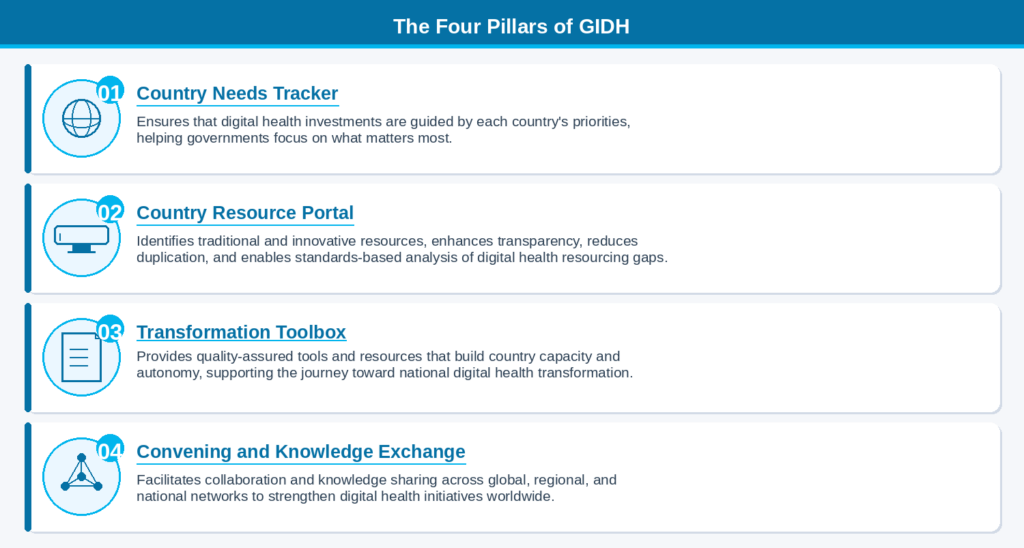
GIDH has four operating objectives. It assesses what countries actually need, rather than what donors assume they need. It aligns funding with the gaps countries identify. It accelerates the implementation of the WHO strategy on the ground. It connects networks so that a solution tested in one country reaches another that needs it.
That last objective matters more than it sounds. A great deal of digital health work gets repeated because there is no mechanism to share it. GIDH exists partly to fix that.
Why the WHO Digital Health Strategy Extension to 2027 Matters
The extension to 2027 ties the strategy to the UN’s Pact for the Future and the 2030 Sustainable Development Goals. That alignment is not just symbolic. It puts digital health on the same policy calendar as climate, poverty, and education commitments. Health ministers now justify digital investment using the same frameworks they use for everything else the UN tracks.
The numbers reflect how far uptake has moved. As of May 2025, 129 countries had active national digital health strategies. More than 1,600 government officials from over 100 countries had completed WHO training in digital health and AI. Five years ago those figures would have seemed optimistic.
How WHO and GIDH Build Standardized National Healthcare Systems
The shift in how countries build health systems is visible in how the sector describes its own problems. Before 2020, the dominant complaint was that pilots never scaled. Now the complaint is that systems cannot connect.
That is progress, but it is also the next problem to solve. WHO addresses it by promoting interoperability standards that health systems across labs, clinics, hospitals, and pharmacies must follow. The goal is cross-border data exchange, not just data exchange within a single institution.
Area | Before 2020 | In 2026 |
System design | Isolated pilots with no coordination | National digital architecture under one strategy |
Technical approach | Vendor-oriented systems | Standards-based interoperability across institutions |
Data flow | Limited exchange within institutions | Cross-border exchange through agreed protocols |
How WHO Governs AI and Advanced Technologies in Health Systems
AI in health creates specific governance problems that general technology regulation does not cover. A biased algorithm in a credit application is a commercial problem. A biased algorithm in a clinical diagnosis is a patient safety issue.
WHO’s governance standards require that AI tools pass independent validation before health authorities put them into use. Health professionals must be able to review and challenge what an algorithm recommends. The Strategy also sets requirements around wearables and the data they generate, including how that data gets stored, who can access it, and how bias in training data gets detected before it affects clinical outputs.
How GIDH Helps Countries Plan and Allocate Digital Health Resources
Countries with fewer resources face a specific problem in digital health. They get offered solutions built for somewhere else. GIDH’s Country Needs Tracker addresses this by mapping what countries have identified as their own priorities, and matching available resources to those priorities rather than to what donors want to fund.
The result is that investments cover real gaps. Countries avoid buying systems that duplicate what a neighbour already built. Developers find markets that actually need what they are building. The duplication problem shrinks, though it does not disappear.
How the WHO Digital Health Strategy Strengthens Accountability
Health systems have historically been difficult to audit. Paper records, disconnected databases, and inconsistent documentation standards made financial and clinical accountability nearly impossible in many settings.
Structured data standards change that. When a health system uses HL7 FHIR for data exchange and ICD-11 for disease classification, every transaction leaves a record in a format that auditors can actually read. WHO’s Strategy makes these standards a requirement, which means accountability becomes a function of the system design rather than an add-on.
Core Principles of the WHO Global Strategy on Digital Health
Global Collaboration Across Health Systems
WHO aligns digital health work at global, regional, and national levels. GIDH brings the stakeholders into that alignment. The aim is to make digital health investment flow toward Universal Health Coverage rather than toward whatever is easiest to fund. Countries stop running isolated projects with no connection to their own national priorities.
Data-Driven Governance for Digital Health Programs
WHO’s Strategy requires specific governance mechanisms, not general commitments to good practice. Those mechanisms include ethical AI governance inside health systems, cybersecurity standards that apply through a product’s full lifecycle, protocols for secure cross-border data exchange, and patient rights over their own health data.
Integrated Health Systems and Interoperability Standards
WHO specifies the standards that health systems must use. HL7 FHIR covers data exchange. ICD-11 covers disease classification. A hospital in one country and a pharmacy in another can exchange records through these standards without building custom integrations. That technical commonality is what makes a genuinely connected health system possible.
People-First Digital Health System Design
The Strategy sets requirements that keep technology serving patients. Health systems must build for accessibility in areas with limited connectivity. They must train healthcare workers to use digital tools, not just deploy the tools and assume adoption will follow. System design must include population groups that technology often misses: older adults, people with disabilities, and those in remote locations.
How the WHO Managed Network Operates
Digital Health Compliance Requirements Under WHO and GIDH Standards
WHO’s Global Strategy and its technical frameworks set the compliance floor for digital health solutions worldwide. Countries, developers, and health authorities must meet these requirements.
Core Compliance Areas for Digital Health Solutions
Area | What It Requires in Practice |
Data Privacy and Security | Health systems must protect confidentiality, integrity, and availability of patient data at all times |
Interoperability | Solutions must follow standards-based data exchange protocols including HL7 FHIR and ICD-11 |
Ethical System Design | Developers must build for transparency, informed consent, and user trust |
AI Accountability | Authorities must independently validate AI outputs before health professionals rely on them in clinical decisions |
WHO SMART Guidelines for Digital Health Tool Compliance
SMART stands for Standards-based, Machine-readable, Adaptive, Requirements-based, and Testable. WHO designed this framework to make its clinical recommendations machine-readable so that health information systems can apply them directly rather than relying on human interpretation of guidance documents.
Digital Maturity Assessment Tools for Country-Level Health Systems
Countries use WHO benchmarking tools to measure where their systems stand against national and global digital health goals. These assessments produce results that health ministries can defend to finance ministries. They identify specific gaps rather than general shortfalls, which makes the case for targeted investment much easier to make.
GIDH AI Governance Frameworks for Safe Health AI
GIDH requires AI tools deployed in health systems to clear bias detection, clinical validation, and ethical review requirements. Health authorities get a structured approval process rather than a case-by-case judgment call. The framework applies equally to tools developed in high-income countries and those built locally.
Key Regulatory Developments in Digital Health for 2026
Transparent AI Operations in Clinical Settings
Health authorities now require AI clinical decision support tools to submit to independent review. A clinician who disagrees with an algorithm’s recommendation must have the technical basis to challenge it. That requirement changes how developers document their models and how health systems procure AI tools.
Cybersecurity Across the Full Product Lifecycle
Health technology developers must embed security requirements at every stage of a product’s development and deployment. Risk management documentation must cover the full lifecycle and get updated as threats change. A security audit at launch is no longer sufficient.
WHO Global Digital Health Certification Network and Cross-Border Standards
WHO’s Global Digital Health Certification Network gives member states a shared basis for verifying digital health tools across borders. Countries can recognise each other’s certification decisions rather than running duplicate reviews. That reduces the regulatory burden on developers and speeds up deployment in new markets.
Conclusion
The WHO Global Strategy on Digital Health runs to 2027. GIDH, launched in February 2024, converts its standards into coordinated action across countries, funders, and technical partners. The combination has moved digital health from an experimental sector into a governed one.
The governance work continues because digital health tools carry real risks. A poorly designed patient record system can expose sensitive data. An unvalidated algorithm can push a clinical decision in the wrong direction. WHO and GIDH apply the same logic to digital tools that health regulators apply to medicines: systematic review, clear standards, and accountability when things go wrong.