What is a Pharmacovigilance Audit?
A pharmacovigilance (PV) audits is a systematic and independent assessment of an organization’s pharmacovigilance system, processes, records, and controls to determine whether they comply with applicable regulatory requirements and internal procedures.
Behind every safe and effective medicine on the market lies a complex system of checks and balances, and key parameter of that system is pharmacovigilance audits. While they might not grab headlines like clinical trials or breakthrough approvals, PV audit services are the quiet guardians of drug safety, ensuring that pharmaceutical companies uphold the highest standards of compliance, ethics, and patient care.
Audits in pharmacovigilance (PV) function as systematic, independent reviews akin to quality control in drug safety. They evaluate whether the processes used to collect, analyze, and respond to adverse event data meet both regulatory requirements and internal company protocols. Far from being simple checklists, PV audits serve as a robust verification mechanism to ensure that organizations maintain systems capable of safeguarding patient safety, upholding legal obligations, and ensuring ethical integrity.
So, what exactly are pharmacovigilance audits? Why do they matter, and how can companies prepare for them? This blog breaks down everything you need to know, from audit types and global regulatory affairs expectations to the role of emerging technologies in shaping modern PV practices.
Let’s dive in.
Need Support with Pharmacovigilance Audits & Compliance?
Strengthen your pharmacovigilance system with DDReg Pharma's audit and compliance services, including PV audits, GVP compliance assessments, gap analysis, CAPA support, mock inspections, and quality system reviews.
Explore PV Audit & Compliance Services →Types of Pharmacovigilance Audits
Understanding the different types of pharmacovigilance audits is crucial for building a resilient and compliant PV system.
- Internal vs. External Audits
- Internal Audits: Conducted by an organization’s own audit or quality teams, internal audits are proactive tools designed to identify potential risks, process gaps, and areas for improvement before external evaluation.
- External Audits: These are carried out by independent third-party auditors such as regulatory authorities (e.g., the FDA or EMA) or business partners (e.g., contract research organizations, distributors). These audits often focus on verifying compliance with regulatory frameworks and contractual obligations. Regulatory inspections, a form of external audit, may be routine or for-cause, triggered by specific safety events or prior non-compliance.
- Routine vs. Triggered Audits
- Routine Audits: Planned according to a risk-based schedule (often annually or biennially), these audits are part of a broader PV audit program designed to continuously monitor compliance and effectiveness.
- Triggered Audits: Initiated in response to specific events, such as changes in regulations, major system updates, internal quality findings, or external complaints that suggest possible safety risks.
- Vendor Pharmacovigilance Audits – As pharmacovigilance activities are frequently outsourced, Marketing Authorisation Holders should periodically assess vendors, contract research organisations, drug safety service providers, and business partners through structured audits. Vendor audits help verify contractual compliance, quality system effectiveness, data integrity, and regulatory adherence while ensuring appropriate oversight of outsourced pharmacovigilance activities.
- Risk-Based Pharmacovigilance Audits -Risk-based pharmacovigilance audits focus audit efforts on areas that present the greatest potential compliance or patient-safety risks. The scope and frequency of these audits are determined through risk assessment, considering factors such as critical PV processes, outsourced activities, system changes, previous findings, and regulatory requirements.
- System and Process Audits -System and process audits assess whether specific pharmacovigilance systems and processes are working as intended and meet applicable regulatory and internal requirements. They may examine areas such as ICSR case processing, signal management, safety reporting, SOPs, training, data management, and quality controls to identify gaps and opportunities for improvement
Pharmacovigilance Audit vs Inspection
| Pharmacovigilance Audit | Pharmacovigilance Inspection |
|---|---|
| Usually performed as part of an organization’s quality/audit programme | Conducted by a regulatory authority or competent authority |
| Can be internal or external | Regulatory activity |
| Focuses on assessing systems and processes | Assesses regulatory compliance |
| Findings are managed through the organization’s quality system | Findings may lead to regulatory actions |
| Often risk-based | May be routine or triggered |
A Step-by-Step Guide to the Pharmacovigilance Audit Process
A structured audit process ensures thorough and consistent evaluations across different parts of the PV system.
- Planning: Auditors define the scope, objectives, and evaluation criteria. A risk assessment is typically conducted to focus on high-risk areas such as new partnerships, outsourcing, or post-marketing surveillance.
- Execution: During this phase, auditors:
- Review key documents (e.g., Standard Operating Procedures or SOPs)
- Interview relevant staff
- Observe operations such as adverse event reporting or signal detection
- Check whether electronic systems align with data integrity and regulatory standards
- Analysis and Reporting: Findings are consolidated into a formal audit report that includes:
- Compliance issues
- Observations and best practices
- Recommendations for improvement. This report is shared with the audited party for further action.
- Follow-Up: Companies must implement Corrective and Preventive Actions (CAPA) to address audit findings. Follow-up audits or assessments may be scheduled to ensure the effectiveness of these corrective actions.
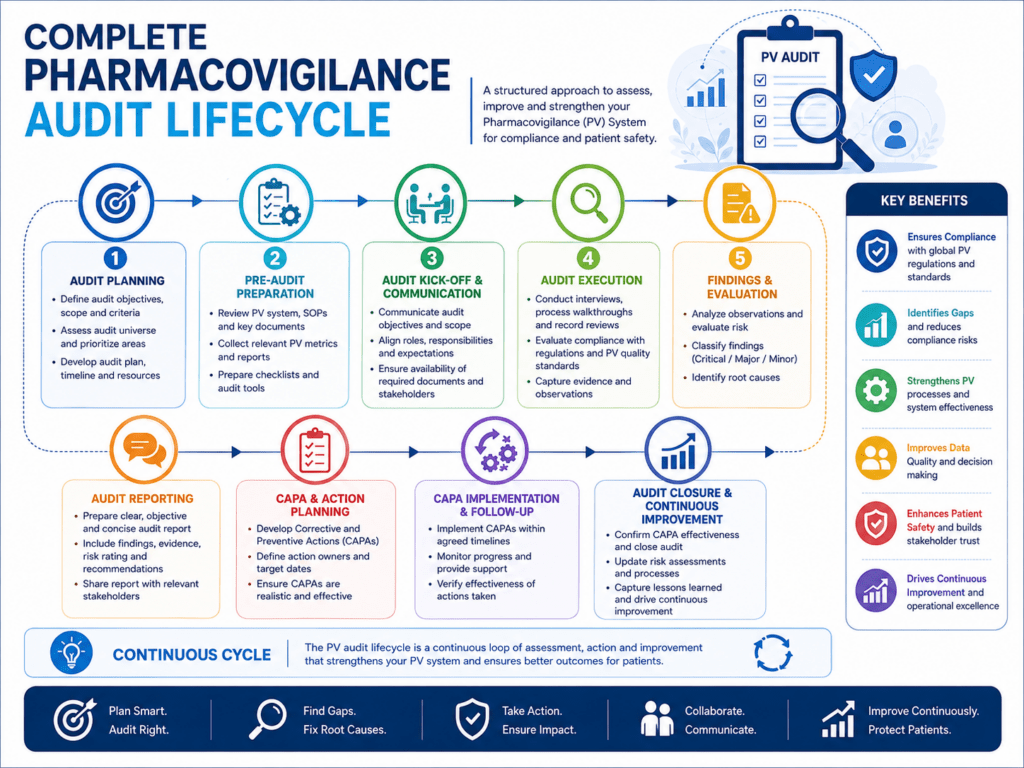
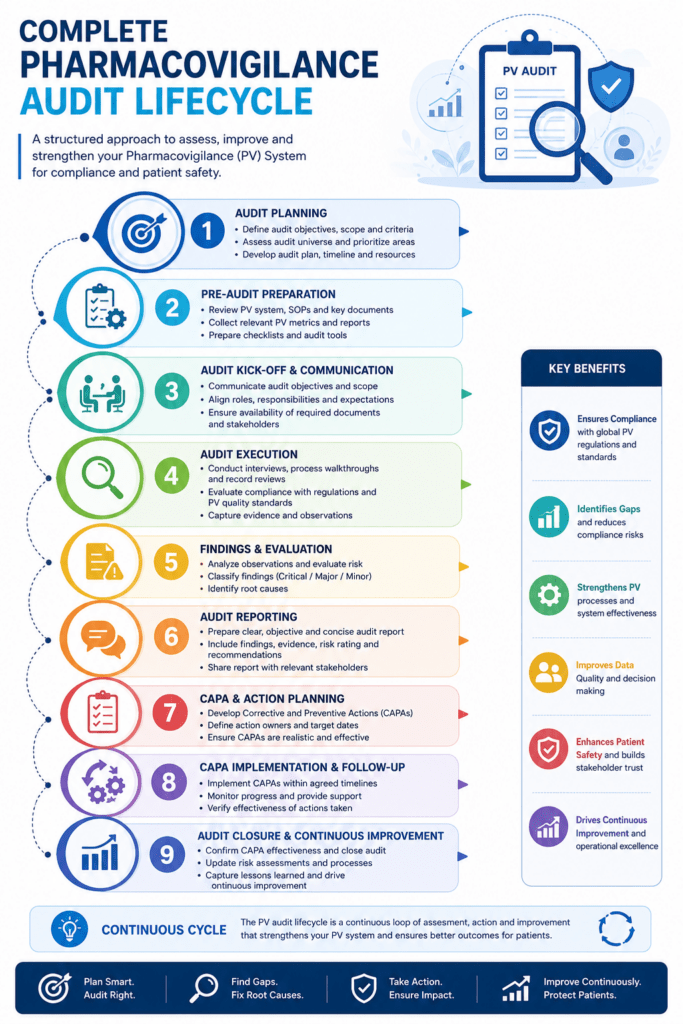
Complete Pharmacovigilance Audit Lifecycle
A comprehensive pharmacovigilance audit lifecycle extends beyond the audit itself. It includes risk-based audit planning, audit execution, documentation of findings, CAPA implementation, effectiveness verification, and continuous monitoring. This lifecycle approach supports ongoing quality improvement and sustained regulatory compliance throughout the pharmacovigilance system.
Key Regulatory Requirements for Pharmacovigilance Audits
Pharmacovigilance audits are not optional—they remain a core regulatory expectation under major global pharmacovigilance frameworks and continue to evolve with new regulatory guidance.
EMA’s Good Pharmacovigilance Practices (GVP)
The European Medicines Agency (EMA) requires Marketing Authorisation Holders (MAHs) to maintain a risk-based pharmacovigilance audit programme in accordance with Good Pharmacovigilance Practices (GVP) Module IV. Audit planning, findings, corrective and preventive actions (CAPAs), and their implementation should be appropriately documented within the Pharmacovigilance System Master File (PSMF).
The current EMA GVP page says the GVP guideline is regularly reviewed and notes that amendments adopted in 2025 and ICH E2D(R1)/M14 will feed into upcoming revisions.
The latest updates to GVP Module IV continue to reinforce risk-based audit planning, independent audit functions, comprehensive documentation of audit findings, and timely implementation of CAPAs, further strengthening pharmacovigilance quality systems across the product lifecycle.
FDA Pharmacovigilance Inspections –
In the United States, the Food and Drug Administration (US FDA) continues to conduct pharmacovigilance inspections to evaluate compliance with post-marketing safety reporting requirements. These inspections commonly assess adverse event reporting, quality management systems, signal management, personnel responsibilities, and compliance with Risk Evaluation and Mitigation Strategies (REMS).
ICH Guidelines for Global Harmonisation –
International Council for Harmonisation (ICH) pharmacovigilance guidelines continue to provide the global foundation for safety surveillance.
- ICH E2A establishes standards for expedited reporting of adverse events.
- ICH E2E outlines the principles of pharmacovigilance planning throughout the product lifecycle.
- ICH E2D(R1), implemented in several regions during 2026, introduces updated expectations for managing and reporting post-authorisation safety data, including safety information obtained from organised data collection systems such as patient support programmes, market research programmes, digital platforms, and other solicited sources.
As regulatory expectations continue to evolve, organisations should maintain risk-based audit programmes and periodically review their pharmacovigilance systems to ensure ongoing compliance with regional requirements and internationally recognised best practices.
This table helps to understand the requirements for PV Audits easily.
| Framework | Relevance to PV |
|---|---|
| EMA GVP Module IV | Pharmacovigilance audits |
| EMA GVP Module III | Pharmacovigilance inspections |
| ICH E2A | Definitions and standards for expedited reporting |
| ICH E2E | Pharmacovigilance planning |
| ICH E2D(R1) | Post-approval safety data and reporting |
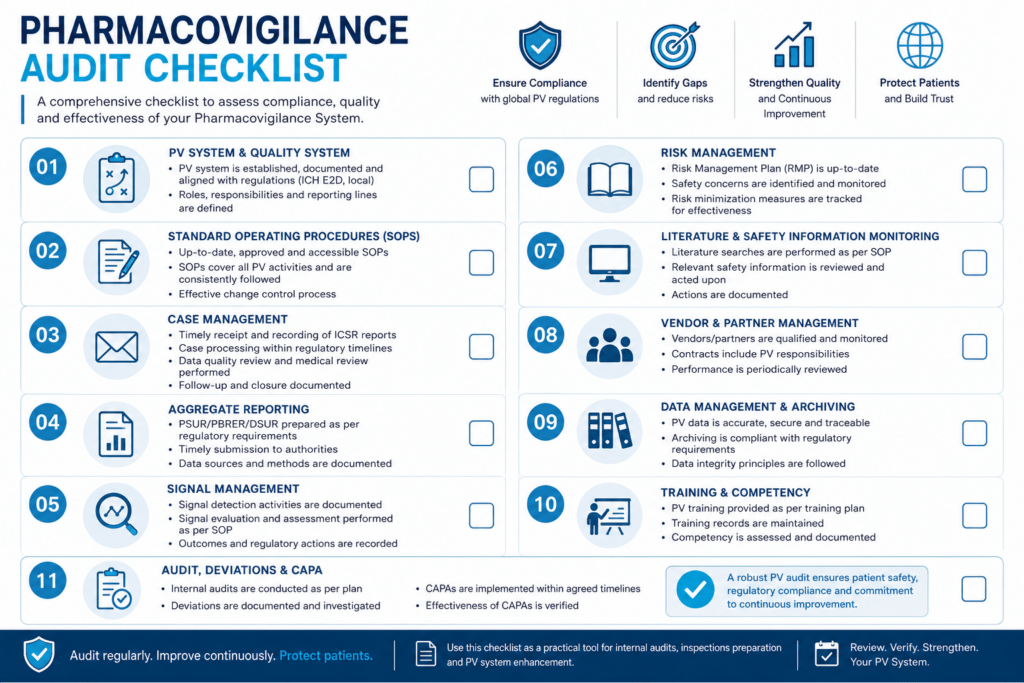
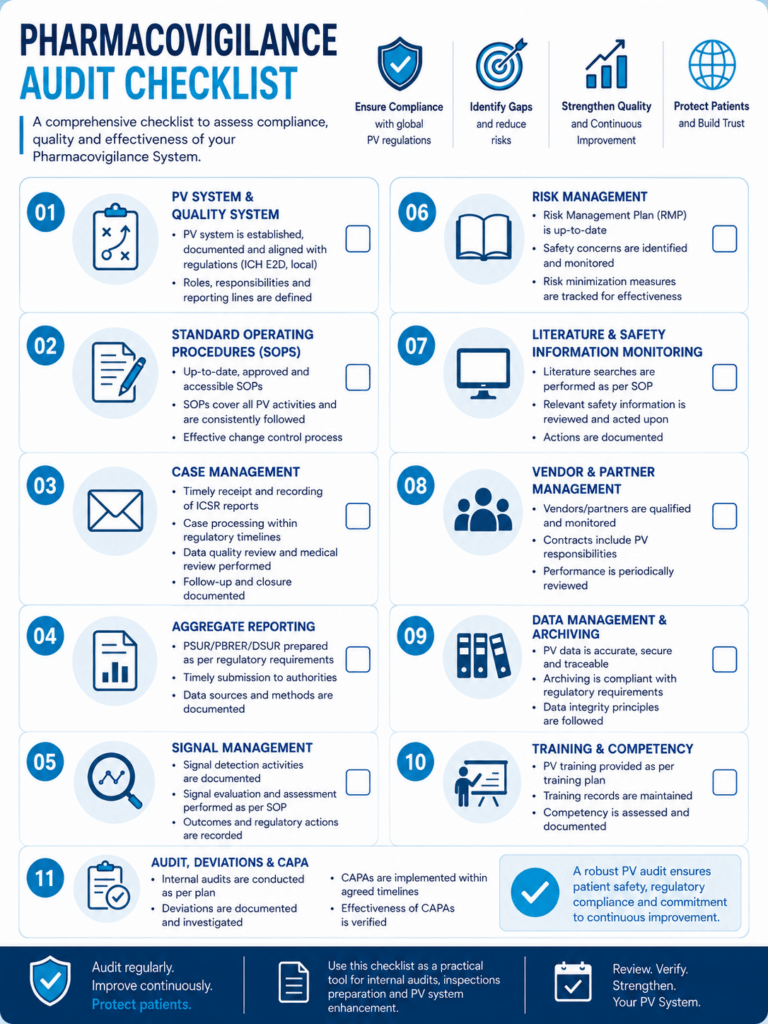
Pharmacovigilance Audit Checklist
How Technology is Transforming Pharmacovigilance Audits
Technological innovation continues to reshape pharmacovigilance auditing by improving efficiency, data quality, and regulatory oversight. How does technology improve pharmacovigilance audits? Technology improves PV audits by helping organizations analyze safety data, identify potential compliance risks, maintain accurate records, track audit findings and CAPAs, and improve inspection readiness.
- Artificial Intelligence (AI) and Machine Learning support trend analysis, signal prioritisation, anomaly detection, and risk-based audit planning while enhancing review of large safety datasets.
- Advanced Analytics enable continuous monitoring of pharmacovigilance performance and facilitate data-driven quality assessments.
- Cloud-Based Audit Platforms improve collaboration, document control, audit traceability, and global oversight across geographically distributed teams.
- Electronic Document Management Systems (EDMS) strengthen version control, document accessibility, and inspection readiness.
- Digital Pharmacovigilance Systems are increasingly expected to support data integrity, cybersecurity, and complete audit trails as regulatory authorities continue to encourage modern, technology-enabled pharmacovigilance systems.
Remote and Hybrid Pharmacovigilance Audits
What are remote and hybrid pharmacovigilance audits? Remote audits are conducted primarily through digital tools and virtual interactions, while hybrid audits combine remote activities with selected on-site assessments.
Regulatory authorities and organisations continue to adopt remote and hybrid audit models where appropriate. Secure digital platforms, electronic documentation, virtual interviews, and remote access to validated systems enable efficient audit execution while maintaining data integrity, transparency, and regulatory compliance.
How is AI used in pharmacovigilance quality management?
AI can help analyze quality data, identify potential compliance risks, monitor CAPA activities, and detect trends that may require further investigation, while qualified professionals remain responsible for reviewing results and making decisions.
Artificial intelligence and digital quality management solutions are increasingly supporting pharmacovigilance quality systems by improving trend analysis,identifying compliance risks, monitoring CAPAs, and strengthening continuous quality improvement while maintaining appropriate human oversight.
Conclusion
Audits for pharmacovigilance remain an important component of the management of quality and patient safety throughout the entire product life cycle.
As expectations for pharmacovigilance in the world shift in 2026 – with an increased focus on risk-based auditing and up-to-date EMA GVP guidelines, as well as an ICH E2D(R1) oversight of vendors- the digital quality management process and auditing processes that are technology-enabled, it is essential that organizations make sure their pharmacovigilance programs are constantly monitored and ready for inspection.
Implementing complete audit lifecycles, efficient CAPAs, and improved quality based on data not only helps ensure compliance with regulatory requirements but also improves operational efficiency, improves patient protection, and ensures constant improvement across all pharmaceutical surveillance programs.
DDReg’s Pharmacovigilance Audit & Compliance Services
DDReg Pharma provides pharmacovigilance services to help pharmaceutical companies assess their safety systems, identify compliance gaps, and strengthen inspection readiness. Our support can include PV system audits, vendor audits, PSMF-related assessments, CAPA review, and evaluation of key pharmacovigilance processes.
With experience across global regulatory frameworks, DDReg helps organizations take a structured, risk-based approach to pharmacovigilance quality and compliance throughout the product lifecycle.
Frequently Asked Questions (FAQs)
Pharmacovigilance audits help verify that drug safety systems comply with regulatory requirements, identify quality gaps, strengthen risk management, and support continuous patient safety throughout the product lifecycle.
Pharmacovigilance audits are guided by global regulatory frameworks, including the EMA Good Pharmacovigilance Practices (GVP) Module IV, FDA pharmacovigilance inspection expectations, and ICH pharmacovigilance guidelines, including E2A, E2E, and ICH E2D(R1).
Current trends include risk-based audit planning, greater oversight of outsourced pharmacovigilance activities, increased adoption of AI-enabled quality management tools, remote and hybrid audits, and stronger focus on data integrity and inspection readiness.
A complete audit lifecycle typically includes audit planning, risk assessment, audit execution, documentation of findings, CAPA implementation, effectiveness verification, follow-up activities, and continuous quality improvement.
Organisations should maintain updated SOPs, validated pharmacovigilance systems, complete audit documentation, effective CAPA programmes, regular staff training, vendor oversight, and periodic internal audits to remain inspection-ready and compliant with evolving global regulations.