
In a busy pharmaceutical laboratory, a group of scientists huddles over pre-clinical data, discussing whether the next experimental compound is ready and safe for first-in-human studies. Nearby, regulatory professionals methodically organize dossiers, confirming that each study aligns with international regulations. In today’s world of drug and device development, true success requires as much focus on safety and efficacy. At the core of ensuring safety is a carefully designed toxicology strategy in drug and device development.
For regulatory experts, toxicology is more than scientific requirements− it is a strategic decision that can create a future product. From dealing with conventional drugs, complex biologics, small molecules, and other novel combinations, the approach to toxicology testing can determine regulatory outcomes and market performance. Here, we investigate how organizations can build strong toxicology strategies, follow ICH S guidelines, and prepare regulatory dossiers that balance compliance with clinical planning.
Understanding Toxicology Strategy in Drug & Device Development
Toxicology is a fundamental study of the harmful effects of substances on living systems. For drug development, this helps identify potential toxicities before compounds reach human exposure. In medical device development, it evaluates materials and byproducts for safety.
A strategic toxicology plan flags early safety risks, optimizes preclinical studies, and produces strong regulatory submissions. Without such planning, hidden toxicities may emerge and threaten patient safety.
Why Toxicology strategy matters
A reactive approach- Clinical Study is performed only when authorities request it; it can lead to unexpected trial interruptions, costly delays, and product withdrawal. In contrast, a forward-thinking toxicology strategy in drug and device development provides:
- Prior safety risks detection and evaluation
- Enhance preclinical study designs for better outcomes
- Simplify regulatory processes and faster approvals
- Building stakeholder confidence in safety and efficacy
If a novel anti-inflammatory drug shows positive results in preclinical studies, but without an early toxicology plan, unexpected liver toxicity in humans could emerge, potentially stopping development. Early use of predictive toxicology and targeted studies mitigates these risks.
The Role of ICH S Guidelines in Shaping Strategy
In worldwide drug and device development, regulatory alignment is critical, not optional. The ICH Safety (S) Guidelines toxicology provides a framework that turns toxicology from a collection of separate tests into an integrated and risk-based strategy. By coordinating scientific and technical requirements across major regulatory agencies like the FDA, PMDA, ICH, and EMA guidelines, unnecessary animal testing can be reduced and keep patients safe.
Key Components of ICH S-Based Strategy
1. Determining Study Scope and Timeline
A major advantage of the ICH S guidelines for toxicology is that they deliver a “master schedule” for safety data in alignment with clinical development.
- Aligning Study Duration with Clinical Progress– ICH S4 and M3(R2) provides harmonized durations for repeat-dose toxicity studies. Typically, six months in rodents and nine months in non-rodents are enough to support chronic human use, avoiding the complications of country-specific requirements.
- Clinical Integration– Before testing humans, guidelines require certain clinical studies. Safety pharmacology studies (S74) are typically completed before phase 1 trials to minimize the risk of acute functional effects.
2. Standard Methodology of Testing
- Carcinogenicity studies (S1A-S1C) are necessary for drugs intended for use longer than six months and provide standard methods for selecting doses.
- The study of Genotoxicity (S2) describes a standard set of tests for identifying DNA-reactive compounds early, helping to decide if a drug candidate should move forward.
- Reproductive toxicology study (S5) provides standard methods to assess risks to fertility and embryo-fetal development, helping ensure consistent safety labeling for pregnant women.
3. Shifting to a Risk-Focused, Evidence-Driven Approach
As per recent updates to guidelines such as S1B(R1), mark a strategic WoE approach instead of rigid testing.
- 3Rs– Animal welfare principles that encourage minimizing animal studies.
- Exposure-Driven safety– Under S3A (Toxicokinetic), evaluating toxicity based on real systemic exposure for better human risk assessment.
4. Toxicology Impacting Regulatory Success.
Aligning toxicology strategy in drug & device development with ICH S Guidelines offers clear advantages for regulatory submissions.
- Regulatory Dossier– Adhering to ICH guidelines allows the Nonclinical Overview of CTD to be accepted across regions without the need for additional studies.
- Improving Resource Efficiency– This approach saves both time and capital, allowing products to reach patients faster.
Regulatory Dossiers Preparation
A well-planned toxicology approach in the regulatory dossier should be demonstrated.
- A clear rationale for the studies selected.
- Adherence to ICH S Guidelines for toxicology
- Transparent reporting and interpretation of results
- A risk-benefit assessment to support clinical trial or medical device approval.
Comparison between Dossier Forms
Features | Drug Submissions (CTD) | Medical Device Submissions (STED) |
Primary Focus | Pharmacology, pharmacokinetics, and therapeutic efficacy | Safety, functional performance, and design validation |
Format Of Documentation | Standard five-module CTD structure | Flexible, risk-based technical documentation tailored to device type |
Toxicology | Systemic Toxicity and organ-level effects (ICH S Guidelines) | Biocompatibility, leachable, and degradation (ISO 10993) |
Benefits of Harmonized Dossier Flow
A coordinated dossier preparation across the region offers tangible benefits, including approvals and market access.
- Reduced redundancy in studies
- Faster regulatory acceptance
- Global market readiness
- Resource efficiency
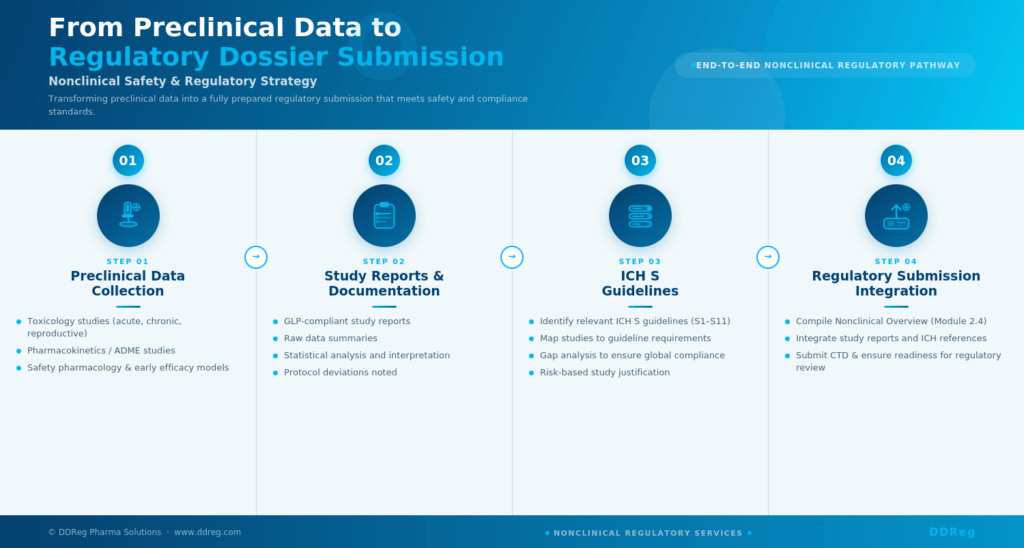
From Preclinical Data to Regulatory Dossier Submission
By transforming preclinical data into a fully prepared regulatory submission that meets safety and compliance standards.
Conclusion
Developing a strong toxicology strategy in drug and device development is no longer optional; it is strategically essential. Safety is the foundation of every successful drug or medical device. A well-structured strategy− built on scientific expertise, regulatory requirements, and careful planning helps the foundation remain strong. From early risk detection to the preparation of regulatory dossiers. The integration of ICH S guidelines, toxicology, and a proactive, data-driven mindset transforms toxicology from a basic regulatory compliance into a strategic advantage.
For pharmaceutical and medical device companies, investing in proactive toxicology planning today leads to smoother regulatory approvals, safer products, and improved patient outcomes.
Why Choose DDReg for Toxicology Services
DDReg offers expert toxicology services that align scientific rigor with regulatory expectations. Their team provides comprehensive assessments, study design guidance, and safety evaluations to ensure compliance across global markets. DDReg minimizes risk and accelerates decision-making for safer product development. Clients experience clarity, efficient workflow, and a trusted partner committed to guiding them through every stage of their toxicology strategy.