
The MOHAP to EDE transition marks one of the most significant regulatory milestones in the UAE’s healthcare system in recent years. Established under Federal Decree-Law No. 38 of 2024, the Emirates Drug Establishment (EDE) has now assumed the medical product regulatory functions previously held by the Ministry of Health and Prevention (MOHAP), consolidating oversight under a single, specialized federal authority.
For medical device manufacturers, importers, and distributors, this is far more than an administrative reshuffle. The MOHAP to EDE transition centralizes regulatory framework, oversight, and compliance for medical devices across all seven emirates, replacing a system that was previously spread across multiple bodies with one unified digital authority.
Businesses looking to enter or expand their medical device operations in the UAE must now align with the new EDE regulatory compliance framework — from product classification and dossier submission through to post-market surveillance — to avoid delays under the updated system.
What is the MOHAP to EDE transition?
Up until now, the MOHAP was the central authority for medical device registrations. With the formation of the Emirates Dru Establishment (EDE), regulatory authority for medical devices has largely been assigned to a centralized federal regulatory system.
The intention of the relocation is to foster an integrated system of regulation for medical devices, pharmaceuticals, and other health-related products which will improve system efficiency and transparency and bring the UAE system into greater harmony with international regulatory standards.
For medical device businesses, this transition means EDE’s systems and processes will govern all future eCTD regulatory submissions, registrations, requests, and representations.
UAE medical device regulations
- Assessment of technical and quality documents.
- Compliance for import and distribution.
- Post market surveillance and safety evaluation.
Our Regulatory Affairs experts help clients understand requirements and compile documentation to meet the compliance needs of the UAE.
What Do Medical Device Manufacturers Need to Know About the EDE Transition?
Medical device manufacturers should understand the key regulatory changes introduced by the Emirates Drug Establishment (EDE) and assess how they affect product registration, market authorization, and compliance.
The transition impacts key areas for medical device compliance:
The transition to EDE oversight impacts several critical areas of medical device compliance, including product classification, manufacturer and Marketing Authorization Holder (MAH) registration, and marketing authorization requirements.
1. UAE Medical Device Registration Requirements
All medical devices that are to be imported and sold in the UAE need to go through an EDE registration process. This needs the submission of all the technical, quality, safety, and regulatory documents that show that the device is compliant with the UAE requirements.
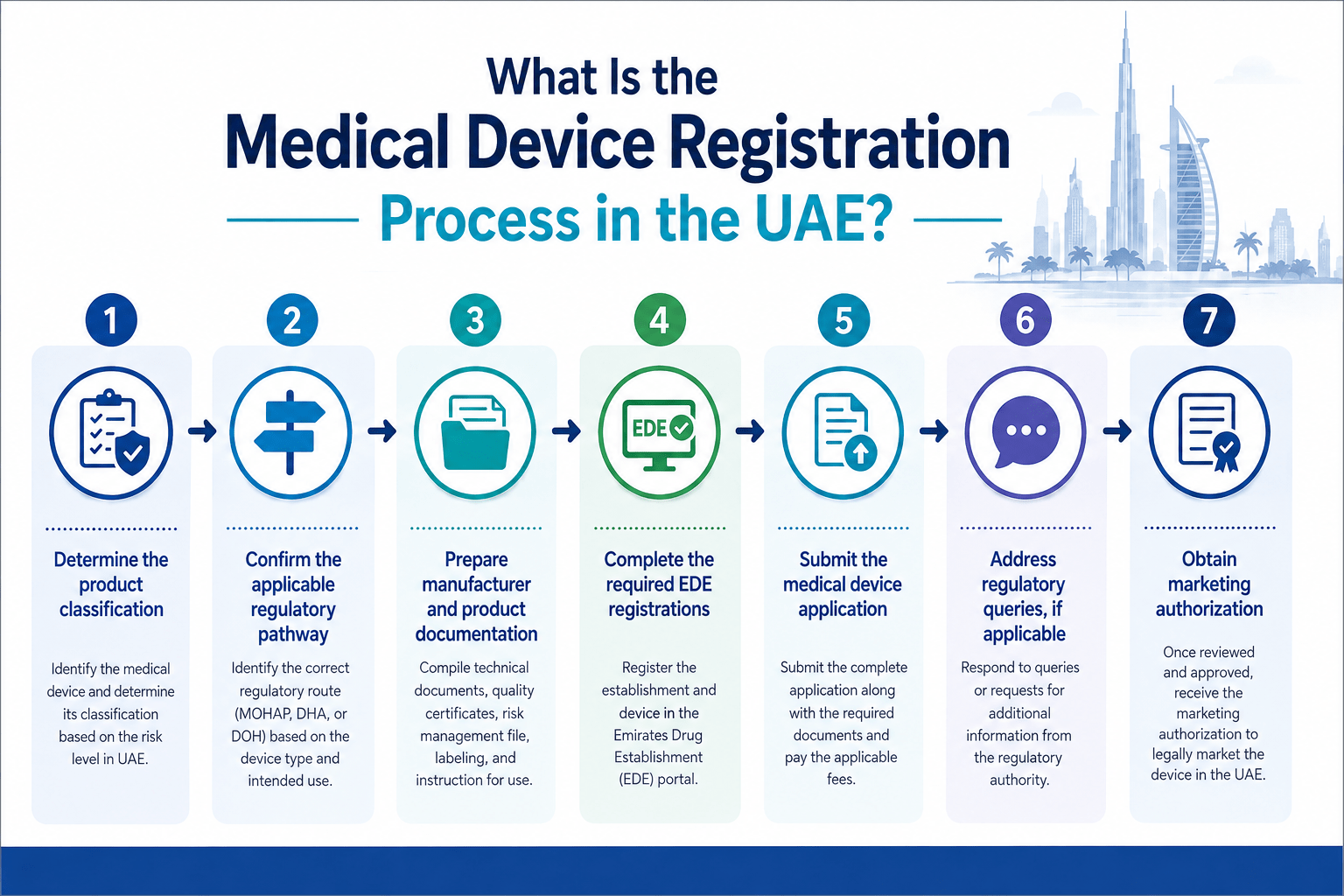
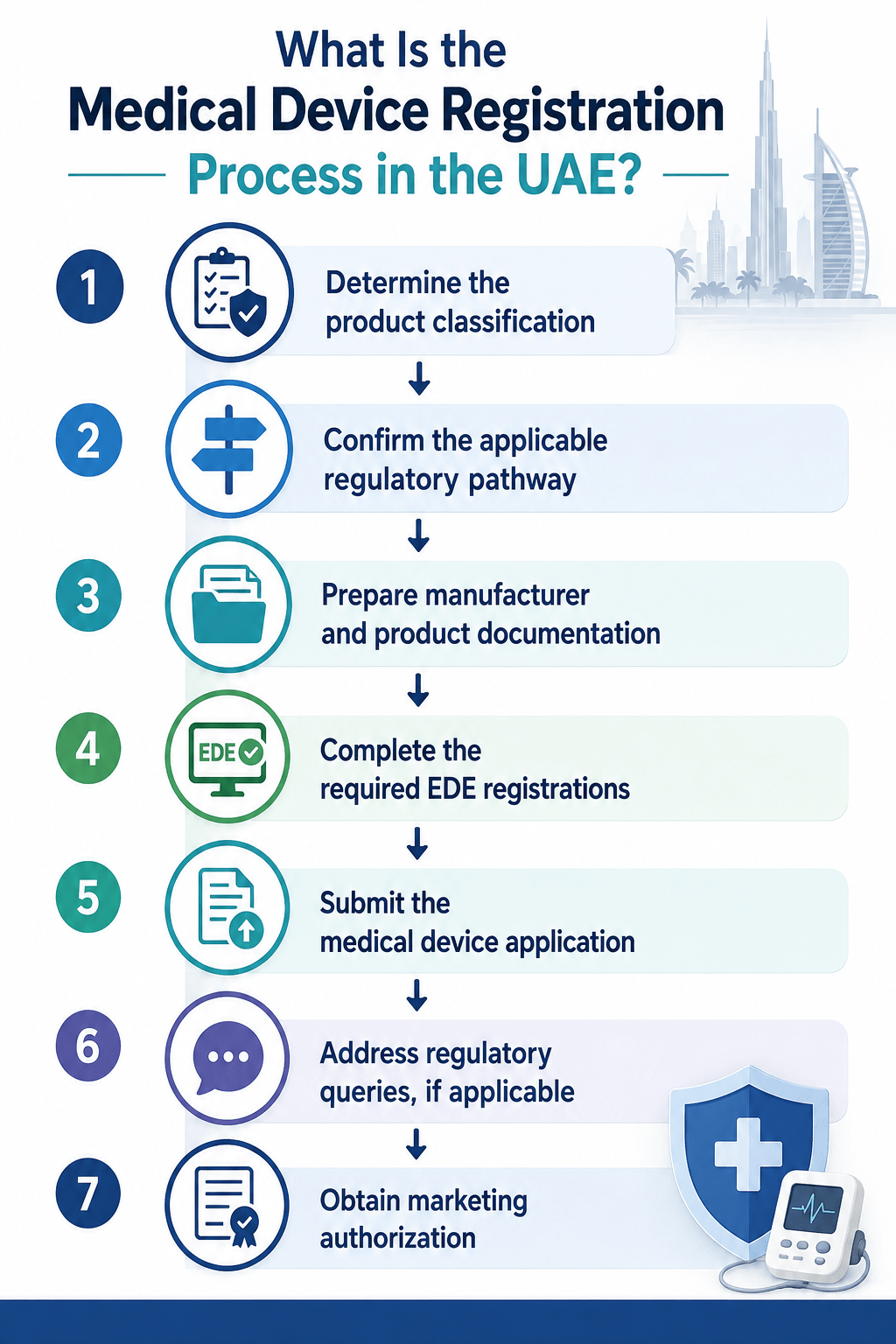
Some of the key documents include the:
- Technical specifications of the product
- Free Sale Certificate or equivalent
- Medical device CE Mark, FDA clearance, or other relevant conformity evidence
- Quality certifications and manufacturer details
- Labeling and IFU
- Safety and Performance information
- Post market surveillance documents
The requirements may differ based on the medical device classification and the assessed risk.
2. Manufacturer and Marketing Authorization Holder (MAH) Requirements
Prior to product registration, the companies involved in the commercialization of medical devices may need to hold the respective registrations for manufacturer, marketing authorization holder, medical warehousing, and marketing offices.
For the registration of the manufacturing site, requirements may include the company profile, product listing, and ISO 13485 certification and manufacturing licenses.
A robust regulatory strategy is critical since the inadequate manufacturer documentation and disparity of documentation across the global regulatory framework may result in delays in market access.
3. Compliance Documentation
Within the framework of EDE, companies need to ensure that their regulatory submissions are thorough and in accordance with the current requirements.
Some of the common issues that manufacturers face include:
- Inaccurate device classification
- Absence of technical documentation
- Discrepancies between international approval documents and UAE submission documents
- Noncompliance of labeling and artwork
- Insufficient local representation
- Obligations of the regulator not being met in a timely manner.
A well-defined regulatory approach mitigates the risk of unnecessary delays for companies trying to access the UAE market from other regions.
Current EDE Medical Device Regulation
Requirement | Current information |
Authority | Emirates Drug Establishment (EDE) |
Service | Marketing Authorization for a Medical Device |
Listed completion time | 45 working days |
Registration fee | AED 5,000 |
Application fee | AED 100 |
Authorization validity | 5 years |
Source: https://www.ede.gov.ae/en/w/issuance-of-marketing-authorization-for-a-medical-device
Regulatory Affairs Services in UAE
These services leverage Regulatory Affairs in UAE to help companies in the pharmaceutical, biotechnology, and medical devices sectors fulfill local regulatory requirements and help them get approval by local services and submission management for the entire lifecycle of their products.
Primary Services include:
- Regulatory Strategy & Consulting – Pathway advisory services associated with the requirements of the UAE.
- Product Registration & Submissions – Full preparation and submission of a regulatory dossier.
- Medical Device & Pharmaceutical Compliance – Support for the approval process and preparation of compliance documentation.
- Regulatory Updates & Intelligence – Keeping clients informed about the changes and new regulations in the UAE.
- Lifecycle Management – Support management of post approval requirements for variations and renewals.
- Medical Device Classification and Regulatory Strategy- The appropriate regulatory pathway cannot be determined without risk classification of the device by the manufacturer.
- Potential Risks Associated with Device Malfunctioning- When devising a classification approach, it becomes easier to identify the relevant documentation, the regulatory pathway, and the requested level of evidence.
Core Services Provided Under the EDE Framework:
- Product Classification: This service is about determining and confirming whether a particular product fits into one or more of the four designated categories, which are, Pharmaceutical, In-Vitro Diagnostic, Medical Device, or Consumer Health Product.
- Site and Facility Registration: In conjunction with EDE, Consultants undertake pre-audits and are involved in the validation of GMP, as per the requirements of ISO 13485, for the listed Manufacturing Facilities.
- Dossier Compilation and Submission Support: Preparation and organization of technical and regulatory documentation in accordance with the applicable EDE submission requirements.
- Bilingual Labeling and Artwork Compliance: Consultants develop product packaging as well as printing and insert materials that meet the required Bilingual formatting in English and Arabic.
- Post-Market Pharmacovigilance (PV): This includes the establishment of a local safety framework and recruitment of a QPPV, management of PSURs, and establishing a rapid reporting of adverse events.
Post-Market Compliance Obligations
The regulatory compliance obligations for Medical Devices do not cease at the point of authorization.
Medical Device organizations are obligated to be continually compliant after the authorization of a medical device. This includes the management of device variations, monitoring the safety of the device, handling complaints, maintaining vigilance, and providing periodic updates to the regulatory body as well as managing license renewals. Ensuring compliance for every stage of the product lifecycle is essential for sustained commercialization of the product in the UAE.
Why Companies Require Regulatory Knowledge During the EDE Transition
The medical device marketplace in the UAE is gaining interest from medical device innovators around the world.
For successful entry into a new market beyond the approval of a product, regulatory expectations and requirements for documentation and compliance must be understood.
Benefits of an experienced regulatory partner include:
- Reduced regulatory risk
- Increased quality of submissions
- Reduced time delays
- Assured ongoing compliance
- Reduced time for access to the UAE market
How DDReg Helps Medical Device Companies During the UAE Regulatory Shift
Compliance with regulations requires specialized knowledge for each local jurisdiction. DDReg assists clients in developing and implementing strategies for access to the market for medical devices.
Conclusions
Moving from the MOHAP to EDE is a significant change in the regulatory framework for medical devices in the UAE. Companies will be able to better plan for the successful registration and commercialization of medical devices in the UAE if they shift their regulatory strategies to the new framework.
With the change in the regulatory framework for medical devices, DDReg provides the means to develop regulatory strategies, review and prepare documentation, and provide support for submissions and ongoing compliance.
Innovation in regulatory strategies is DDReg’s specialty and with the shift in the regulatory framework for medical devices, DDReg provides the means to develop medical device regulatory strategy along with the review of documentation and offerings for submissions.
A shift in regulatory strategies from the MOHAP to EDE offers opportunities to access the medical device market of the UAE faster than previously possible.
Frequently Asked Questions
The shift from MOHAP to EDE is the new transfer of regulatory oversight for medical devices from the Ministry of Health and Prevention to the Emirates Drug Establishment. The intention of this shift is to create a more centralized regulatory system with more oversight and compliance with international regulations.
Yes. Registration of medical devices in the UAE is still needed for businesses wanting to import, sell, or distribute medical devices there. Companies need to prepare the required regulatory documents and must get approval through the EDE regulatory pathways in order to sell their devices
The EDE transition necessitates that medical device manufacturers examine and possibly revise their regulatory frameworks. Companies must adjust to the EDE and their expectations with regard to documentation, submissions, regulatory obligations, and the management of regulatory tasks for the product lifecycle.
Yes. For medical device registration in the UAE, foreign manufacturers need to have an authorized local representative and are required to have a local distributor and/or a regulatory partner. The local regulatory partner plays a vital role in ensuring the obligations for ongoing regulatory compliance and communication with the regulatory authority are fulfilled.
Due to the nature of the UAE regulatory environment, to have a successful market entry, medical device companies need a consulting partner to assist with the documentation, maintain regulatory compliance through the dynamic nature of the regulations, and optimize the submission process to enhance the approval rate.