
Drug Registration Process in Mexico
The pharmaceutical market in Mexico is one of the largest in Latin America, ranked second only to Brazil. With a growing population, increased government focus on healthcare access, and rising demand for innovative therapies, Mexico presents an attractive opportunity for pharmaceutical companies seeking market expansion. However, gaining regulatory market approval in Mexico, this dynamic market requires a deep understanding of the drug registration process in Mexico administered by the Federal Commission for the Protection against Sanitary Risks (COFEPRIS), Mexico’s national regulatory authority.
In this blog, we unpack the drug registration pathway in Mexico, market approval, and pharmaceutical regulations, outline the COFEPRIS drug approval process, and provide strategic insights for companies looking to successfully complete product registration in Mexico.
For companies entering the market for the first time, understanding the Mexico drug approval process is particularly important because the applicable requirements can vary according to the product category, regulatory status, supporting data, and registration pathway.
Need Support with Drug Registration in Mexico?
Simplify your COFEPRIS registration with DDReg Pharma's expert support for regulatory strategy, dossier preparation, submission, market authorization, and post-approval compliance.
Explore Mexico Regulatory Services →Classification and Regulatory Pathways in Drug Registration in mexico
The pathway for drug registration in Mexico varies depending on the product type. Broadly, medicines are categorized into new chemical entities (NCEs), generics,medical devices,cosmetic product , biologics (including biosimilars), and over the counter (OTC) or herbal products in mexico market.
Products regulated in Mexico fall into different regulatory categories, including medicines, biological products, medical devices, cosmetics, and other regulated health products. The applicable registration pathway depends on the product category.
Preparing for the submission dossier
- New Chemical Entities undergo a rigorous evaluation process. Sponsors must submit a dossier preferably in CTD (Common Technical Document) format covering data on pharmaceutical quality, preclinical studies, clinical trial results, and risk management plans. Depending on dossier completeness and therapeutic area, timelines for approval can range between 12 to 18 months. However, COFEPRIS may offer an expedited route through reliance mechanisms if the product is already approved by reference regulatory authorities such as the FDA, EMA, or Health Canada.
- Generic drugs, on the other hand, must demonstrate bioequivalence with an approved reference drug product registration in mexico. Local bioequivalence studies are typically required unless waived through international mutual recognition frameworks. While the review timelines for generics are shorter, usually around 8 to 12 months companies must ensure thorough documentation and local representation.
- For biologics and biosimilars,, the bar is set higher. Sponsors must submit comparability studies, robust quality data, and detailed pharmacovigilance plans. As these products are often more complex in nature, the pharmaceutical product registration process can be longer and may involve post-approval risk mitigation strategies.
- OTC drugs and herbal medicines benefit from lighter regulatory scrutiny but still require demonstrable safety and efficacy. In all cases, the final marketing authorization services is issued for a five-year period and is renewable thereafter.
Drug Registration Pathways in Mexico
The timeline for drug registration in Mexico depends on the type of medicinal product and the applicable COFEPRIS review pathway. New molecules generally require a more extensive scientific assessment, while generic, biological, herbal, homeopathic, and vitamin products may follow different regulatory timelines.
Pathway | Typical use | Key consideration |
Standard registration | Products requiring full assessment | Full applicable dossier/evaluation |
Reliance / abbreviated | Eligible products with recognized reference-authority decisions | Eligibility must be confirmed |
Generic pathway | Generic medicines | Applicable equivalence/bioequivalence requirements |
Biological pathway | Biological products | Product-specific quality and evidence requirements |
COFEPRIS Drug Registration Requirements
Before submitting a drug registration application in Mexico, applicants need to prepare documentation covering the product’s administrative status, quality, non-clinical and clinical evidence, labeling, manufacturing, local representation, and pharmacovigilance obligations. The exact requirements depend on the product type and applicable registration pathway.
- Administrative and CTD Requirements -This covers the regulatory and administrative information needed to support the application, together with the applicable dossier structure.
- Quality / CMC Requirements – CMC means Chemistry, Manufacturing, and Controls.This section demonstrates that the drug can be consistently manufactured with the required quality, identity, strength, purity, and stability.
- Non-Clinical Requirements – Non-clinical information provides evidence generated before or outside human clinical use to support the product’s safety and pharmacological profile.
- Clinical Requirements – Clinical documentation provides evidence supporting the drug’s safety, efficacy, and appropriate use in humans.
- Labeling Requirements – The applicant must provide the product labeling services and related information required for the Mexican market.
- Spanish Language and Translation Requirements – states that applicants should ensure required documentation is provided in Spanish or accompanied by appropriate Spanish translations and supporting certification, where applicable.
How to Register a Drug in Mexico: 8-Step COFEPRIS Process
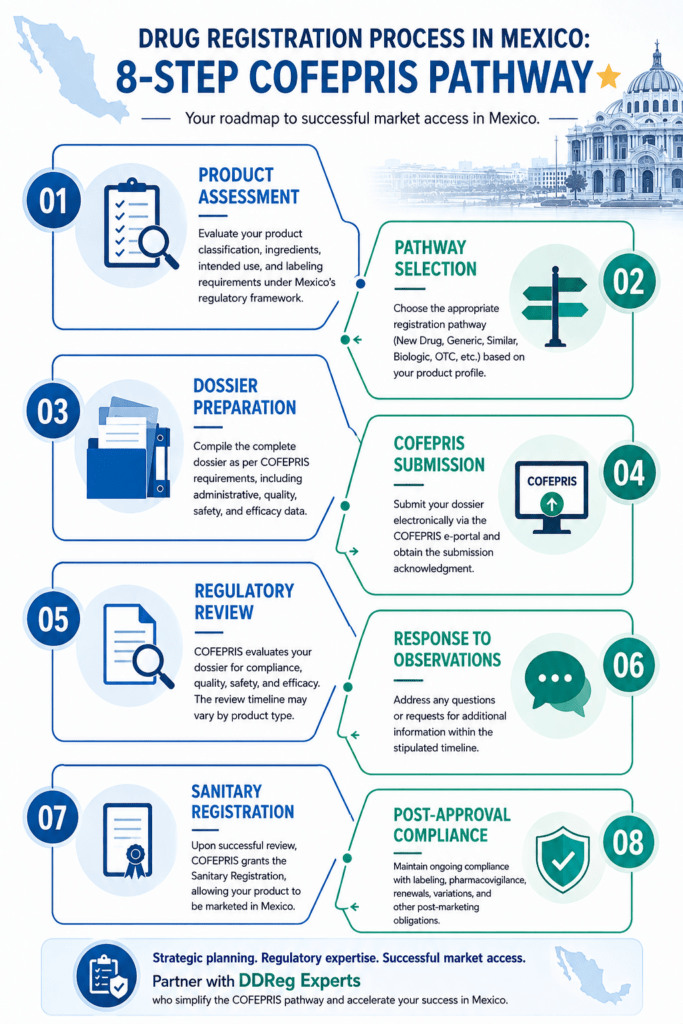
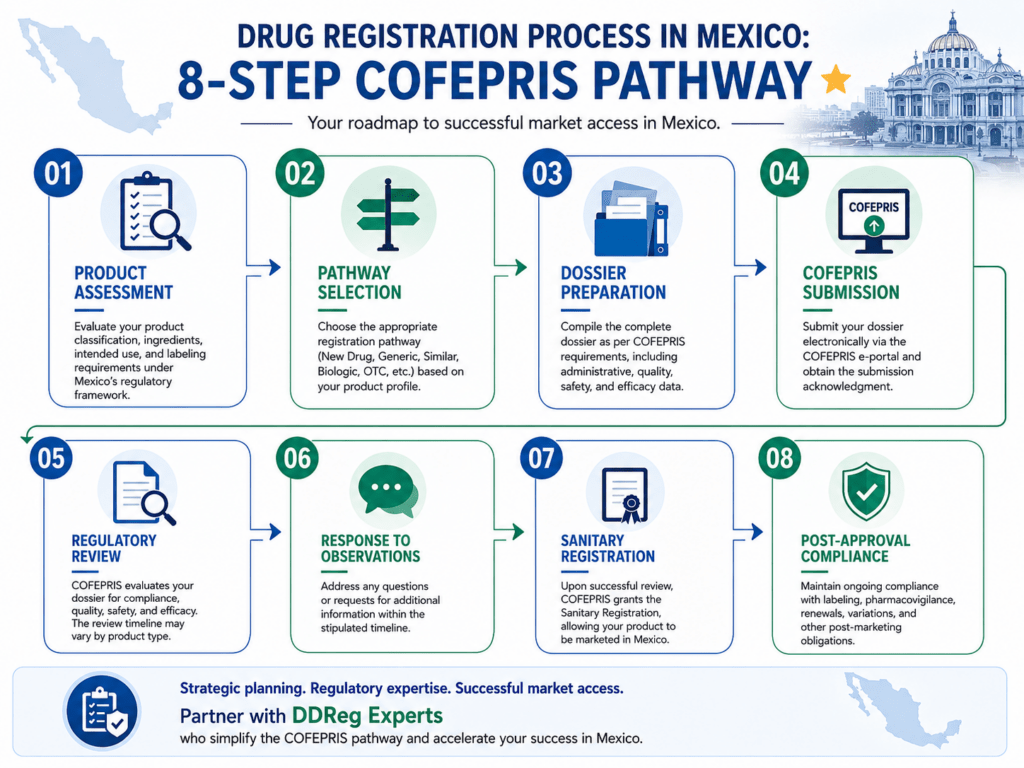
The drug registration process in Mexico is managed by COFEPRIS, the Federal Commission for the Protection against Sanitary Risks. Applicants generally need to classify the product, determine the appropriate registration pathway, prepare the required dossier, submit it to COFEPRIS, respond to regulatory observations, and obtain sanitary registration before commercializing the product in Mexico.
It generally involves several stages, from understanding the product and selecting the appropriate pathway to preparing the dossier, submitting the application, responding to regulatory observations, and obtaining the sanitary registration.
- Product and regulatory assessment – The product is assessed based on its composition, classification, intended use, manufacturing arrangements, regulatory history, and available supporting data.
- Pathway selection – The appropriate registration route is identified based on the product category and applicable COFEPRIS requirements.
- Dossier preparation – The required administrative, quality, non-clinical, clinical, labeling, and other supporting documentation is compiled and reviewed.
- Submit the Application to COFEPRIS – The registration application and supporting dossier are submitted through the applicable procedure.
- Undergo Regulatory Evaluation – COFEPRIS evaluates the application and may raise observations or request additional information.
- Respond to COFEPRIS Observations – The applicant addresses regulatory questions and provides the requested clarification or supporting documentation.
- Obtain Sanitary Registration – Once the applicable requirements are satisfied, the relevant sanitary registration may be granted.
- Maintain Post-Approval Compliance – Following approval, companies continue to manage regulatory and pharmacovigilance obligations throughout the product lifecycle.
This step-by-step approach provides a practical overview of drug registration in Mexico (COFEPRIS) and highlights why pathway selection and dossier readiness should be considered before dossier submission.
Timelines of Drug Registration Take in Mexico
Drug Registration Pathway | Official Timeline | What It Means |
New molecules | Up to 120 calendar days | Applies to new active substances and generally involves a detailed scientific and regulatory assessment. |
Generics, biocomparables & innovative biotechnological drugs | Up to 90 calendar days | Covers applicable generic and biological product registration pathways when a complete dossier is submitted. |
Herbal, homeopathic & vitamin medicines | Up to 25 business days | Applies to eligible products submitted under these specific regulatory categories. |
COFEPRIS Drug Registration: 2026 Regulatory Updates
The Mexican regulatory environment has continued to evolve in 2026. One of the most relevant developments for companies involved in medicinal product registration in Mexico is the publication of CTD Version 3.0 by COFEPRIS on February 27, 2026.
The updated CTD guidance provides direction for integrating registration dossiers and modifications for medicines and biological products. COFEPRIS also provides the corresponding dossier format, checklist, cover letters, registration history, and change-control-related documentation.
Companies preparing new applications or updating existing dossiers should therefore confirm that their submission structure is aligned with the current COFEPRIS CTD requirements rather than relying only on older templates.
COFEPRIS has also formalized its Vía Regulatoria Abreviada (Reliance) framework. The current framework covers medicines and medical devices and allows eligible applications to rely on previous decisions by recognized Reference Regulatory Authorities (ARR), with COFEPRIS conducting a focused evaluation of key documentation.
For companies planning pharmaceutical product registration in Mexico, this means that the regulatory pathway should be assessed before dossier preparation begins. Eligibility for the abbreviated route is not automatic simply because a product has already been approved by the FDA, EMA, Health Canada, or another foreign authority. Eligibility depends on the applicable Mexican recognition and equivalence arrangements, the recognized reference authority, product type, and supporting documentation.
COFEPRIS Reliance Pathway and Expedited Review
In recent years, COFEPRIS has introduced recognition and reliance pathways to streamline the approval of products already authorized by reference agencies. Under this framework, applicants can submit evidence of prior approval from recognized reference regulatory authorities along with the documentation required under the applicable Mexican pathway, providing a more streamlined regulatory evaluation for eligible applications.
The current Vía Regulatoria Abreviada (Reliance) provides a more defined framework for eligible medicines and medical devices. COFEPRIS states that the route is based on decisions by recognized Reference Regulatory Authorities and involves a focused evaluation of key documentation rather than simply repeating the full assessment performed by the reference authority.
Applicants should therefore determine whether the product qualifies for the applicable reliance or equivalence arrangement before selecting the submission strategy.
Pharmacovigilance and Post-Market Obligations in Mexico
Post-marketing surveillance is a critical component of Mexico’s regulatory authority framework. Upon approval, companies must establish a pharmacovigilance system in the country. This includes appointing a Qualified Person for Pharmacovigilance (QPPV), maintaining safety databases, and submitting Periodic Safety Update Reports (PSURs) in accordance with COFEPRIS drug registration guidelines. Any serious or unexpected adverse events must be reported within defined timelines.
Need Pharmacovigilance Support in Mexico?
Strengthen drug safety compliance in Mexico with DDReg Pharma's expert support for ICSR processing, COFEPRIS reporting, risk management, signal management, aggregate reports, and PV compliance.
Explore Mexico Pharmacovigilance Services →Evolving Landscape and Strategic Considerations
COFEPRIS has taken meaningful steps in recent years to modernize its regulatory processes. The adoption of digital tools and tracking systems now allows applicants to monitor the progress of their submissions online. Moreover, public-private collaboration has increased transparency and fostered greater engagement between the regulatory and the industry.
Companies looking to launch pharmaceutical products in Mexico should consider several strategic elements:
- Early regulatory consultation can help define the optimal pathway and identify data gaps.
- Leveraging international approvals through recognition mechanisms may accelerate time-to-market.
- Engaging local experts and regulatory consultants can improve dossier quality and streamline interactions with COFEPRIS.
Additionally, pricing and reimbursement, although not regulated by COFEPRIS, must be considered as part of the broader market access strategy. The Inter-Ministerial Commission for the Control of Prices of Medicines and Health Supplies (CIPM) is responsible for setting maximum retail prices, particularly for products procured by the public sector.
A further strategic consideration is assessing the current abbreviated/reliance pathway before dossier preparation begins. Where a product may qualify, determining the applicable reference authority, equivalence arrangement, and documentation requirements early can help companies select the most appropriate submission strategy.
Companies should also confirm the current CTD Version 3.0 requirements when preparing dossiers for medicines and biological products. The updated framework provides the current structure, checklist, and supporting documents recommended by COFEPRIS.
Common Challenges in Drug Registration in Mexico
Companies entering Mexico can face several practical challenges during the registration process. These may include selecting the appropriate regulatory pathway, ensuring that the dossier meets current COFEPRIS requirements, preparing complete administrative and technical documentation, addressing regulatory observations, and coordinating information across global and local teams.
For international companies, another common challenge is keeping global documentation aligned with Mexican submission requirements. Changes in CTD expectations, reliance arrangements, labeling requirements, and other regulatory procedures can also affect submission planning.
Early gap assessment and regulatory planning can help identify these issues before submission and reduce avoidable delays during the evaluation process.
Other Healthcare Product Registration in Mexico
Medical Device Approval Timelines in Mexico
Although this blog focuses primarily on medicines, companies operating across multiple healthcare product categories should also understand that medical device approval timelines in Mexico follow their own regulatory requirements.
COFEPRIS currently includes medical devices within its Vía Regulatoria Abreviada (Reliance) framework. The applicable pathway depends on the type of device, its regulatory classification, the applicable equivalence arrangement, and the supporting regulatory evidence.
Regulatory services for Medical device registration should therefore be assessed separately from pharmaceutical registration rather than assuming that the same requirements or timelines apply to both product categories.
Cosmetic Product Registration in Mexico
The regulatory requirements for cosmetic services differ from those applicable to medicines. Therefore, companies considering cosmetic product registration in Mexico should first establish whether the product meets the Mexican definition and determine the applicable sanitary and labeling requirements.
A cosmetic product should not automatically be treated as a pharmaceutical product simply because it contains an active or functional ingredient. Product classification should be established before determining the applicable regulatory obligations.
Biologic Registration Mexico
For companies developing or commercializing biological products, biologic registration Mexico involves additional considerations compared with conventional pharmaceutical products.
COFEPRIS’s current CTD Version 3.0 guidance specifically covers the integration of registration dossiers and modifications for medicines and biological products.
Biological products may require detailed quality information, characterization, comparability or other product-specific evidence, depending on the type of product and applicable Mexican requirements. Companies should therefore assess the regulatory pathway early and ensure that the dossier is prepared according to the current COFEPRIS framework.
Conclusion
The drug registration process in Mexico is governed by a robust regulatory framework that aligns increasingly with international standards. While COFEPRIS ensures rigorous evaluation, its openness to global harmonization and reliance mechanisms presents opportunities for faster access to this high-potential market.
For pharmaceutical companies, success lies in a well-prepared dossier, early engagement with regulatory authorities, and a strong local presence. With healthcare demand on the rise and a favorable regulatory climate, Mexico offers not only access to a large and growing patient population but also a gateway to the broader Latin American region.
Drug Registration and Regulatory Support in Mexico
DDReg is a global regulatory solutions provider supporting pharmaceutical company with strategic drug registration, compliance, and market access. With proven expertise in Latin America, including Mexico’s COFEPRIS, we help streamline submissions, accelerate approvals, and ensure end-to-end regulatory success in mexico market.
Frequently Asked Questions (FAQs)
The registration timeline depends on the type of medicine, the applicable regulatory pathway, the completeness of the dossier, and the complexity of the regulatory evaluation. Products that qualify for an applicable reliance or abbreviated pathway may follow a different process from standard applications. Companies should therefore assess the product and pathway before establishing a definitive registration timeline.
A pharmaceutical registration dossier generally includes administrative and legal documentation, quality and CMC information, manufacturing details, non-clinical and clinical data, labeling, and applicable pharmacovigilance or risk-management information. The specific documentation required depends on the product and registration pathway. Applicants should also ensure that the dossier follows the current COFEPRIS submission requirements.
Yes, prior approval by a recognized foreign regulatory authority can support certain regulatory pathways in Mexico, but it does not automatically grant Mexican registration. COFEPRIS has established reliance and abbreviated regulatory mechanisms under defined conditions. Companies should first determine whether their product and existing regulatory approval meet the applicable eligibility requirements.
The abbreviated regulatory pathway is a reliance-based mechanism that allows COFEPRIS, under defined conditions, to recognize certain requirements, tests, and evaluation procedures performed by recognized Reference Regulatory Authorities or through the WHO Prequalification Programme. It is intended to streamline the regulatory evaluation of eligible products, but eligibility and documentation requirements must be assessed for each application.