There is a certain kind of diplomacy that happens in grand halls, where handshakes are photographed and words are carefully chosen. And then there is the quieter, more consequential kind, the kind that shows up in the medicine cabinet of a transplant patient in São Paulo, in the blister pack of an antimalarial tablet reaching a clinic in the Amazon, in the bottle of antihypertensive pills that a retiree in Porto Alegre can actually afford.
That second kind of diplomacy is what unfolded between February 18 and 21, 2026, when Brazil’s government mission landed in India with a clear and urgent mandate: to turn a warm bilateral friendship into something more tangible a resilient, affordable, and sovereign pipeline of medicines for millions of Brazilians.
The results were remarkable, and the world should be paying attention.
Why Brazil and India Are a Natural Fit in the World of Medicine
Brazil and India do not always make the news together. Yet by almost every measure that matters for global public health, these two countries represent an extraordinary complementary pair.
India is the world’s pharmacy. It supplies roughly 20% of global generic medicines by volume, is home to the largest number of US FDA-approved pharmaceutical plants outside the United States and has built over decades a formidable ecosystem of active pharmaceutical ingredient (API) manufacturing the raw chemical backbone without which no finished medicine can exist.
Brazil, meanwhile, runs one of the world’s most ambitious universal public health systems: the Sistema Único de Saúde, or SUS, a constitutionally guaranteed framework serving over 150 million citizens. It is a system built on the belief that healthcare is a right, not a privilege but one that has long depended heavily on imported pharmaceutical inputs to fulfil that promise.
The logic of a deeper partnership, then, is almost self-evident. What took longer was the political will, the institutional architecture, and the trust to make it real.
That trust was on full display as Brazilian President Luiz Inácio Lula da Silva arrived in New Delhi in February 2026 for his fifth visit to India as head of state, this time accompanied by Health Minister Alexandre Padilha and a formidable delegation of business leaders. The backdrop was Prime Minister Narendra Modi’s own historic visit to Brasília just seven months earlier, the first by an Indian prime minister in over fifty years. The momentum was undeniable.
The Regulatory Agreement That Will Speed Up How Medicines Reach Patients
At the center of the health chapter of this diplomatic breakthrough was the signing of a Memorandum of Understanding between Brazil’s Health Regulatory Agency, ANVISA, one of the most rigorous and respected drug regulators in the developing world and India’s Central Drugs Standard Control Organisation (CDSCO).
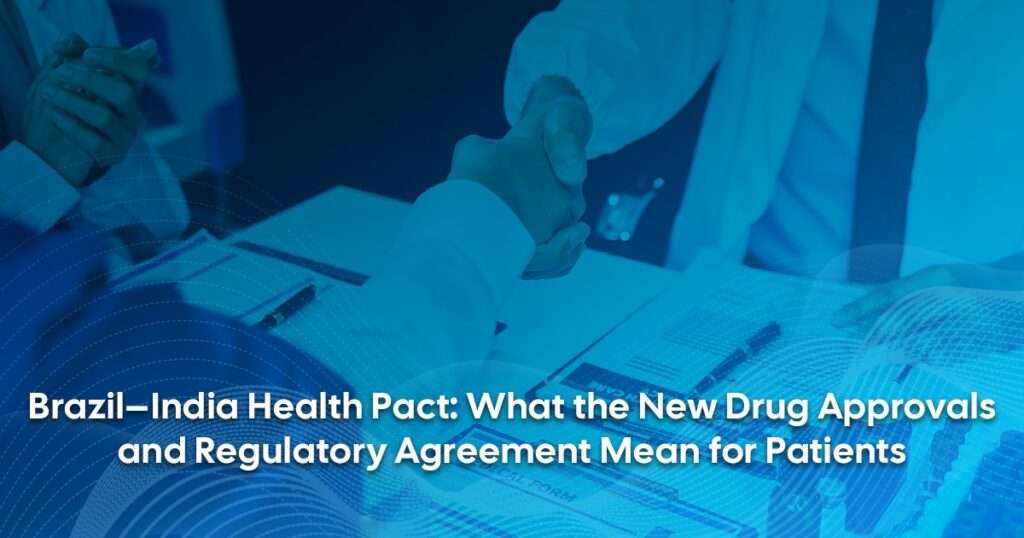
Signed in the presence of both heads of state at Hyderabad House in New Delhi, the MOU is not ceremonial paper. It establishes a structured framework for cooperation and exchange of information in the field of medical products, including pharmaceutical ingredients, drugs, biological products, and medical devices, aiming to promote convergence in regulatory practices and facilitate effective and coordinated oversight.
What this means in practical terms is a kind of regulatory shortcut built on trust. When ANVISA has already assessed a manufacturing facility and found it compliant, that information can now flow to CDSCO and vice versa, rather than each agency starting from scratch. The result is faster approvals, reduced duplication, and ultimately quicker access to medicines for patients.
The agreement reflects the shared commitment of both nations to ensuring the availability of safe, effective, and quality-assured medicines and medical products for their populations, and is expected to contribute to strengthening supply chains, encouraging regulatory best practices, and supporting access to affordable healthcare solutions.
In an era when global supply chains have proven dangerously fragile as the COVID-19 pandemic so brutally demonstrated, this kind of regulatory alignment is not just administrative efficiency. It is strategic resilience.
Six Manufacturing Approvals and the Diseases They Will Help Treat
Beyond the MOU’s headline symbolism, the mission yielded something even more immediately consequential: ANVISA approved six Indian pharmaceutical manufacturing facilities under its Good Manufacturing Practices Certificate (CBPF), clearing them to supply active pharmaceutical ingredients to the Brazilian market.
The range of medicines that will benefit from these new supply authorizations reads like a map of modern public health challenges:
For organ transplant patients, one facility’s certified production of tacrolimus-an immunosuppressant critical to preventing rejection after kidney, liver, or heart transplants represents a lifeline. Brazil performs tens of thousands of organ transplants each year, making reliable, affordable tacrolimus not a luxury but a medical necessity.
For the fight against viral infections, certified production of acyclovir sodium targets herpes zoster, the painful shingles-causing virus that strikes with increasing frequency among older adults and immunocompromised patients. Two separate facilities received certification for different forms of this molecule, underscoring the importance of redundancy in pharmaceutical supply.
For the silent epidemic of cardiovascular disease, which kills more Brazilians than any other cause, multiple certifications cover inputs for drugs treating arterial hypertension and hypercholesterolemia. Among the approved ingredients are several widely used statins and antihypertensives, molecules that millions of Brazilians take daily and that the SUS distributes at no cost.
For malaria, a disease that continues to exact a deadly toll in Brazil’s Amazon basin, the certification of hydroxychloroquine sulfate production keeps open a supply line for a medicine that, whatever its controversies elsewhere, remains genuinely useful in antimalarial treatment protocols.
For mental health, approvals covering antidepressants and anti-anxiety compounds address a crisis that has long been underfunded and under-acknowledged. Brazil carries one of the world’s highest burdens of depression, and accessible medication is a foundational part of any serious response.
Additionally, two finished medicines using Indian-origin inputs were formally registered during the mission: mirabegron, for urinary incontinence- a condition affecting quality of life for millions, particularly older adults and neomycin sulfate, a topical antibiotic used in wound care.
Together, these approvals are not statistics. They are molecules that will flow through distribution networks, arrive at pharmacies, and reach patients who need them.
Brazil Wants to Stop Just Buying Medicines From India and Start Making Them Together
Perhaps the most significant dimension of this mission, the one that carries weight beyond the immediate approvals is Brazil’s stated ambition to move from being a customer of Indian pharmaceuticals to a genuine co-creator.
Brazil is seeking to shift from a buyer-seller relationship to a production partnership, focusing on attracting factories, encouraging joint ventures, and localizing the manufacturing of active pharmaceutical ingredients (APIs).
Brazilian Health Minister Alexandre Padilha described the mission as “historic,” noting that it secured a projected BRL 10 billion in investments over the next decade, aimed at strengthening domestic production of high-tech medicines in Brazil through partnerships between Indian companies, Brazilian public institutions, and private firms.
This is the language of industrial policy meeting public health ambition. For Brazil, it means the SUS could one day be supplied not merely by importing finished drugs, but by manufacturing them on Brazilian soil with Indian technical expertise, Indian API supply chains, and Brazilian institutional capacity working in concert.
For India, it means a deepening foothold in one of the world’s largest pharmaceutical markets, with a pathway toward the kind of production partnerships that create lasting commercial relationships rather than transactional export sales.
The pharmaceutical ventures align with Brazil’s objective to shift from being solely a buyer to a production partner with India.
Why This Deal Matters Beyond Just Brazil and India
It would be easy to frame this story as a bilateral trade success, and it is that. But the significance runs deeper.
India and Brazil are the two largest democracies of the Global South, BRICS partners, and G20 members with an outsized collective voice on questions of global governance. When they choose to deepen cooperation in pharmaceutical regulation, they are doing something that ripples outward.
They are demonstrating that the Global South can build its own regulatory architecture, one that doesn’t merely replicate Western frameworks but develops genuine mutual recognition grounded in real institutional capacity. Such regulatory harmony could streamline approvals for exports and imports, and the pact signals deeper strategic alignment between India and Brazil within forums like BRICS and G20, extending beyond trade to critical sectors like public health.
As Prime Minister Modi noted, “When India and Brazil work together, the voice of the Global South becomes stronger.” In pharmaceuticals, that voice now has a regulatory framework behind it.
The Challenges Still Ahead and Why They're Worth Solving
The MOU and the GMP certifications are important beginnings, not endings. Several challenges lie ahead.
Regulatory convergence is painstaking work. ANVISA and CDSCO operate under different legal systems, use different technical standards in certain areas, and have different timelines for assessments. Translating a framework for information-sharing into routine, institutionalized practice requires sustained investment in people, systems, and political will.
Supply chain diversification, the goal of reducing dependence on any single source country for critical APIs is a strategic imperative that takes years to execute. The certifications granted in February 2026 expand Brazil’s supplier base, but building true resilience means going further, including encouraging local API manufacturing in Brazil itself.
And the technology transfer agenda, which undergirds the most ambitious vision of this partnership, requires patient co-investment from both sides research institutions, regulatory bodies, and pharmaceutical companies working in alignment.
None of this is easy. But the architecture is being built.
At the End of the Day, This Is About the Patient at the Pharmacy Counter
There is a scene that will never be photographed, never make headlines, and will happen sometime in the months and years ahead: a pharmacist in a Brazilian city hands a package of medication to a patient. The patient has hypertension, or herpes zoster, or depression. The medicine is affordable because the SUS covers it. The supply is reliable because regulatory pathways have been cleared. The quality is assured because inspectors on two continents have verified the manufacturing conditions.
That invisible, ordinary, life-preserving moment is what the Brazil-India health mission of February 2026 was really about.
Diplomacy, when it works, ends up in medicine cabinets.
—
Resources: ANI, Business Standard, The Tribune, and official communications from Brazil’s ANVISA and India’s Ministry of Health and Family Welfare.