
What are FDA medical Device Regulations
Medical devices are indispensable tools that help improve the ability to diagnose and treat illnesses, both simple and complex in nature. As technological disruptors become increasingly available in the healthcare industry, medical device manufacturers are developing more advanced devices, making compliance with FDA medical device regulations essential to ensure their safety, quality, and effectiveness. Among the regulatory agencies, the United States Food and Drug Administration (US- FDA) regulates medical devices in the United States through a comprehensive regulatory framework designed to protect public health. However, navigating these regulations can be relatively daunting, particularly for foreign manufacturers looking to enter the US market for the first time. This blog provides an overview of FDA medical device regulations, including device classifications, approval pathways, and key compliance requirements for marketing medical devices in the United States.
Planning to Register Your Medical Device in the USA?
Bring your medical devices to the U.S. market with confidence. DDReg Pharma provides end-to-end FDA regulatory consulting, including device classification, 510(k), De Novo and PMA submissions, Technical Documentation, QMS support, Establishment Registration & Device Listing, U.S. Agent services, and post-market compliance to help you achieve faster market access.
Explore USA Medical Device Regulatory Services →US FDA Medical Device Classification: An Overview
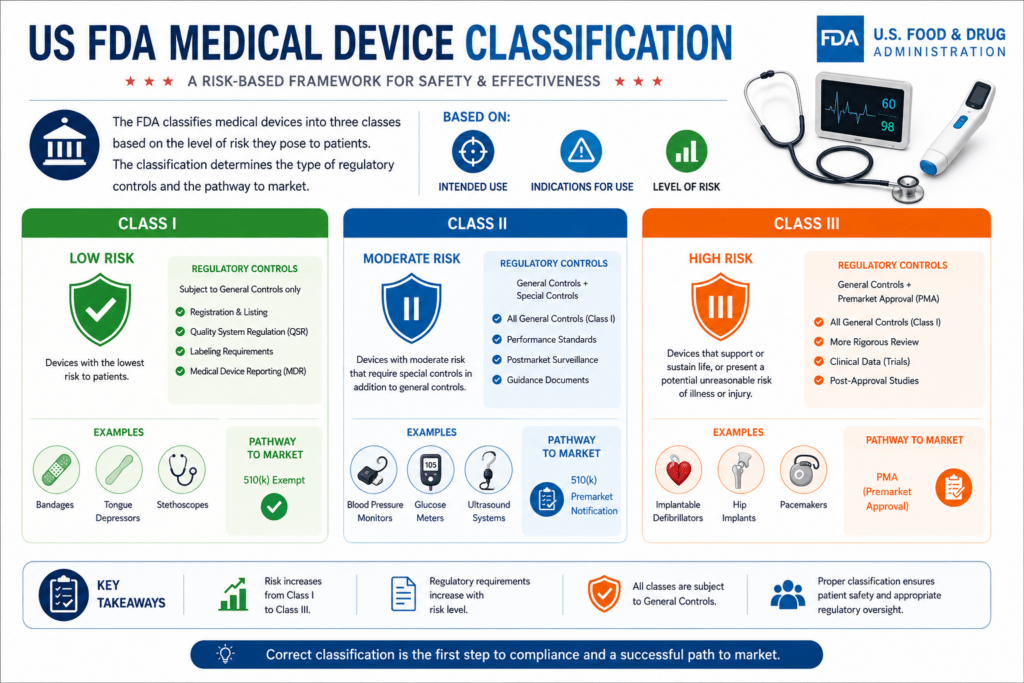
The FDA classifies medical devices into three categories—Class I, Class II, and Class III—based on their intended use, indications for use, and the level of risk they pose to patients. The classification of medical devices falls under a uniquely structured system of FDA medical device regulations administered by the FDA. In general, the FDA classifies devices based on the device’s intended use, the indications for use, as well as the estimated risks posed by the device.
Class I Medical Devices
The lowest-risk devices fall under Class I and are subjected to general controls, among which are establishment registration, device listing, labeling, recordkeeping, and Medical Device Reporting.
A majority of Class I devices are exempt from the FDA 510(k) premarket notification process; however, manufacturers must determine whether their specific device qualifies for the exemption.
Class II Medical Devices
Devices classified under Class II are considered to be of moderate risk and are subjected to both general and special controls. These may include performance standards, specific labeling requirements, post-market surveillance, and device testing.
The majority of Class II devices require a 510(k) premarket notification to demonstrate substantial equivalence to a legally marketed predicate device.
Class III Medical Devices
Devices classified as Class III are considered the highest-risk medical devices. They typically sustain or support life, are implanted, or may pose a significant risk of illness or injury. Most Class III medical devices require Premarket Approval (PMA) before they can be marketed in the United States.
Most Class III devices require Premarket Approval. Determining the classification of a medical device determines the applicable quality-system requirements, the testing, and the regulatory pathway for the device.
What are the Key Regulations Governing Medical Devices in USA?
The FDA has established a comprehensive framework to ensure that medical devices are safe, effective, and manufactured to high-quality standards. This framework includes several key regulations that vary based on the classification of the device.
- Establishment Registration and Medical Device Listing – 21CFR Part 807
The FDA requires all manufacturers and distributors of medical devices to register their establishments with the agency before selling their products. This process is conducted electronically through the FDA Unified Registration and Listing System (FURLS). Further, foreign manufacturers must have a U.S. agent who can act as a point of contact for the FDA. Manufacturers are also required to list their medical devices, providing detailed information about each device, such as manufacturers, contract manufacturers, sterilizers, repackagers, relabelers, specification developers, and others involved in the production or modification of medical devices.
- Premarket Notification 510(k)
Premarket Notification, commonly referred to as 510(k), is a regulatory pathway established by the FDA under 21 CFR Part 807 Subpart E. It allows manufacturers to demonstrate that their medical device is substantially equivalent (SE) to a device that is already legally marketed in the United States.
Manufacturers must submit their 510(k) application at least 90 days before marketing the device. Once submitted, the FDA reviews the 510(k) application to determine whether the new device is SE to the predicate (legally marketed device(s) to which equivalence is drawn). If deemed SE, the FDA issues a clearance letter, allowing the manufacturer to market the device. If not substantially equivalent (NSE), the applicant may resubmit another application/ or De Novo pathway/ or file a reclassification petition / or submit a PMA.
- Premarket Approval
Premarket Approval (PMA) was established by the Food and Drug Administration (FDA) under 21 CFR Part 814. This process is mainly designed for Class III medical devices.
Requirements for PMA:
- Applicants submitting class III medical device applications must provide appropriate scientific evidence to demonstrate the safety and effectiveness of proposed medical devices. This includes:
- Results from non-clinical studies [such as bench testing (which is performance testing like mechanical and biological engineering performance) and animal testing].
- Data from clinical trials that demonstrate the device’s safety and effectiveness.
- Information about manufacturing processes and quality control measures.
- Proposed labeling for both healthcare professionals and patients.
- Investigational Device Exemption (IDE)
The Investigational Device Exemption (IDE) - 21 CFR Part 812 is an exemption that allows manufacturers to gather clinical information on medical devices that have not yet received marketing approval, which can later support applications for premarket approval (PMA) or premarket notification (510(k)).
Clinical evaluation of devices not cleared for marketing requires an investigational plan approved by an IRB or FDA (If the study involves a significant risk device), informed consent from all patients, labelling for investigational use only, monitoring, and required records and reports.
- Quality System Regulation
The Quality System Regulation (QSR), codified in 21 CFR Part 820 ensures that medical devices are designed, manufactured, and distributed in a manner that guarantees their safety and effectiveness.
As of January 31, 2024, the FDA announced the Quality Management System Regulation (QMSR) Final Rule, which amends the existing QSR by incorporating international standards set by ISO 13485:2016. This update aims to harmonize U.S. regulations with global standards for medical device quality management systems. The new rule will take effect on February 2, 2026.
- Labeling requirements
The Labeling Requirements for medical devices are governed by 21 CFR Part 801, which outlines the essential information that must be included on device labels.
The following Parts of Title 21 of the CFR contain labeling requirements for medical devices:
- General Device Labeling - 21 CFR Part 801
- Use of Symbols - 21 CFR Part 801.15
- In Vitro Diagnostic Products - 21 CFR Part 809
- Investigational Device Exemptions - 21 CFR Part 812
- Unique Device Identification - 21CFR Part 830
- Good Manufacturing Practices - 21 CFR Part 820
- General Electronic Products - 21 CFR Part 1010
- Medical Device Reporting
Medical Device Reporting (MDR), governed by 21 CFR Part 803, establishes essential requirements for manufacturers, importers, and user facilities to be promptly informed of significant safety issues related to medical devices.
The Medical Device Reporting (MDR) regulation mandates manufacturers, importers, and device user facilities to report adverse events and product-related problems to the FDA. The regulation requires reports to be filed on Medwatch Form 3500A or an electronic equivalent. The FDA published a final rule in February 2014, requiring e-submission for processing, review, and archiving.
Comparison of 510(k) and PMA and De Novo: Which Pathway is Appropriate for Your Device?
The classification and intended use of a device, along with its risk and the technology it employs, as well as the existence or absence of a predicate device, will determine the appropriate regulatory pathway for a medical device.
- 510(k) Premarket Notification – The 510(k) regulatory pathway is employed if a predicate device exists. In this case, the manufacturer is required to prove substantial equivalence through the performance of a series of tests that may include software validation and biocompatibility, electrical safety, and performance tests. An accepted 510(k) leads to FDA clearance.
- PMA –High-risk Class III devices typically require Premarket Approval (PMA). Class III device manufacturers must provide substantial evidence to the FDA to support their claim of the device’s safety and effectiveness.Approval of a PMA application leads to FDA approval.
- De Novo Classification Request –The De Novo pathway accommodates the submission of low- or moderate-risk devices that are innovative and lack a predicate device. The applicant must prove that the risks are manageable and can be addressed through general or special controls. Approval of a De Novo request leads to the establishment of a new Class I or Class II device. AI medical device FDA approval is being used more and more in medical imaging, diagnosis, patient surveillance, and the support and guidance for clinical decisions and even the planning of medical treatments.
There is no separate pathway for the approval of medical devices containing artificial intelligence by the FDA. Devices with artificial intelligence may be evaluated using the 510(k), De Novo, or PMA processes, depending on the intended use and the availability of a predicate device.
When Does AI Software Become a Medical Device?
AI software likely results in regulation when it is used to:
- Diagnose or identify a disease
- Interpret a medical image
- Forecast a decline in a patient’s condition
- Provide a treatment option
- Conduct an analysis of physiological data
- Assist in making a medical decision
- Operate a medical device
The FDA evaluates the use and the claims associated with the product. The use of AI alone is not the deciding factor to regulation.
Proving AI Device Efficacy
A submission for an AI device may be required to provide evidence of:
- Validation and verification of the software
- Performance of the AI and assessment of clinical utility
- Datasets used for the AI and the assessment of clinical utility
- Quality of the data and representation of the patient
- Falsely identifying or not identifying a condition
- Cybersecurity
- Design of the device to optimize use
- Current and foreseeable risks
- The performance of the device for specific subgroups
- Surveillance of the device after it is approved for use
The datasets must include sufficient data for the specific patient population and the clinical environment.
Challenges in the US FDA Medical Device Industry
The U.S. medical device industry is considered as a global leader in innovation, still it faces several challenges, particularly in ensuring the safety and efficacy of devices postmarket. A recent Government Accountability Office (GAO) report, published on August 15, highlights two significant challenges the FDA faces in establishing a robust postmarket surveillance system for medical devices: limited use of unique device identifiers (UDIs) and insufficient funding.
- Limited Use of Unique Device Identifiers (UDIs) –UDIs are crucial for tracking and identifying specific medical devices in real-world settings. While the FDA has mandated their inclusion on product labels since 2013, adoption across healthcare systems remains inconsistent. The limited integration of UDIs in electronic health records (EHRs) and billing systems hampers the ability to efficiently trace devices linked to adverse events or recalls. This gap complicates safety monitoring and poses risks to patients. For example, UDIs could simplify recall processes, enabling affected individuals to identify problematic devices more easily. Despite advocacy efforts and collaborative initiatives, the FDA lacks the authority to mandate their use in clinical and administrative workflows. The agency has relied on encouraging adoption through coordination with stakeholders and promotional efforts.
- Funding Constraints The financial burden of establishing and maintaining an active postmarket surveillance system is another pressing issue. The FDA estimates that $8 million is required to operationalize the system, but current appropriations fall short. While the FDA has allocated $5 million from its existing budget, it did not receive the additional $3 million requested from Congress. Without adequate funding, the FDA must divert resources from other critical postmarket activities, potentially compromising broader safety initiatives.
To address this issue, the FDA has proposed alternative funding mechanisms, such as using medical device user fees. However, current laws restrict the application of these fees to postmarket surveillance, necessitating collaboration with Congress and the industry to explore viable solutions.
Foreign Manufacturer Guide: Entering the US Medical Device Market
Medical devices entering the US market must comply with the FDA’s requirements.
- Confirm the Product’s Regulatory Status –The FDA has strict definitions of what constitutes a medical device, especially with software, digital health, and AI devices. Manufacturers need to first confirm whether the devices fall under the FDA’s definition.
- Determine Classification and Regulatory Pathway –Manufacturers need to assess the class and the appropriate regulatory pathway of the device, e.g., whether a 510(k), De Novo request, or PMA is required. Approval in another country does not provide entitlement to market the device in the US.
- Appoint a US Agent –Foreign manufacturers must designate an agent as a point of contact for the FDA and for coordinating inspections. The manufacturer bears full responsibility for ensuring compliance.
- Registration and Listing Requirement –All foreign manufacturers must register their establishments and submit a listing of the devices they wish to distribute. This information must be accurate and kept current.
- Quality System Requirements –All foreign manufacturers must be prepared to implement the requirements of 21 CFR Part 820. These requirements include provisions for design controls, supplier controls, validation of manufacturing processes, and the management of customer complaints and corrective and preventive actions as well as maintained records.
- FDA Inspections –The FDA may conduct inspections of foreign manufacturing facilities.
- Labeling Requirements –All devices must be labeled and packaged, and instructions for use must be provided, in accordance with the FDA’s requirements. Where applicable, manufacturers must provide a Unique Device Identifier and submit the device information to the Global Unique Device Identification Database. Some of the challenges of UDI implementation include the management of packaging-level identifiers, variations of data consistency, the updating of legacy data, and the accuracy of data in the UDI System.
- Import Review Preparation –The FDA may verify the registration and listing requirements, the premarket authorization for the device, the compliance of the device with applicable labeling requirements, the device’s import alert status, and the information pertaining to the shipment before allowing the importation of a device.
Conclusion
As the industry continues to evolve with rapid technological advancements, the regulatory landscape must adapt accordingly to address emerging challenges and opportunities. While the complexities of compliance, stringent clinical evaluation requirements, and the need for robust cybersecurity measures present significant hurdles, they also drive innovation and improvement in device quality and safety. These developments promise to enhance the efficiency of the approval process while maintaining rigorous safety standards. Manufacturers must comply with the latest regulatory guidelines and must submit high-quality dossiers to speed up the approval process. As stakeholders work together to address the evolving needs of the industry, the future of medical device regulation holds great potential for enhancing healthcare delivery and patient care.
In addition to providing regulatory services and pharmacovigilance services for global customers, DDReg Pharma offers specialized clinical regulatory services to assist with Clinical Trial Applications in the United States. For further information, connect with our experts. Read more about medical device regulations from the experts here: Regulatory Framework for Software and Artificial Intelligence as Medical Device