

Pharmacovigilance Standard Operating Procedures (SOPs) are the operational foundation of a reliable pharmacovigilance system. Well-written procedures translate regulatory obligations into day-to-day activities, reduce unnecessary variation in how safety information is handled, support data integrity, and provide evidence of control during audits and inspections. They transform global regulatory requirements into clear, actionable workflows that ensure patient safety, regulatory compliance, and operational efficiency.
For Marketing Authorisation Holders (MAHs), Qualified Persons for Pharmacovigilance (QPPVs), Pharmacovigilance Officers-in-Charge (PvOIs), and safety teams, effective pharmacovigilance SOP writing is therefore about much more than maintaining documents.
An SOP needs to reflect how the organisation actually receives, evaluates, processes, reports and monitors safety information.
This has become increasingly important as requirements continue to evolve across the EU, US, India and other markets. In 2026 alone, important developments around E2B(R3), EU pharmacovigilance inspections, ICH safety guidance and AI governance have given organisations additional reasons to review whether their existing pharmacovigilance SOPs still reflect current practice.
Need Help Developing Pharmacovigilance SOPs?
Build clear, compliant, and inspection-ready pharmacovigilance SOPs with DDReg Pharma's support for SOP development, process documentation, workflow design, review, implementation, and maintenance.
Explore Pharmacovigilance Services →What Are Pharmacovigilance SOPs?
A pharmacovigilance SOP is a controlled document describing how a defined safety activity should be performed, who is responsible, which systems or records are involved, and what timelines or quality controls apply.
An effective SOP for pharmacovigilance should connect regulatory expectations with the organisation’s actual operating model.
For example, an ICSR procedure should not simply state that adverse events are reported to regulators. It should explain how safety information enters the organisation, when regulatory awareness is established, how cases are validated and followed up, who performs medical and quality review, and how applicable reporting deadlines are controlled.
The same principle applies to signal management, aggregate reporting, literature monitoring, PV risk management and outsourced PV activities.
Why Are Pharmacovigilance SOPs Important?
Pharmacovigilance SOPs ensure consistency, traceability, and compliance in safety reporting. Regulatory bodies require that all pharmacovigilance processes, such as adverse event reporting, signal detection, and aggregate safety submissions, are documented and executed in a controlled manner.
- EMA Good Pharmacovigilance Practices (GVP): In the EU, GVP Module I identifies core PV processes including PV ICSR management, signal management, periodic safety reporting, authority commitments, safety communication, and implementation of safety-related variations. It also expects the effectiveness of the PV quality system to be monitored.
- FDA (21 CFR 314.80/600.80): In the United States, 21 CFR 314.80 specifically requires applicants subject to the provision to develop written procedures for surveillance, receipt, evaluation and reporting of postmarketing adverse drug experiences.
- India PvPI Guidance (2024): India’s Pharmacovigilance Guidance Document for MAHs of Pharmaceutical Products, Version 2.0, published through NCC-PvPI/IPC in collaboration with CDSCO, similarly describes expectations for PV systems, quality management, PSMF, training, PV audits, inspections and written procedures. Good SOPs therefore help an organisation demonstrate three things during inspection.
The process is defined. The people performing it understand their responsibilities. The documented process is being followed. A beautifully written SOP that does not reflect real operations can create as much inspection risk as an incomplete one.
What Should a Pharmacovigilance SOP Include?
The exact structure depends on the organisation and process, but consistent document architecture makes a PV quality system easier to maintain and inspect.
SOP Element | What It Should Clarify |
Purpose | Why the procedure exists and the PV activity it controls |
Scope | Products, countries, departments, systems and activities covered |
Roles and responsibilities | Who performs, reviews, approves and escalates each activity |
Definitions | Process-specific terminology that needs consistent interpretation |
Procedure | Workflow, decision points, timelines and required controls |
Systems and data | Safety database, E2B standards, coding dictionaries and relevant tools |
Quality controls | QC, reconciliation, deviation and escalation requirements |
Records | Documents, evidence, audit trails, retention and archiving |
References | Applicable regulations, guidance, agreements and related SOPs |
Annexes | Forms, templates, flowcharts or operational checklists where useful |
A RACI matrix can support responsibilities in complex organisations, but it is an internal governance tool rather than a universal regulatory requirement. The most important principle is consistency. The SOP, work instructions, PSMF, vendor agreements and actual operating process should not describe different versions of the same activity.
Steps to Write an Effective Pharmacovigilance SOP
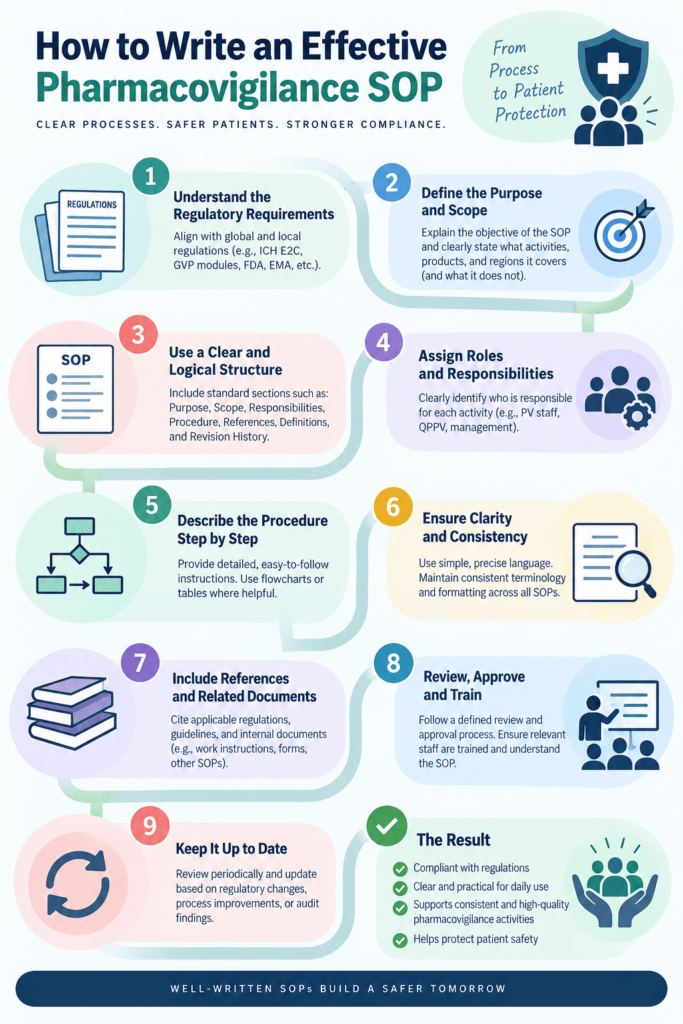
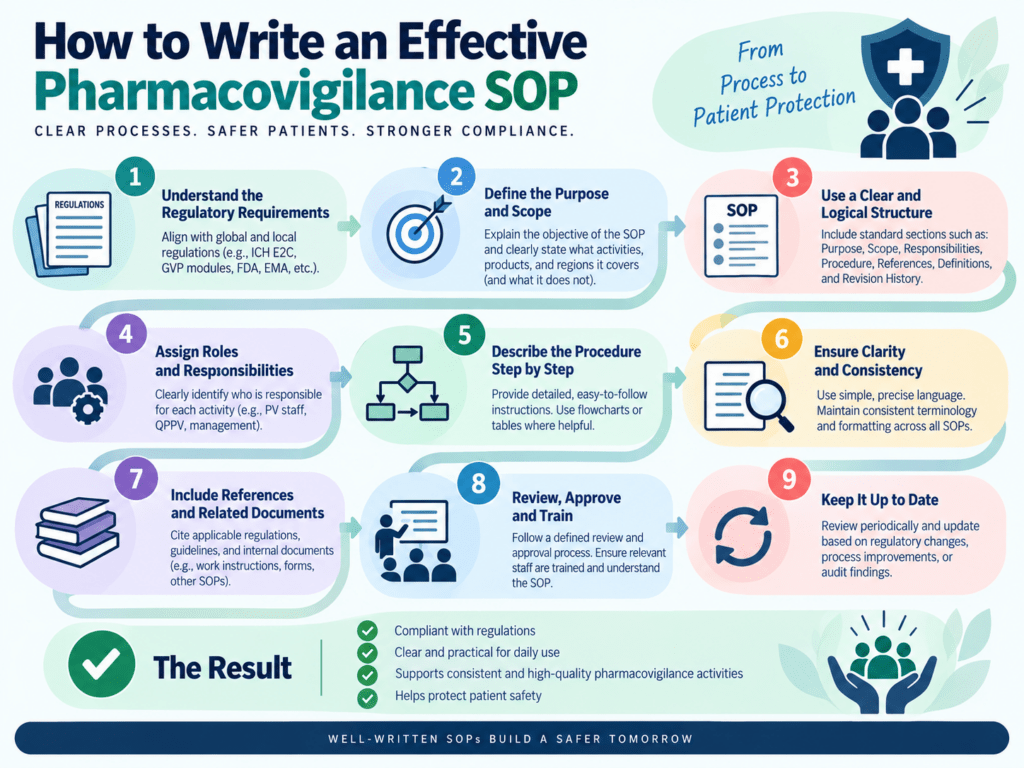
Effective SOP development should begin with the process, not with a blank document template.
- Map the actual PV process-Document how the activity currently works from beginning to end, including handoffs between departments, affiliates, partners and vendors. For ICSR management, this may include intake, validation, duplicate checking, follow-up, coding, medical assessment, quality review, submission and reconciliation.
- Identify applicable regulatory requirements – Determine which jurisdictions, products and regulatory frameworks affect the procedure. A global SOP can provide the common process, while regional annexes or work instructions can address local differences where necessary.
- Define responsibilities and decision points –The procedure should make ownership clear. If a case reaches a call centre on a weekend, if a vendor receives safety information first, or if an eCTD regulatory submission is rejected, the SOP should make it possible to determine what happens next without relying on informal knowledge.
- Build controls into the workflow –Quality should not appear only at final review. The SOP should describe relevant controls such as reconciliation, duplicate management, submission acknowledgements, escalation, deviation management, CAPA, and documentation of unsuccessful follow-up attempts.
- Test the SOP against real scenarios – Before implementation, walk through realistic examples with the people expected to use the procedure.
If trained personnel consistently need verbal explanations to understand what the SOP means, the document probably needs improvement.
Key Principles of Effective Pharmacovigilance SOP Writing
Good Pharmacovigilance SOP best practices can be summarised around clarity, traceability and usability. The language should be specific enough to control the process without becoming a click-by-click description of every system action. Detailed system instructions are often better placed in controlled work instructions. Responsibilities should be unambiguous, especially where PV activities cross departments or organisations.
The procedure should also define how exceptions are handled. Real pharmacovigilance processes do not always follow the ideal workflow. Missing information, system outages, late partner cases, rejected submissions and conflicting data all require controlled responses. Using each document for the right level of detail makes the overall PV quality system easier to update.
Pharmacovigilance SOP Requirements: What Should You Consider?
There is no single universal list of Pharmacovigilance SOP requirements that applies identically in every market. The SOP library should reflect the organisation’s products, authorisations, PV responsibilities, outsourced activities and applicable country requirements.
Several areas deserve particular attention in 2026:
- FDA electronic safety reporting in 2026 – FDA now refers to its safety-reporting database as the FDA Adverse Event Monitoring System (AEMS), formerly FAERS. Since April 1, 2026, certain commercial IND safety reports for serious and unexpected suspected adverse reactions must be submitted electronically to AEMS using E2B(R3). For postmarketing ICSRs submitted via ESG NextGen, FDA currently allows companies that have not transitioned to continue E2B(R2) through September 30, 2026. Beginning October 1, 2026, those postmarketing submissions must use E2B(R3). SOPs covering electronic reporting should therefore accurately reflect the submission standard and route used by the organisation rather than continuing to refer generically to legacy FAERS processes.
- EU GVP developments – EMA published GVP Module III on Pharmacovigilance Inspections, Revision 2, on September 9, 2026, with a legal effective date of September 10, 2026. Organisations operating EU PV systems should review inspection-readiness procedures against the revised module. EMA has also confirmed that GVP guidance is being updated to reflect changes, including Commission Implementing Regulation (EU) 2025/1466 and the recently adopted ICH E2D(R1) and ICH M14 guidelines. In the interim, EMA states that the relevant ICH guidance should be applied where it affects existing GVP guidance. For organisations processing EU ICSRs, the GVP Module VI Addendum II on masking personal data in ICSRs submitted to EudraVigilance should also be reflected in relevant procedures. The addendum became legally effective on July 25, 2025.
- AI and automation – If artificial intelligence or automated tools support case intake, literature screening, coding, duplicate detection, signal activities or quality review, the SOP framework should explain where the technology is used and where human oversight remains necessary. In January 2026, EMA and FDA jointly published ten principles for good AI practice across the medicines lifecycle. They emphasise areas including context of use, risk-based application, data governance, performance assessment, documentation, human-centric design and lifecycle management. This does not mean regulators require a universal standalone “AI SOP.” It means AI-enabled PV processes need appropriate governance within the applicable quality system.
- Regulatory Reporting Timelines –Incorporate reporting timelines carefully, as requirements differ by jurisdiction and report type. For US postmarketing reporting under 21 CFR 314.80, serious and unexpected adverse drug experiences subject to the provision must generally be submitted as soon as possible and no later than 15 calendar days from initial receipt. Follow-up reports are also subject to applicable 15-day requirements. In the EU, MAHs submit serious suspected adverse reactions electronically to EudraVigilance within 15 days and non-serious suspected adverse reactions occurring in the EU within 90 days. India-specific procedures should follow the current CDSCO/NCC-PvPI framework and applicable reporting obligations rather than assuming that US or EU timelines automatically apply.
Are Your Pharmacovigilance SOPs Inspection-Ready?
Identify gaps and strengthen your PV quality system with DDReg Pharma's audit and compliance services, including SOP reviews, GVP assessments, gap analysis, CAPA support, and mock inspections.
Explore PV Audit & Compliance Services →Common Types of Pharmacovigilance SOPs
To ensure full coverage of regulatory and safety requirements, a PV system should include SOPs for:
- ICSR Case Management – Intake, triage, MedDRA/WHODrug coding, narrative writing, follow-ups, and regulatory reporting timelines.
- Electronic Safety Reporting (E2B R3) – Case validation, submission to FAERS/EudraVigilance, acknowledgment handling, and error corrections.
- Signal Management – Detection, validation, prioritisation, assessment, and decision-making aligned with GVP Module IX.
- Aggregate Safety Reporting – Preparation and submission of PBRERs/PSURs under ICH E2C(R2).
- Risk Management Plans (RMPs) – Development and lifecycle management of risk minimisation strategies.
- Literature Monitoring – Weekly database searches, review, and case creation procedures.
- Pharmacovigilance Agreements (PVAs) – Partner responsibilities, reconciliation timelines, and safety data exchange.
- PV Quality Management – Training, deviation handling, CAPA, audits, and inspection management.
- PSMF / PvMF Maintenance – Compilation, updates, and readiness for inspection.
- Data Privacy and Integrity – GDPR compliance, ALCOA+ principles, and personal data masking in case narratives.
- Vendor Oversight — qualification, delegated activities, performance monitoring, reconciliation, deviations, and audit interfaces.
For EU-authorised products, systematic scientific literature review is expected no less frequently than weekly under GVP Module VI, alongside appropriate monitoring of relevant local literature screening in pharmacovigilance. That frequency should not automatically be copied into SOPs for every jurisdiction without assessing the applicable local requirement.
What About a Pharmacovigilance Vendor SOP?
Outsourcing a PV activity does not remove the MAH’s responsibility for its pharmacovigilance system.
Where third parties perform safety activities, a pharmacovigilance vendor SOP or vendor-oversight procedure should describe how vendors are qualified and governed, how responsibilities are documented, how safety information is exchanged and reconciled, and how deviations, changes, performance concerns and access to records are managed.
In the EU, an MAH may subcontract PV activities but retains ultimate responsibility for the pharmacovigilance system, with written agreements expected to define delegated responsibilities.
Common Mistakes to Avoid When Writing PV SOPs
Many SOP weaknesses are not caused by missing regulatory citations. They occur because the document no longer matches the real process.
Common problems include:
- copying a global template without adapting it to the organisation.
- mixing regulatory requirements with internal targets without identifying the difference.
- leaving vendor or affiliate responsibilities unclear.
- using outdated submission-system names or reporting standards.
- hard-coding country requirements into a global procedure without a maintenance mechanism.
- failing to describe deviations, rejected submissions, or contingency processes.
- allowing SOPs, work instructions, agreements, and the PSMF to contradict one another.
- revising an SOP without ensuring affected personnel are appropriately trained.
Timelines to Include in Pharmacovigilance SOPs
Regulatory reporting timelines are critical for compliance. SOPs should explicitly mention:
- US FDA: 15 calendar days for serious and unexpected adverse events; follow-up submissions within 15 days.
- EU EMA: 15 calendar days for serious ICSRs; 90 days for non-serious ICSRs.
- India PvPI: Local reporting requirements aligned to CDSCO guidelines.
Including a timeline table in SOP annexes enhances operational clarity.
| Market | Key regulatory reference | SOP focus |
|---|---|---|
| EU | GVP | PV quality system, ICSR, signal management, aggregate reporting, inspections |
| US | 21 CFR 314.80 | Surveillance, receipt, evaluation and reporting of postmarketing adverse drug experiences |
| India | CDSCO/NCC-PvPI framework | PV system, quality management, PSMF, training, audits and inspections |
Best Practices for Modern Pharmacovigilance SOPs
To meet global expectations, SOPs should:
- Define “Day 0” for each source of safety data.
- Integrate data privacy and de-identification requirements for narratives and attachments.
- Document literature monitoring methods, including zero-result searches.
- Include AI/automation governance where machine learning tools are used.
- Maintain regional annexes to address country-specific requirements without altering the core SOP.
Quality Metrics to Monitor
Effective PV quality systems should monitor whether key processes are working as intended. Useful measures may include timely expedited reporting, electronic-submission rejection rates, case completeness, coding quality, aggregate-report timeliness, signal-management performance, reconciliation outcomes and CAPA effectiveness.
- Timely expedited reporting (≥98% compliance).
- Low E2B(R3) rejection rates.
- Narrative completeness and MedDRA coding accuracy.
- Signal management cycle times from detection to decision.
- On-time aggregate report submissions.
- CAPA effectiveness reviews.
Tracking these metrics supports proactive compliance and continuous improvement.
Maintaining Up-to-Date Pharmacovigilance SOPs
Regulators expect SOPs to reflect the most current guidance. Organizations should:
- Conduct quarterly regulatory intelligence reviews for EMA, FDA, ICH, and PvPI updates.
- Apply version control with clear major and minor revision tracking.
- Run mock inspections to validate operational alignment.
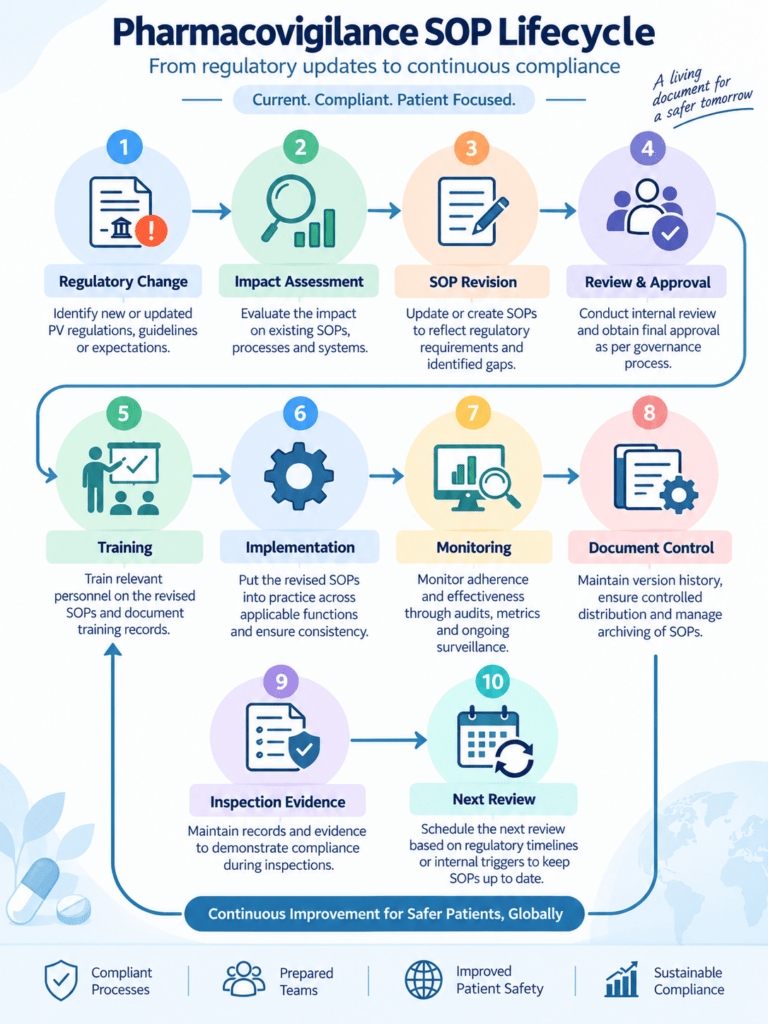
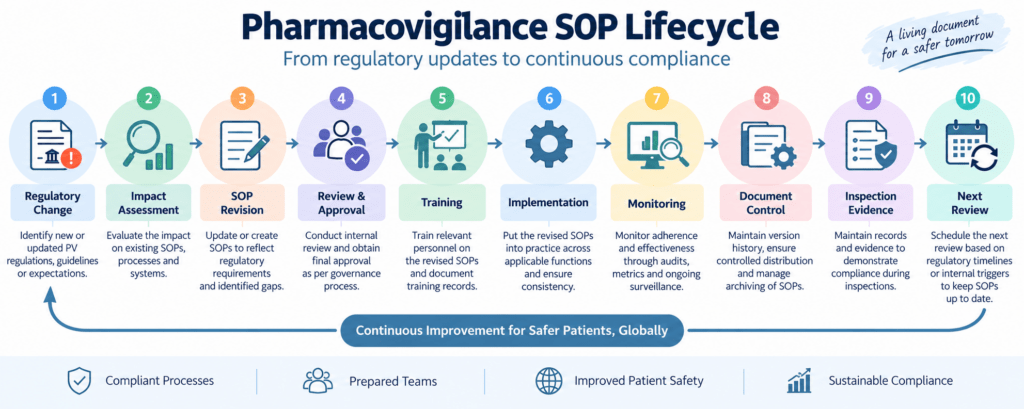
Continuous maintenance ensures SOPs.A stronger approach is to establish a documented review cycle combined with event-driven revision whenever a material change affects the procedure. Version control, change history, effective dates, training records and superseded-document management should make it possible to understand which procedure applied at any point in time. Remain aligned with global expectations.
How DDReg Can Help
DDReg supports pharmaceutical and biotechnology companies in developing and maintaining practical, inspection-ready pharmacovigilance SOPs. Support can include SOP drafting, gap assessment, PV quality-system alignment, vendor and partner procedures, regulatory intelligence, inspection readiness and updates required as global pharmacovigilance solution expectations evolve.
The objective is not simply to produce more SOPs. It is to create procedures that regulatory affairs services provider teams, PV professionals and external partners can consistently follow in real operations.
Conclusion
Pharmacovigilance SOPs are the operational backbone of safety compliance. They establish clarity, consistency, and accountability in every process, from case intake to aggregate reporting. By embedding regulatory timelines, masking requirements, data standards, and quality controls into SOPs, organizations can build a pharmacovigilance system that is both inspection-ready and patient-centric.
In 2026, SOP maintenance also needs to account for changing electronic-reporting standards, evolving GVP guidance, and the growing use of AI and automation in safety operations. The strongest Pharmacovigilance SOP writing approach therefore combines current regulatory requirements with practical workflows, clear ownership, appropriate quality controls and disciplined change management. An SOP is inspection-ready only when the document and the real process tell the same story.
Frequently Asked Questions
Pharmacovigilance SOPs are controlled procedures that explain how an organisation performs specific drug-safety activities consistently and in line with applicable regulatory requirements. They typically cover areas such as adverse-event processing, safety reporting, signal management, literature monitoring, aggregate reports, risk management, quality activities and vendor oversight.
A good SOP for pharmacovigilance should clearly define its purpose, scope, responsibilities, workflow, timelines, decision points, systems used, quality controls, records and applicable regulatory references. Supporting templates, forms or flowcharts can be included where they make the process easier to follow. The document should describe how the process actually operates rather than simply restating regulatory guidance.
Responsibility depends on the organisation's PV quality system. Process owners normally draft and maintain relevant procedures, while quality and pharmacovigilance leadership provide appropriate review and approval. For an MAH, outsourcing activities does not remove responsibility for having an effective pharmacovigilance system. In the EU, the MAH remains responsible for operating its PV system even when activities are delegated to third parties.
A pharmacovigilance vendor SOP or vendor-oversight procedure describes how outsourced PV activities are controlled. It may address vendor qualification, responsibilities, safety-data exchange, reconciliation, performance monitoring, deviations, change management, audit support and access to records. Regulators do not prescribe one universally named “vendor SOP,” but written procedures and agreements should make delegated responsibilities clear and ensure that the MAH can maintain appropriate oversight.
An SOP explains what must be done, by whom and under what controls. A work instruction generally provides more detailed guidance on how a specific task is performed. For example, an ICSR SOP may define the overall case-processing workflow, while a work instruction may explain how a processor performs duplicate checks or enters data into the safety database. Keeping these levels separate makes procedures easier to maintain when systems or operational details change.
Organisations submitting safety reports to FDA need to ensure that relevant electronic-reporting procedures reflect current E2B(R3) requirements and the FDA's AEMS, formerly FAERS environment. For applicable commercial IND safety reports, mandatory E2B(R3) submission began on April 1, 2026. FDA's transition for applicable postmarketing ICSRs through ESG NextGen reaches mandatory E2B(R3) use on October 1, 2026. SOPs should therefore accurately reflect the submission route and technical standard used by the organisation.