

For a foreign medical device manufacturer, entering Kenya is not simply a matter of obtaining product approval and arranging the first shipment. The regulatory pathway extends beyond the device itself to include local representation, import controls, technical documentation, quality systems, labelling, post-market responsibilities and ongoing regulatory maintenance.
Kenya’s Pharmacy and Poisons Board (PPB) regulates medical devices and In vitro diagnostic medical devices (IVDs) under the national health-products framework. The current framework is based on the Pharmacy and Poisons Act, the Pharmacy and Poisons (Registration of Health Products and Technologies) Rules, 2022, and PPB guidance for medical-device registration and related activities. PPB has also introduced reliance-based approaches that can support more efficient assessment where the applicable eligibility conditions are met.
The Kenyan framework requires a local representative for foreign applicants, while PPB’s medical-device guidance gives that representative responsibilities extending into technical documentation, vigilance, field safety corrective actions, supply-chain compliance and regulatory communications.
How are Medical Devices Regulated in Kenya?
The Pharmacy and Poisons Board (PPB) is Kenya’s national regulatory authority responsible for regulating medical devices and IVDs, alongside other health products and technologies. PPB evaluates medical-device applications based on risk classification and reviews areas such as safety, performance, technical documentation, manufacturing information, labelling and supporting evidence.
The main regulatory foundation includes:
- The Pharmacy and Poisons Act, Cap. 244
- The Pharmacy and Poisons (Registration of Health Products and Technologies) Rules, 2022
- PPB’s Guidelines for Registration of Medical Devices Including In-Vitro Diagnostics
- PPB procedures covering medical-device evaluation and registration
- PPB requirements for establishment registration, import/export controls, change notifications and post-market surveillance report
- Current reliance mechanisms that may be applicable to eligible medical devices and IVDs
PPB currently classifies medical devices into Class A, B, C and D, with risk increasing from Class A to Class D. Classification is based on factors including intended purpose, intended users, invasiveness, duration of contact, whether the device delivers energy or medicinal products, and other risk characteristics. Where more than one classification rule applies, the higher applicable class is used. This risk-based approach means that the regulatory pathway and evidence expected for a low-risk device can differ substantially from those required for a higher-risk or more complex product.
What Does Medical Device Registration in Kenya Involve?
Medical device registration in Kenya involves the submission and regulatory assessment of information demonstrating that the device meets applicable safety and performance requirements.
The precise submission package depends on the device class and the evaluation route. For Class A devices, PPB provides a listing pathway with a defined set of administrative, labelling and supporting documents. Higher-risk Class B, C and D devices generally require substantially more technical information, including the Common Submission Dossier Template (CSDT), essential-principles documentation, device description, design verification and validation information, risk analysis, manufacturing information, clinical evidence, labelling and proof of quality management.
PPB’s current procedures also provide for standard and reliance/fast-track approaches where applicable. Its 2025 reliance guideline applies to medical devices and IVDs and allows PPB, where the relevant conditions are satisfied, to use prior assessments or regulatory decisions from recognised reference authorities while retaining responsibility for the Kenyan regulatory decision.
What Do Foreign Medical Device Manufacturers Need Beyond Product Registration?
A manufacturer may have a technically strong global dossier submission but still lack the Kenyan infrastructure required to keep the product compliant once it reaches the market.
A foreign manufacturer should plan for at least six interconnected areas:
- Local regulatory representation – A Kenyan local representative must be identified for a foreign applicant.
- Product registration – The device must follow the applicable PPB registration or listing route.
- Import and trade controls – Registration does not remove the need to comply with import-permit requirements.
- Establishment responsibilities – Relevant local entities involved in importing, distributing or trading medical devices may have establishment licensing or registration obligations.
- Post-market oversight – Vigilance, incident reporting, recalls and field safety corrective actions must be managed after market entry.
- Lifecycle maintenance – Changes to the registered device, labelling services, intended use, manufacturing information or other approved details may require notification or prior regulatory approval.
Does a Foreign Manufacturer Need a Local Representative in Kenya?
Yes. A foreign applicant must appoint a local representative in Kenya under the national registration framework. The PPB medical-device guideline refers to this representative as a Local Authorized Representative (LAR) and states that the requirement is mandatory before registration approval is granted. The PPB system also uses the term Local Technical Representative (LTR) for medical-device representatives.
Only one local representative should normally be identified for a device, and the representative should remain consistent across the device labelling and Declaration of Conformity. The PPB guideline also states that LARs are registered by the Board and that Local Technical Representatives must obtain the relevant licence to trade in medical devices and IVDs.
The PPB guideline assigns the representative responsibilities that can include:
- Regulatory Liaison – Act as the primary contact with PPB and manage regulatory communications.
- Technical & Compliance Support – Maintain technical documentation and support ongoing compliance reviews.
- Vigilance & Safety – Support incident reporting, safety monitoring and field safety corrective actions.
- Lifecycle & Supply-Chain Oversight – Manage changes, regulatory updates and relevant supply-chain responsibilities.
For foreign manufacturers, selecting the local representative should therefore be treated as a strategic regulatory decision, not simply a local administrative requirement.
Kenya Medical Device Registration Requirements for Foreign Manufacturers
The Kenya medical device registration requirements for foreign manufacturers cover the product, manufacturer, local representative, technical documentation and supporting regulatory evidence. Requirements vary by device classification and registration pathway, so the submission should be tailored accordingly.
Depending on the device and pathway, the manufacturer should be prepared to provide:
| Regulatory Area | Key Information |
|---|---|
| Applicant & Device | Manufacturer, LAR/LTR, device details & classification |
| Regulatory & Technical | Regulatory history, CSDT & technical documentation |
| Safety, Risk & Clinical | Essential Principles, conformity, risk & clinical evidence |
| Manufacturing & Labelling | Manufacturing site, QMS, labels & IFU |
| Post-Market | PMS & PMCF, where applicable |
Medical Device Classification in Kenya
Classification is determined by the manufacturer based on intended use and the applicable classification rules. Factors include invasiveness, duration of contact, active versus non-active operation, delivery of medicinal products or energy, biological effects and other special characteristics. If multiple rules apply, the highest resulting classification is used.
IVDs are also classified from Class A through Class D, but their classification considers factors such as intended use, the expertise of the intended user, the importance of the information generated and the potential impact of an incorrect result on the individual and public health. Classification should be completed early because it can influence the evidence package, assessment route, fees, regulatory scrutiny and overall launch strategy.
Kenya uses a four-level risk classification system:
| Class | General Risk Level | Examples |
|---|---|---|
| Class A | Low | Cotton wool, bandages, urine collection bottles and certain non-invasive devices |
| Class B | Low to moderate | Certain urinary catheters and tracheal tubes |
| Class C | Moderate to high | Certain long-term contact lenses and urethral stents |
| Class D | High | Pacemakers, implantable defibrillators and certain cardiovascular implants |
What Documents Are Required for Medical Device Registration in Kenya?
A foreign manufacturer should not assume that an existing US FDA, EU, UK or other international submission can simply be uploaded without modification. Existing regulatory evidence can be valuable, particularly where reliance mechanisms are available, but the Kenyan submission still needs to satisfy the applicable national requirements. The documentation required depends on the risk class and registration route.
For Class A devices, applicable supporting documentation may include:
- Regulatory: Authorization, conformity & country-of-origin approval
- Labelling: Labels, IFU & User Information
- Quality: QMS, sterilization & product testing
- Supporting: Certificates and promotional materials, where applicable
Kenya Medical Device Import Requirements
Under Kenya’s trade framework, importation of new medical devices requires the importer to have the relevant PPB medical-device registration certificate, and PPB issues an import permit for each consignment. These permits are processed through the Kenya National Trade Net System. The Kenya Trade Information Portal identifies the medical-device registration certificate, certificate of incorporation and invoice among the required documents for the permit process.
For a foreign manufacturer, this means the market-entry plan needs to define:
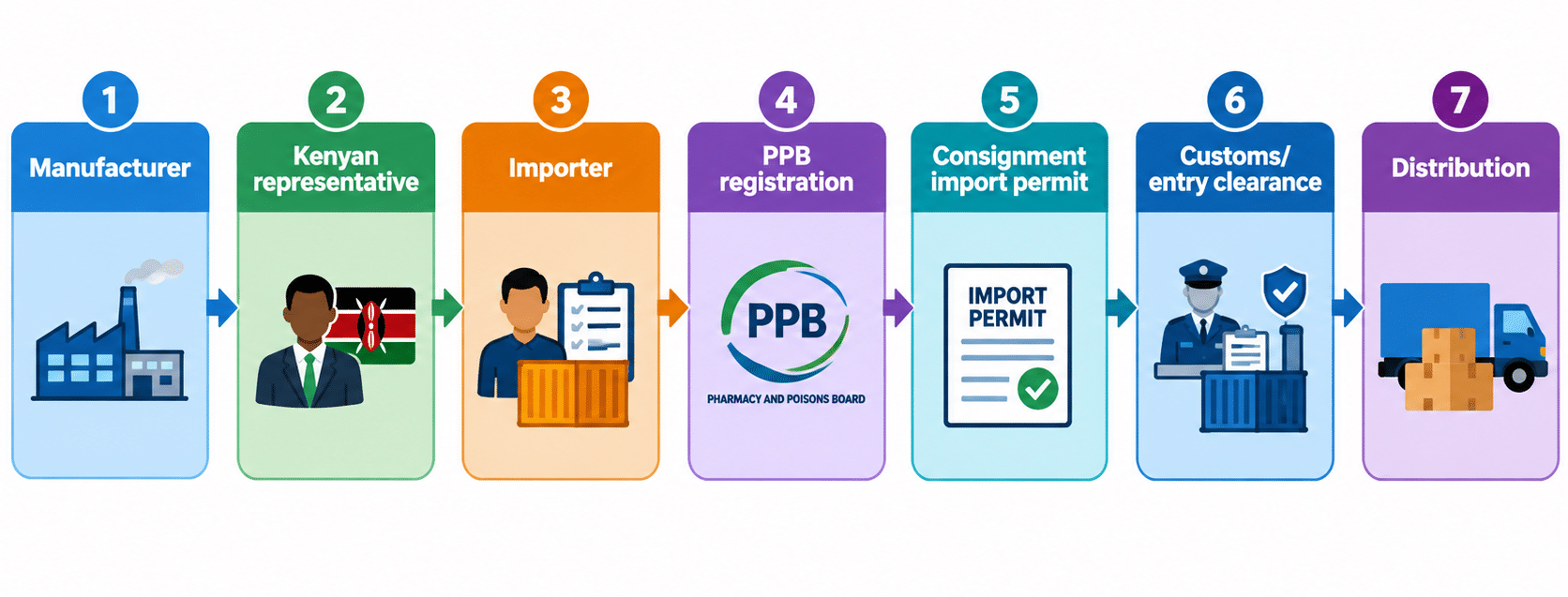
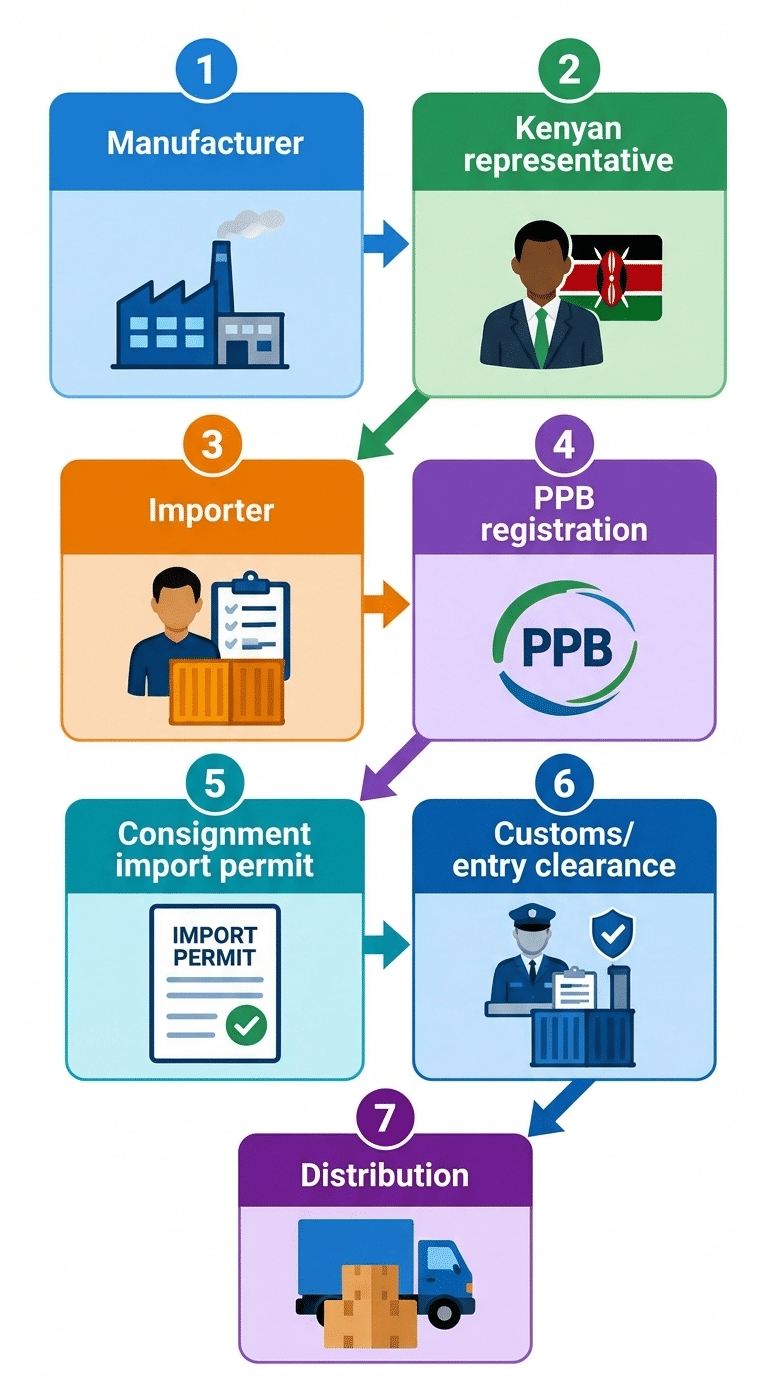
The entity responsible for importing should therefore be identified early rather than after product registration has been completed. Manufacturers should also distinguish between the product’s PPB registration and the licensing or registration requirements applicable to the Kenyan establishment involved in importing, distributing or trading medical devices.
Labeling Requirements for Medical Devices in Kenya
Labelling should be aligned with the information submitted to PPB and the approved intended use of the device.
The PPB guideline requires appropriate identification of the manufacturer or relevant business entity and provides specific labelling requirements for medical devices and IVDs. For IVDs, the information can include device identification, product name, intended use, warnings and precautions, manufacturer/packer/distributor or representative information and traceability information such as lot or control numbers.
The registration guideline states that legible versions of applicable label levels should be submitted and that labelling information may be provided in English for the registration dossier, with translation items and the translation plan indicated where applicable. For foreign manufacturers, the practical priority is consistency. The device name, manufacturer information, representative details, intended purpose, warnings, model information and other critical statements should remain aligned across:
- PPB submission documents
- Device labels
- IFU
- Declaration of Conformity
- Technical documentation
- Commercial materials
Quality Management and Manufacturing Requirements
PPB’s medical-device establishment guidance identifies ISO 13485:2016 as a widely accepted basis for an appropriate quality management system for medical-device establishments. The guidance expects an establishment to have a QMS supporting continued safety, quality and performance throughout the product lifecycle and supply chain.
For product registration, proof of QMS may include ISO 13485 certification or other forms of evidence recognised under the applicable pathway. For higher-risk devices, QMS evidence forms part of the submission package. Manufacturers should therefore ensure that the technical dossier, manufacturing process, quality-system evidence and actual production arrangements tell the same story.
This is particularly important when the global manufacturer has multiple manufacturing sites, contract manufacturers, sterilization facilities or critical suppliers. The Kenyan dossier should clearly identify the relevant manufacturing arrangements and ensure that changes to those arrangements are assessed for their regulatory impact.
Clinical and Safety Evidence for Medical Devices in Kenya
Clinical evidence is not simply a formality in Kenya. PPB’s medical-device guideline states that clinical evaluations are required for all medical devices. The extent and type of supporting clinical evidence depend on the device, its intended use, risk profile and available evidence.
Where a pre-market clinical investigation has been conducted, supporting documentation may include the clinical investigation protocol, relevant regulatory and ethics approvals, final study reports and evidence addressing the applicable safety and performance endpoints.
Where clinical evaluation relies on equivalence to another device, the manufacturer should provide a reasoned justification addressing relevant technical, biological and clinical differences. Representative clinical data should also cover the applicable indications and variants. This does not mean that every foreign manufacturer must automatically conduct a new clinical trial in Kenya. The more important issue is whether the available clinical evidence adequately supports the device’s intended purpose, safety, performance and claims under the applicable Kenyan requirements. The dossier should also address risk management plan, biological safety, sterilization and other verification or validation evidence where relevant to the device.
Post-Market Requirements After Medical Device Registration
Obtaining medical device approval Kenya is only the start of ongoing compliance. Manufacturers and their Kenyan representatives must continue to manage vigilance, complaints, safety actions, recalls, changes and technical-file updates after market entry.
PPB also requires annual retention of registered medical devices and IVDs to maintain market-authorisation status. Registration certificates are generally valid for five years, subject to applicable PPB requirements. Changes to the device, intended use, classification, manufacturing or other registered information should be assessed before implementation, as PPB may require notification, prior approval or a new submission depending on the change.
The key principle: registration enables market entry; ongoing regulatory maintenance keeps the device compliant.
Step-by-Step Medical Device Market Entry Strategy for Kenya
A practical Kenya medical device market entry strategy should connect regulatory, commercial and operational decisions rather than treating registration as an isolated activity.
- Define Scope & Classification
Confirm device status, intended use, classification and applicable requirements. - Select Pathway & Local Representative
Choose the appropriate PPB pathway and appoint a qualified Kenyan LAR/LTR. - Assess Gaps & Prepare the Dossier
Compare the global dossier with Kenyan requirements and address technical, clinical, QMS, labelling and regulatory gaps. - Submit & Prepare for Import
Submit to PPB, manage queries, and align importer, establishment and import-permit requirements. - Maintain Market Compliance
Manage retention, vigilance, changes, recalls and ongoing technical-file requirements.
Common Mistakes Foreign Medical Device Manufacturers Make in Kenya
Several issues repeatedly create unnecessary regulatory friction for international manufacturers.
- Treating registration as market entry — Registration does not replace local representation, import controls or post-market obligations.
- Choosing a representative only for submission — The LAR/LTR must support ongoing regulatory responsibilities.
- Submitting a global dossier unchanged — Conduct a Kenya-specific gap assessment against PPB requirements.
- Underestimating classification — Classification affects the evidence, pathway and regulatory review.
- Inconsistent documentation and labelling — Keep device, manufacturer, intended-use and representative details aligned.
- Ignoring retention and change control — Plan annual retention and regulatory changes from the start.
- Separating registration from import planning — Align import permits and importer responsibilities before launch.
Kenya Medical Device Registration Checklist for Foreign Manufacturers
A practical Kenya medical device registration readiness check can be organised into four areas:
| Area | Readiness Check |
|---|---|
| Regulatory | Device definition, classification, applicable PPB pathway and local representative confirmed |
| Technical | CSDT/technical file, risk management, clinical evidence, verification/validation and QMS evidence ready |
| Commercial & Import | Kenyan importer/establishment responsibilities, registration certificate and consignment import-permit process aligned |
| Lifecycle | Annual retention, vigilance, complaint handling, FSCA/recall, change notification and technical-file maintenance established |
Before submission, manufacturers should also confirm that the device information, labels, IFU, Declaration of Conformity, manufacturing information and local representative details are consistent. A strong Kenya medical device registration strategy therefore ends with more than a complete dossier. It ends with a regulatory operating model that can support the device after approval.
How DDReg Supports Medical Device Market Entry in Kenya
DDReg supports medical-device market access across global markets, including Africa, with capabilities spanning product registration, regulatory strategy services, legal/in-country representation and distributor identification.
For Kenya-focused projects, support can be structured around the manufacturer’s specific needs, including:
- Regulatory Strategy & Classification – Pathway, classification and Kenya-specific gap assessment
- Registration & Dossier Support – Medical Devices Technical documentation, submission and product registration
- Local Representation & Compliance – Local representative, labelling and regulatory compliance
- Market Entry & Lifecycle Support – Import planning, post-approval changes and post-approval life cycle management
- Regional Regulatory Coordination – Regulatory intelligence and support across African markets
Conclusion
For foreign manufacturers, Kenya medical device market entry should be planned as a lifecycle regulatory programme rather than a one-time product registration exercise.
The Kenyan framework combines risk-based device classification and technical evaluation with local representation, import controls, quality-system expectations, clinical and safety evidence, post-market surveillance, annual retention and change management.
For manufacturers planning expansion into the country, the strongest approach is to begin with the full operating model: classify the device correctly, understand the applicable PPB pathway, appoint an appropriate local representative, prepare a Kenya-specific evidence package, align import responsibilities and establish the processes needed to maintain compliance after launch.
Frequently Asked Questions
It involves submitting the applicable administrative, technical, safety, performance, clinical, manufacturing and labelling information to PPB according to the device's risk class and regulatory pathway. Foreign applicants must also appoint an appropriate local representative in Kenya.
Yes. Kenya's registration rules require a foreign applicant to appoint a local representative, and PPB's medical-device guidance makes local representation a mandatory element before registration approval. The representative also has ongoing responsibilities relating to regulatory communication, vigilance, technical documentation and field safety actions.
Registration is necessary, but importation involves additional requirements. Kenya's trade framework provides for a PPB import permit for each consignment of new medical devices, processed through the Kenya National TradeNet System. The importer also needs to satisfy the applicable establishment and import requirements.
The timeframe depends on the device classification, assessment route, completeness of the submission and PPB review process. PPB states that its target processing timelines begin from receipt of the application and exclude periods when the application is stopped for clarification or additional information. The authority also notes that the stated timelines are guidance rather than a guarantee of regulatory approval. Reliance or other facilitated pathways may be available for eligible products.