

The FDA’s Quantitative Systems Pharmacology (QSP) Guidance helps drug developers make safer first-in-human (FIH) dosing decisions for complex biologics. By integrating computational modeling, pharmacology, and systems biology, QSP improves dose selection, reduces clinical risk, and supports Model-Informed Drug Development (MIDD).
Biologic therapy development is a complex combination of science and regulatory concerns. Biologics revolutionized therapeutic options, including cancer and autoimmune disease management.
Nevertheless, the introduction of novel biologics to clinical trials requires meticulous planning, particularly with respect to the first dose in humans.
The first-in-human (FIH) study is a critical milestone in the drug development cycle. It generates the first data on the novel therapeutic’s behavior in humans; however, it carries a substantial degree of uncertainty, particularly for high-risk biologics where minor variations in biological response could induce serious safety liabilities.
The U.S. Food and Drug Administration (FDA) encourages the Center for Drug Evaluation and Research (CDER) to utilize innovative modeling techniques, including Quantitative Systems Pharmacology (QSP), to promote better and safer decision-making.
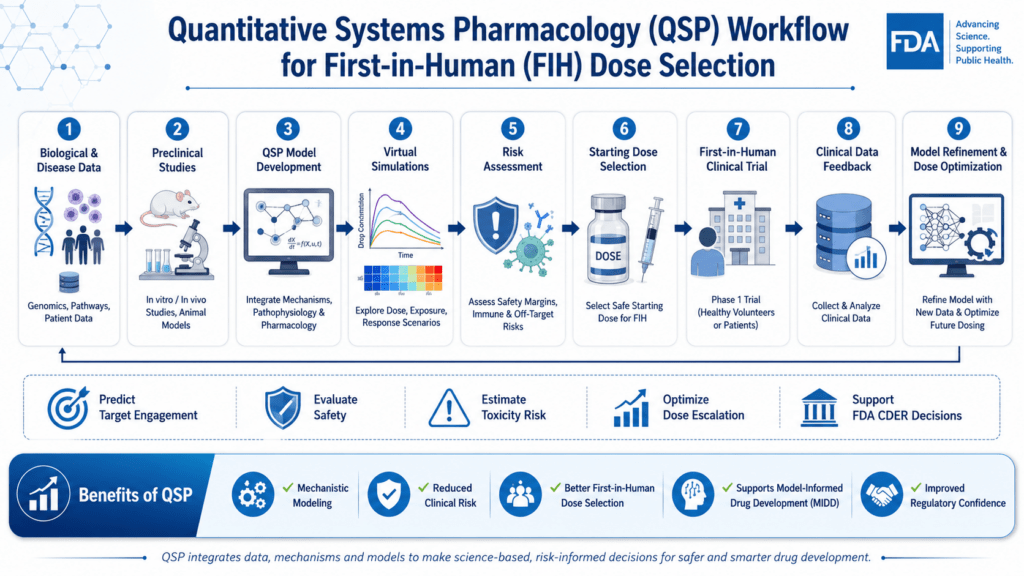
QSP is a powerful tool to mitigate the routine cycle of trial and error, deepening the knowledge of a drug’s complex biological system. It is even possible to predict before human trials the safety, the dose, and the therapeutic effects to a much greater degree than before.
What Is the FDA QSP Guidance for CDER?
“QSP” describes “Quantitative Systems Pharmacology”, and the FDA QSP Guidance describes the systematic creation of quality systems and managed processes within an organization that fulfills the safety, quality, and regulatory approval demands of the marketplace.
In the life sciences and pharmaceutical industries, FDA QSP-related guidance encourages industries to elevate quality management systems (QMS) throughout the entire product lifecycle, including development, manufacturing, testing, and post-market activities.
Key Principles of FDA QSP Guidance for CDER
Quality Management Systems (QMS) – Frameworks to produce uniformly high-quality products.
Risk Management – Quality risk management and assessment.
Process Controls – Manufacturing process reliability and control of business process activities.
Documentation & Data Integrity – Quality records and documented evidence of quality.
Regulatory Compliance – Quality product and service requirements set by the FDA and Good Manufacturing Practices (GMP).
What is Quantitative Systems Pharmacology (QSP)?
QSP integrates the disciplines of mathematics, biology, and pharmacology; and offers a data-rich and predictive framework of a drug’s behavior within the human body.
In essence, QSP offers a relatively safe and controlled virtual testing environment and permits the simulation of various drug behavior prior to the initiation of clinical testing.
QSP provides a systems-level view of biology beyond just drug concentration and response; for example:
- The drug and target interaction
- Cell response to the drug
- Modulation and response of various pathways of the immune system
- The progression of the disease state
- The safety and efficacy of various dosing paradigms
For the more sophisticated and complex biologics, the unpredictable nature of the system may benefit from the FDA QSP guidance for CDER where other methodologies may be of limited value.
Why First-in-Human Dose Selection Is Critical for High-Risk Biologics
The selection of the first dose for a first-in-human trial ultimately comes down to the balancing the risk versus the reward of selecting a dose that is low but provides the opportunity to learn about the drug’s behavior versus a dose that is high and may pose significant risk to the study subjects.
This is especially challenging when designing a trial of high-risk biologics that include:
- Therapies that are intended to modify immune system activity
- Therapies that contain two binding sites (dual-specific in nature)
- Therapies that contain cytokines
- T-cell Engaging Therapies
- Innovative Biological Molecules with Distinct Mechanisms of Action
Flowing from the nature of biologics, insight into their mechanisms of action may require the consideration of multiple biological systems.
Because biologics are large proteins, altering the dosage may render unexpected adverse effect (AE) profiles, as some biologics may elicit autoimmunity when dosed incorrectly.
Why First-in-Human Dose Selection Is Critical for High-Risk Biologics
Traditionally, the selection of the first-in-human dosage relied heavily on the results of preclinical studies, some of which are animal studies, as well as the evaluation of:
- The No Observed Adverse Effect Level (NOAEL)
- The Minimum Anticipated Biological Effect Level (MABEL)
While they still have their place, they may not adequately describe the behaviour of a biologic in humans. For example, due to the nature of biology, perhaps a given animal model may not perfectly predict the immune response in humans.
This is where Quantitative Systems Pharmacology (QSP) offers a unique advantage, as it provides the means to experimentally relate drug concentration with the biological response it elicits, thus providing insight into associated risk concerns.
How Quantitative Systems Pharmacology (QSP) Facilitates Assured First-in-Human Dosage Selection
1. Predicting the Ideal Starting Dosage
Due to it unique modeling capabilities, before the first human trial is even started, QSP is able to simulate a plethora of therapeutic dosage selection scenarios.
With QSP, companies will be able to assess:
- The anticipated biological activity
- The level of target engagement
- The risk of potential toxicity
- The anticipated dosage response
Thus, a company will be able to select a “better” starting dosage, as it will be based off of documented science, as opposed to extrapolated historic data.
2. Assessing the Risks of High Biological Complexity
The greatest risk with a given biologic is that the therapeutic may evoke a high complexity response, particularly with biologics that modulate the immune system.
QSP allows researchers to assess:
- The likelihood of target engagement
- The potential risk of eliciting an immune response
- The dosage that would evoke the desired biological response
What are some variabilities in response to treatment these patient populations may have?
Providing answers to these questions at the development stage will enable safer and more effective clinical trials to be conducted.
3. Aiding Safer Designs of Clinical Trials
QSP will also be able to assist with the design of the following clinical trial elements:
- Plans for dose escalation
- Strategies for patient selection
- Strategies for the monitoring of biomarkers
- Evaluating safety
This is of particular importance for the development of substances that will elicit unpredicted responses in the trial participants during the first human trials of the study.
FDA CDER and the Importance of QSP in Drug Development
The FDA CDER recognizes the importance that Model-Informed Drug Development (MIDD) approaches have on the strengthening of regulatory decisions that are made, in particular the approach of QSP.
For sponsors of complex biologics, the FDA QSP guidance for CDER will offer additional scientific rationale during regulatory affairs consultations for:
- Investigation New Drug applications
- First-in-human studies
- Dose justification
- Clinical development
The integration of QSP will demonstrate that the study of dose selections is grounded in the understanding of the biological rationales.
Best Practices for Building a Robust QSP Model
Creating a successful pathway through the maze of the US regulatory system requires an understanding of the fluid interactions of FDA regulations, QSP compliance, and the varied regulatory systems that govern the different healthcare offerings. DDReg has the most complete service for US Regulatory Affairs to assist pharmaceutical, biotech, medical device, and healthcare companies in the development, registration, and marketing of their offerings in the US healthcare system.
Utilizing the combined wealth of regulatory knowledge and FDA experience, DDReg offers the widest possible support for companies throughout the lifecycle of their offerings. This includes the earliest phases of the development and strategy formation, regulatory compliance, and all post-marketing services.
Our US regulatory solutions offer services that will help companies to mitigate regulatory hurdles to shorten the time to market while also keeping the focus on achieving the regulatory expectations for the FDA.
Formulating a substantial QSP model extends beyond simply performing calculations. It is essential to accurately depict aspects of biological reality.
Key components involve:
- Excellent Knowledge of Biology
- Incorporation of Various Types of Data
- Model Validation and Qualification
Scientific quality of models is contingent on a well-founded model. It is the responsibility of the company to substantiate the reliability and proper construction of their model.
Obstacles to the Adoption of QSP
Despite the various advantages of QSP, the main impediment to model creation and application is the level of specialization required to build and use the model.
Some of the more common issues are:
- Insufficient amounts of biological data
- Difficulty of model construction
- Diversity of skills and knowledge required
- Continuously changing model requirements
- Difficult to interpret regulatory model requirements
Effective QSP requires the integration of many disciplines and the collaboration of scientists, clinicians, pharmacologists and those with data and regulatory expertise.
What DDReg Can Provide to Clients to Alleviate the Burden of QSP and Biologics Related Regulatory Issues
Innovative biologics pose new challenges for client companies in meeting regulatory requirements. DDReg closes this regulatory gap by offering its expertise in regulatory affairs throughout the entire development of drugs and biologics.
- Regulatory Strategy and Drug Development Planning
- Model-Informed Drug Development
- Support for Drug Development Submissions
- Biologics Regulatory Affairs
- Regulatory Knowledge
DDReg’s clients benefit from regulatory affairs consulting and intelligent services by gaining the ability to anticipate the evolving regulatory landscape and developing novel biologics of the highest calibre.
Conclusion
Innovative biologics can carry a very high risk related to their potential. The dosage for the first human trial can be very challenging to determine and requires a great deal of care beyond traditional methods.
Quantitative Systems Pharmacology (QSP) enhances elucidation of biological intricacies and assists with rational drug design and progressive clinical intervention. The adoption of QSP and similar techniques will aid pharmaceutical companies as regulatory bodies bolster science-based guidance.
Through regulatory strategy, biologic development, and model-informed approaches, DDReg enables companies to devise robust strategies for global drug development and navigate complicated regulatory systems.
Frequently Asked Questions (FAQs)
Quantitative Systems Pharmacology (QSP) is an interdisciplinary modeling methodology employing biology, pharmacology, and math-based modeling to demystify a drug’s behavior in a biological system. QSP elucidates the mechanisms, the safety and therapeutic ranges of potential responses, and serves as a decision support system throughout the clinical development process.
QSP is vital in aiding dosing decisions for difficult biologics. When the mechanism is complex and the risk is high, QSP assists researchers in anticipating biological behavior to inform the selection of the safest starting dose by considering the preclinical data, the pharmacology, and the biology of the disease.
Unlike PK/PD models, which focus specifically on drug concentrations and the effects observed, QSP incorporates pathways of disease and mechanisms of drug interaction with targets in addition to the cellular biology to inform a holistic view of how a therapy functions within a system.