
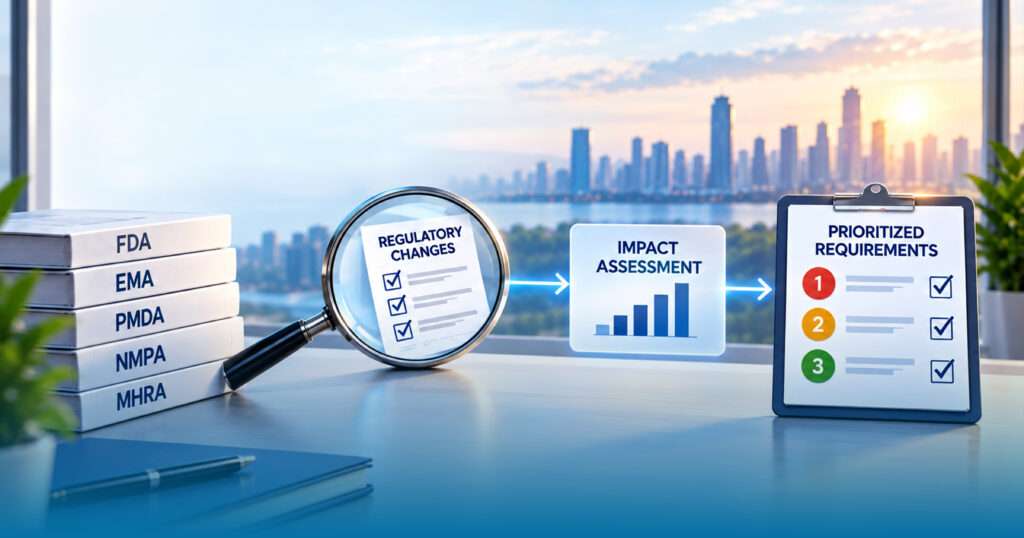
Regulatory teams do not usually struggle because they lack regulatory updates.
For global pharmaceutical teams, a single regulatory update can affect manufacturing processes, product dossiers, labeling, pharmacovigilance activities, submission requirements, or post-approval commitments. Yet its impact may be very different from one product or market to another. It provides a structured way to determine which regulatory changes are relevant, which products and markets are affected, how significant the compliance risk is, and what actions should be prioritized.
In practical terms, regulatory change impact assessment in pharma connects a regulatory change with the affected product, market, regulatory status, compliance gap, required action, owner, and implementation timeline. Rather than treating every regulatory update with the same urgency, global teams can use this approach to focus resources where regulatory risk and implementation requirements are greatest.
What is Regulatory Change Impact Assessment?
Regulatory Change Impact Assessment is a structured process for evaluating how a new or revised regulation, guideline, health authority expectation, technical standard, or procedural requirement may affect an organization’s pharmaceutical products, registrations, dossier submission, processes, systems, and regulatory commitments.
The outcome should be clear enough to classify the change as no immediate impact, monitor, action required, or escalation required. That is what turns regulatory intelligence into effective regulatory change management in pharma.
Why Regulatory Change Impact Assessment Matters for Global Pharma
The challenge becomes greater as the number of products, registrations, manufacturing sites, and jurisdictions increases.
A pharmaceutical company may use the same manufacturing process, control strategy, API source, Module 3 content, safety information, or labeling elements across several registrations. However, the regulatory requirements for pharmaceutical products are not always implemented through the same procedure or timeline in every jurisdiction.
For example, post-approval changes in the United States are managed according to applicable US-FDA regulations and guidance, with reporting requirements depending on the nature and potential impact of the change. ICH Q12 provides a framework intended to make post-approval CMC lifecycle management more predictable and efficient, but implementation still operates within regional regulatory frameworks.
The European Union provides a current example of why structured regulatory monitoring and impact assessment matter. The revised EU Variations Regulation has applied since 1 January 2025, while the revised Variations Guidelines became applicable on 15 January 2026, affecting how Marketing Authorisation Holders manage relevant variation classifications, procedures, documentation, and submissions.
How to Prioritize Regulatory Changes by Product, Market, Risk and Deadline
The most useful unit of assessment is usually not the regulation alone, it is Regulatory Change, Product and Market altogether. Consider a new regulatory requirement affecting a manufacturing process. The same change might be critical for a marketed product in a jurisdiction where compliance is required within a defined deadline; high priority for another product with a pending variation; medium priority for a development program where future dossier content must be updated; or not applicable to a product outside the scope of the requirement. This prevents global teams from assigning the same priority to every product simply because the source regulatory change is important.
Key Prioritization Factors
| Factor | Question to Ask |
|---|---|
| Regulatory criticality | Could non-compliance affect patient safety, product quality, approval status, legal compliance, or continued marketing? |
| Deadline urgency | What is the effective date? Is there a transition period or submission deadline? |
| Product impact | Which products, manufacturing processes, labels, dossiers, safety systems, or commitments are affected? |
| Market exposure | How many registrations or active markets are affected? |
| Implementation complexity | Are studies, validation, documentation updates, variations, system changes, or cross-functional activities required? |
Commercial importance may influence implementation sequencing where several compliant options exist, but it should never be used to downgrade mandatory safety, quality, or legal requirements.
Steps to Conduct a Regulatory Change Impact Assessment
- Capture and Verify the Regulatory Change
Start with the primary regulatory source wherever possible.
Record the following:
- Issuing authority
- Jurisdiction
- Regulation, guideline, or communication
- Publication date
- Effective date
- Transition period
- Previous requirement
- Revised requirement
- Affected regulatory area
Secondary regulatory intelligence sources can support monitoring, but important compliance decisions should ultimately be validated against the relevant health authority or recognized standard-setting source.
- Determine Scope and Applicability
Not every regulatory update applies to every pharmaceutical product.
Determine whether it applies to:
- Innovator products
- Generic drugs
- Biologics or biosimilars
- Vaccines
- Investigational products
- Specific dosage forms
- Manufacturing activities
- New applications
- Approved products
- Post-approval variations and renewals
This stage removes products and activities that clearly fall outside the defined scope.
- Map the Change to Affected Products
Next, connect the regulatory requirement with actual portfolio information.
Relevant product attributes may include:
- Formulation
- Manufacturing site
- API or excipient source
- Manufacturing process
- Analytical methods
- Specifications
- Packaging configuration
- Stability program
- Approved labeling
- Safety information
- Clinical program
- Approved regulatory dossier
This step is important because a regulatory change cannot be assessed properly without understanding the technical and regulatory characteristics of the affected product.
- Assess Each Applicable Market
Once affected products are identified, assess their status market by market.
Consider:
- Local implementation status
- Applicable legislation or guidance
- Marketing Authorisation status
- Submission pathway
- Reporting or variation category
- Existing dossier commitments
- Authority-specific documentation
- Applicable deadlines
- Pending submissions, renewals, or variations
This is particularly important when managing global pharmaceutical regulatory requirements. Scientific principles may be harmonized, but procedural requirements can still differ between jurisdictions.
- Identify the Compliance Gap
Compare the new regulatory expectation with the current approved or operational state.
A useful gap statement should distinguish four things:
- Current state: The approved dossier contains an existing analytical procedure and supporting validation package.
- New expectation: The revised requirement introduces additional validation or documentation expectations relevant to that procedure.
- Identified gap: Existing documentation does not fully address the revised expectation.
- Required assessment: Determine whether additional validation, dossier updates, change control, or eCTD regulatory submission activity is required for each affected product and market.
This format makes the gap specific enough for Regulatory Affairs, Quality, CMC, and other functions to act on it.
- Assess Regulatory and Operational Impact
A regulatory change may affect much more than the dossier itself.
CMC and Manufacturing
- Manufacturing processes
- Specifications
- Analytical methods
- Control strategies
- Stability programs
- Manufacturing sites
- Equipment
- Material sources
Regulatory Operations
- CTD/eCTD content
- Submission formats
- Authority forms
- Validation requirements
- Variations
- Renewals
- Regulatory commitments
Labeling
- Prescribing information
- Package leaflets
- Safety warnings
- Contraindications
- Artwork Management
- Local product information
Pharmacovigilance
- Safety reporting
- Signal management services
- Risk management services
- Aggregate reporting
- Risk-minimization measures
- Core safety information
Clinical Development
- Protocol requirements
- Study conduct
- Evidence requirements
- Endpoints
- Regulatory data standards
This cross-functional assessment prevents a change from being treated as a regulatory-documentation issue when its real impact extends into quality, manufacturing, safety, supply, or clinical operations.
- Prioritize at the Product and Market Level
Once scope, gap, and impact are understood, map the findings into a product-market matrix.
Example Product × Market Impact Matrix
| Product | Market | Applicability | Regulatory Risk | Deadline | Complexity | Priority |
|---|---|---|---|---|---|---|
| Product A | EU | Direct | High | Near-term | High | Critical |
| Product A | US | Requires separate assessment | Medium | No immediate deadline identified | Medium | Medium |
| Product B | EU | Outside scope | Low | N/A | Low | No action |
| Product C | UK | Potentially applicable | Medium | Transition period applies | Medium | High |
The matrix creates a portfolio-level view of where resources should be directed first, it also makes an important point clear that the same regulatory change does not automatically create the same regulatory action for every product or market.
- Assign Action, Owner and Deadline
Every material impact should have a documented owner and action plan.
| Field | Example |
|---|---|
| Product | Product A |
| Market | European Union |
| Impact | High |
| Required Action | Confirm variation pathway and update relevant dossier documentation |
| Owner | EU Regulatory Lead |
| Supporting Functions | CMC, Quality, Regulatory Operations |
| Target Date | Before applicable regulatory deadline |
| Status | Open / In Progress / Completed |
This is where pharma regulatory compliance moves from monitoring into controlled execution.
- Implement, Verify and Close
A change should not be considered closed simply because an activity has been marked complete. Verify that, where applicable:
- Regulatory submissions have been filed
- Approvals or acknowledgements have been received
- Dossiers and product information are aligned
- Required change controls have been completed
- SOPs and internal procedures have been updated
- impacted functions have implemented the change
- supporting evidence has been retained
- related products or markets have been assessed
“No impact” conclusions should also be documented with a clear rationale. This creates evidence that the regulatory development was assessed rather than overlooked.
What Makes Regulatory Change Management More Effective?
Maintain a Reliable Product-Market Registry.
Impact assessment depends on knowing which products are approved, pending, undergoing variation, approaching renewal, or no longer active in each jurisdiction. If portfolio data is fragmented, even strong regulatory intelligence may fail to identify every affected registration.
Connect Regulatory Intelligence with Lifecycle Data
Regulatory updates become much more actionable when they can relate to:
- Products
- Countries
- Registrations
- Variations
- Renewals
- Regulatory commitments
- Submission history
- Responsible teams
This reduces the need to reconstruct portfolio information each time a new requirement appears.
Involve Cross-Functional Experts Early
Regulatory Affairs Services may coordinate the assessment, but implementation may require input from:
- CMC
- Quality
- Pharmacovigilance Services
- Clinical
- Manufacturing
- Supply Chain
- Labeling Services
- Regulatory Operations
Early involvement improves the quality of the assessment and reduces late-stage execution issues.
Preserve a Clear Audit Trail
A mature regulatory change process should be able to show:
What changed → Why it applied → Which products and markets were assessed → What gap was identified → What decision was made → Who owned the action → How it was closed
This strengthens regulatory governance and inspection readiness.
How DDReg Supports Regulatory Change Impact Assessment
Managing changing regulatory requirements across a global pharmaceutical portfolio requires reliable regulatory intelligence as well as visibility into product lifecycle status.
DDReg’s Regulatory Intelligence Services support pharmaceutical organizations with regulatory monitoring, interpretation of changing requirements, regulatory strategy, market-specific intelligence, change controls, and variation planning.
For organizations managing large global portfolios, VITALIC RegIntel supports access to global regulatory updates, guideline intelligence, and cross-market comparisons, helping teams identify relevant changes more efficiently.
VITALIC LC complements this by providing product-wise and market-wise visibility into registrations, variations, renewals, and lifecycle events. Connecting regulatory intelligence with lifecycle information can make it easier to identify where a regulatory change may require assessment and action. The objective is not simply to know that a regulation changed, it is to determine where the change matters, what needs to happen, and which action should come first.
Conclusion
The volume of regulatory information is not the only challenge facing global pharmaceutical teams. The more difficult task is determining which changes are relevant to which products, markets, submissions, and regulatory commitments.
A structured Regulatory Change Impact Assessment creates a repeatable way to make that decision. When this process is supported by reliable regulatory intelligence and accurate lifecycle data, regulatory change management in pharma becomes more targeted, traceable, and easier to manage across global portfolios.
Frequently Asked Questions
Regulatory Change Impact Assessment is the structured evaluation of a new or revised regulatory requirement to determine whether it affects specific pharmaceutical products, markets, registrations, dossiers, processes, or commitments and what action is required.
Companies can prioritize regulatory changes according to regulatory criticality, implementation deadlines, product impact, market exposure, compliance risk, and implementation complexity. Mandatory safety, quality, and legal obligations should take precedence over commercial considerations.
Regulatory monitoring identifies new and revised regulatory requirements. Regulatory impact assessment determines whether those developments apply to an organization's products and markets and identifies the actions required to maintain compliance.
The same regulatory development may affect products differently because of product type, lifecycle stage, manufacturing arrangements, approved dossier content, regulatory status, and jurisdiction-specific requirements. Product-market assessment helps teams determine the correct action for each registration rather than applying one global response.