
Jordan took an important step forward on January 1, 2026, when its Jordan Food and Drug Administration (JFDA) joined one of 57 Participating Authorities of the Pharmaceutical Inspection Co-operation Scheme (PIC/S). The decision was unanimously approved during a PIC/S Committee meeting held November 3-4th 2025, in Hong Kong. By taking this important step forward, Jordan became only the second Arab nation to obtain full membership in this global scheme.
This isn’t just a bold regulatory headline. It’s a strategic shift in how Jordanian pharmaceutical manufacturing and inspection practices line up with internationally accepted Good Manufacturing Practice (GMP) standards. Local manufacturers, international companies, and investors are poised to benefit from this, but there’s a catch: the bar on compliance, quality systems, and inspection readiness just got higher too.
So, what are the actual practical implications for pharmaceutical companies?
Below, we break down what JFDA’s new status means in practice, what it signals for Jordan’s GMP landscape going forward, and how companies can start preparing.
What Is JFDA PIC/S Framework and Why Does It Matter for Pharmaceutical Manufacturers?
PIC/S exists for one main reason: to get regulatory authorities around the world working from the same GMP playbook. It pushes for consistent inspection approaches, closer cooperation between regulators, and confidence that manufacturing facilities are actually meeting the standards they claim to meet.
Jordan’s entry brings total JFDA PIC/S membership to 57 authorities. Kazakhstan, Ghana, the Philippines and China are also making progress towards pre-accession and application processes at this point in time. Membership allows authorities to collaborate more easily among themselves. They exchange inspection knowledge, run joint training programs and apply common GMP principles instead of reinventing everything themselves.
At the same PIC/S Committee meeting held in Hong Kong on November 3, 2025, the Committee unanimously elected Ms. Kathleen Sinninger of the US FDA as PIC/S Chairperson for the 2026–2027 term, effective January 1, 2026.
For manufacturers, sitting inside a PIC/S-aligned system says something. It tells buyers and partners that quality, transparency, and continuous improvement aren’t just talking points. That matters a lot to global pharmaceutical companies deciding who to trust with manufacturing and supply chain work.
What Changed With JFDA PIC/S Membership in 2026?
| Before | After January 1, 2026 |
|---|---|
| JFDA was progressing through PIC/S accession | JFDA became a PIC/S Participating Authority |
| Continued alignment work | Formal participation in PIC/S |
| Developing inspection capabilities | Greater participation in international cooperation |
| National regulatory focus | Increased international regulatory collaboration |
How Does JFDA PIC/S Membership Impact on Manufacturers?
Membership goes beyond simply hanging a certificate on the wall; it transforms how pharmaceutical facilities in Jordan approach quality management, inspections, and compliance.
JFDA began its journey toward membership back in 2018; formal application submission began in January 2021, followed by an on-site PIC/S assessment in April 2025 before everything was officially concluded.
The real credibility of Jordan builds confidence in the country’s regulatory oversight and pulls national GMP requirements closer to what the rest of the world expects, but a few things are worth flagging.
- Inspections get more rigorous: Expect inspection methods grounded in globally recognized GMP principles, with more weight placed on risk-based inspections, functioning quality systems, and compliance backed by actual evidence rather than paperwork alone.
- Trust builds internationally: Multinational pharma companies, CMOs, and global partners look for reliable manufacturing locations, and PIC/S alignment helps put Jordan on that list. JFDA Director General Rana Obaidat has said the milestone reflects how much confidence the international community now has in Jordan’s regulatory competence.
Does Jordan PIC/S Membership Automatically Open New Markets? NO, Jordan PIC/S membership won’t automatically get products approved in new markets. But it strengthens Jordan’s regulatory credibility, which helps manufacturers looking to grow exports or land partnerships in regulated markets. JFDA now has a direct line to 56 other regulatory authorities worldwide, which means better access to inspector training, knowledge sharing, and ongoing improvements to how regulation gets done.
What Should Manufacturers Prepare for JFDA PIC/S Membership?
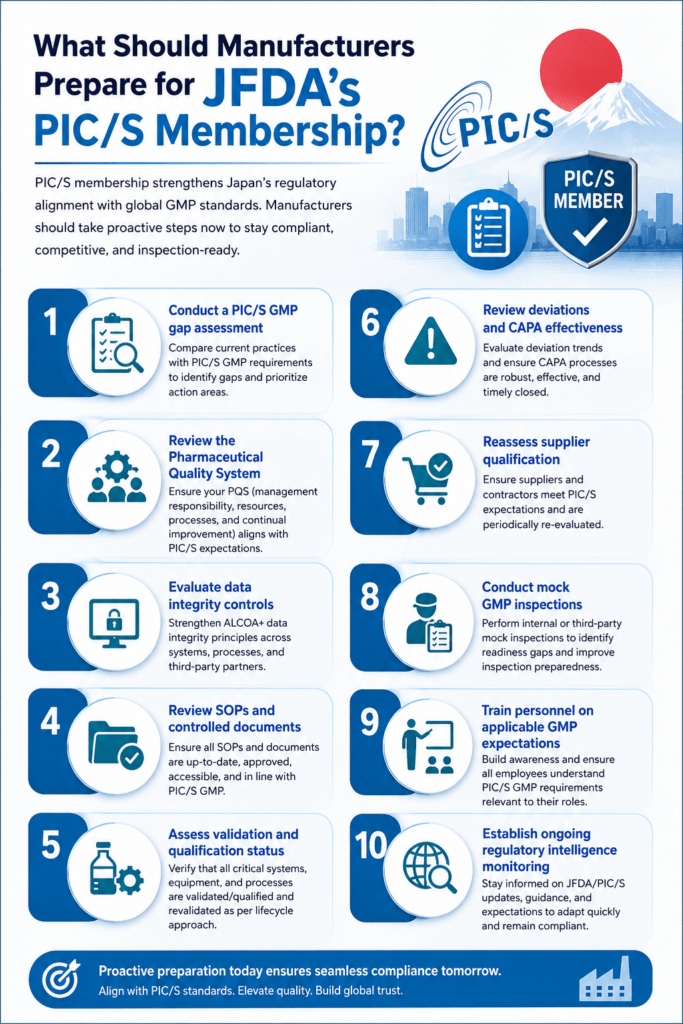
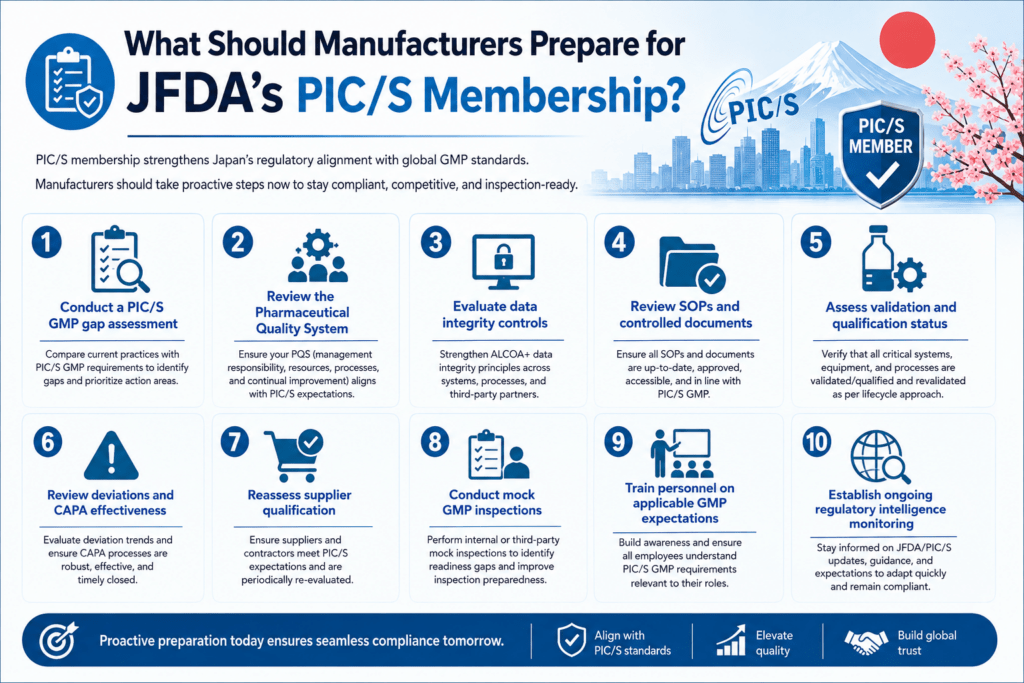
Jordan PIC/S GMP Guidelines: Key Compliance Expectations
With PIC/S-aligned expectations now in play, pharmaceutical companies in Jordan need to keep a close eye on their quality systems and stay on top of continuous compliance.
Six areas where manufacturers need to take action:
- Pharmaceutical Quality System (PQS): Quality management processes must be efficient, well documented, and regularly revised for GMP compliance. Regulators want systems in place that detect issues before they happen rather than just cleaning up afterward.
- Quality Risk Management: Modern GMP expectations demand companies develop systematic ways of spotting, evaluating, and mitigating risks across manufacturing operations, equipment performance evaluation, raw material suppliers, process changes, and product quality attributes.
- Data Integrity and Documentation Control: Data integrity is a topic of increasing importance worldwide, not only in Jordan. Records must be accurate, complete, traceable, and protected from unintended changes; to do so requires close consideration of electronic records, audit trails, lab data management practices, and access controls.
- Validation and Qualification: Manufacturing processes, analytical methods, equipment, cleaning procedures, and computerized systems all need solid validation programs behind them. Good validation proves, not assumes, that a process reliably delivers the quality it’s supposed to.
- CAPA and Deviation Management: Regulators aren’t satisfied with a quick fix. They want to see deviations investigated properly and CAPA systems that dig into root causes instead of just patching symptoms.
- Supplier Qualification and Oversight: As supply chains get more tangled, keeping tabs on API suppliers, raw material vendors, packaging suppliers, and contract manufacturing partners matters more than ever.
How Jordan PIC/S Membership Supports Market Access
Jordan’s PIC/S alignment could genuinely move the needle on market competitiveness. For manufacturers, it opens the door to stronger international partnerships, more confidence from global buyers, more contract manufacturing opportunities, and better export potential overall.
Jordan already boasts an established pharmaceutical sector that exports its products internationally, and this latest recognition by PIC/S is a significant boost to Jordan’s standing as a reliable manufacturing hub in the MENA region.
One caveat, though: Jordan’s PIC/S membership doesn’t replace individual country regulatory requirements. Product registrations, dossier reviews, and market authorizations still follow whatever rules the target market has in place. What PIC/S really offers is assurance, a signal that Jordan’s manufacturing oversight follows internationally accepted principles.
Jordan Regulatory Affairs Services for JFDA Compliance
Jordan Regulatory Affairs Services cater to the pharmaceutical, biotechnology, medical device, and healthcare sectors, assisting them in fulfilling Jordan Food and Drug Administration (JFDA) requirements and navigating the myriad challenges involved in the country’s regulatory pathways.
Services include Jordan regulatory compliance:
- Regulatory Strategy – Advice regarding JFDA approval pathways and associated planning to facilitate effective regulatory and market entry.
- Product Registration & Submissions – Involvement in the creation and/or oversight of the submission of all necessary documentation and requests for JFDA approval.
- Regulatory Compliance Support – Assurance that products adhere to the prevailing regulations of Jordan and to the recognized international standards.
- Medical Device & Pharmaceutical registration – Support in the preparation of technical documentation and supporting files for approval of medical devices and pharmaceuticals.
- Regulatory Lifecycle Management – Support for changes, renewals, post-market changes, and updates to product labeling.
- Regulatory Intelligence – Proactive surveillance of the JFDA and associated regulatory changes to manage and/or mitigate risks for business compliance.
In-depth knowledge of Jordan’s regulatory systems, PIC/S standards and related international standards enables Jordan Regulatory Affairs Services to offer clients timely approval and continued compliance in the Jordanian market.
Preparing for the New Regulatory Environment
Businesses operating in Jordan shouldn’t wait around and see how this plays out; rather, proactive steps should be taken immediately:
- Conduct GMP gap assessments against PIC/S expectations
- Review SOPs and quality documentation carefully
- Tighten data integrity controls
- Train staff on updated GMP principles
- Revisit validation programs
- CAPA processes and deviation procedures
- Prepare teams for risk-based inspections in practice.
Conclusion
Jordan’s entry into PIC/S, effective January 1, 2026, marks a crucial turning point in its pharmaceutical regulatory environment and cements Jordan as only the second Arab nation participating. Membership strengthens regulatory credibility while pushing GMP practices closer towards global standards, offering manufacturers with global ambitions new opportunities to expand globally.
As PIC/S expectations continue shaping compliance in Jordan, companies must keep quality systems, inspection readiness, and continuous improvement top of mind as part of an ongoing commitment, rather than treating this task as something to check off a list.
DDReg Pharma provides pharmaceutical companies in Jordan with comprehensive regulatory affairs services, offering assistance with regulatory strategy development, GMP compliance, audit readiness, dossier preparation, as well as global market access planning.
Frequently Asked Questions
JFDA membership as of January 1st 2026, officially places Jordan within the international framework for GMP inspection cooperation known as PIC/S, making it its 57th Participating Authority.
Expect improved inspection standards, enhanced regulatory trustworthiness, higher quality expectations, and potential new international market opportunities.
GMP expectations aligned with PIC/S principles include quality systems, risk management practices, validation documentation, and inspection readiness.