
How Should You Respond to an FDA Form 483?
An effective FDA Form 483 response should address every inspection observation, identify the underlying root cause, assess potential patient and product risks, establish appropriate corrective and preventive actions (CAPA), define implementation timelines and responsibilities, and provide objective supporting evidence. The response should demonstrate that the company has addressed both the immediate deficiency and the underlying systemic issue.
For companies in regulated industries like pharmaceuticals, biotechnology, and medical devices, regulatory inspections are an integral part of operations. An FDA inspection may feel daunting, but it’s a critical mechanism to ensure compliance with standards (such as Good Manufacturing Practices) to safeguard public health and safety. When compliance gaps are identified, the FDA communicates its findings through FDA Form 483 or Warning Letters, signaling the need for immediate attention and corrective action.
Receiving these notices can be alarming, but they also present an opportunity for organizations to strengthen their systems and processes. How a company responds can make a significant difference in maintaining market access, regulatory trust, and operational continuity. Explore how to respond to 483s and Warning Letters efficiently.
Need Support Responding to an FDA Form 483 or Warning Letter?
Strengthen your FDA response with DDReg Pharma's regulatory expertise in deficiency response, gap analysis, remediation, regulatory correspondence, and compliance support.
Explore USA FDA Regulatory Services →Classification of FDA Inspection Outcomes
When FDA investigators evaluate your facility, their findings determine the facility’s compliance status, classified into three categories:
- No Action Indicated(NAI): No violations of regulatory significance were observed. No further actions are required.
- Voluntary Action Indicated(VAI): Minor issues are identified, but they don’t demand immediate action. Companies are encouraged to voluntarily address these concerns.
- Official Action Indicated(OAI): Serious violations are uncovered, warranting regulatory or administrative actions like warning letters or enforcement measures.
What is FDA Form 483?
An FDA Form 483 is issued when an inspection reveals conditions or practices that do not comply with the Food, Drug, and Cosmetic Act (FD&C Act). These observations serve as a roadmap for corrective actions. Each observation is detailed, pointing out specific areas where the standards weren’t met.
Along with the Establishment Inspection Report (EIR)—a comprehensive inspection record—Form 483 provides the foundation for the FDA’s next steps. While receiving a Form 483 is not a final judgment, ignoring it can escalate issues, leading to warning letters or other regulatory actions.
What is a FDA Warning Letter?
A Warning Letter is issued when the FDA finds significant violations or deems a company’s response to a Form 483 inadequate. It formally outlines non-compliance, like poor manufacturing practices, misleading product claims, inaccurate or incomplete labeling and directions for use.
Companies are generally expected to submit a written response within 15 business days outlining corrective actions, implementation timelines, and supporting evidence. Failure to respond adequately may result in further regulatory actions, including product seizures, injunctions, civil penalties, import restrictions, or consent decrees.
FDA Form 483 vs. Warning Letter: What's the Difference?
FDA Form 483 | FDA Warning Letter | |
Purpose | Communicates inspection observations | Communicates significant regulatory concerns |
Stage | Associated with an FDA inspection | Generally follows regulatory evaluation of findings |
Final enforcement action? | No | Represents a formal regulatory warning |
Company response | Address observations and corrective actions | Address violations and proposed corrective actions |
Potential next steps | May lead to further regulatory action | May lead to further enforcement if concerns are not adequately addressed |
What Does Recent FDA Expect in an Effective Form 483 Response?
FDA expects companies to provide timely, comprehensive, and evidence-based responses to inspection observations. An effective response should address each observation, identify the underlying root cause, assess potential risks, and establish appropriate corrective and preventive actions (CAPAs) supported by realistic implementation timelines and objective evidence.
Organisations are increasingly expected to conduct comprehensive root cause investigations, implement risk-based Corrective and Preventive Actions (CAPAs), establish realistic implementation timelines, and provide objective evidence demonstrating sustainable compliance. These expectations strengthen pharmaceutical quality systems and support ongoing inspection readiness.
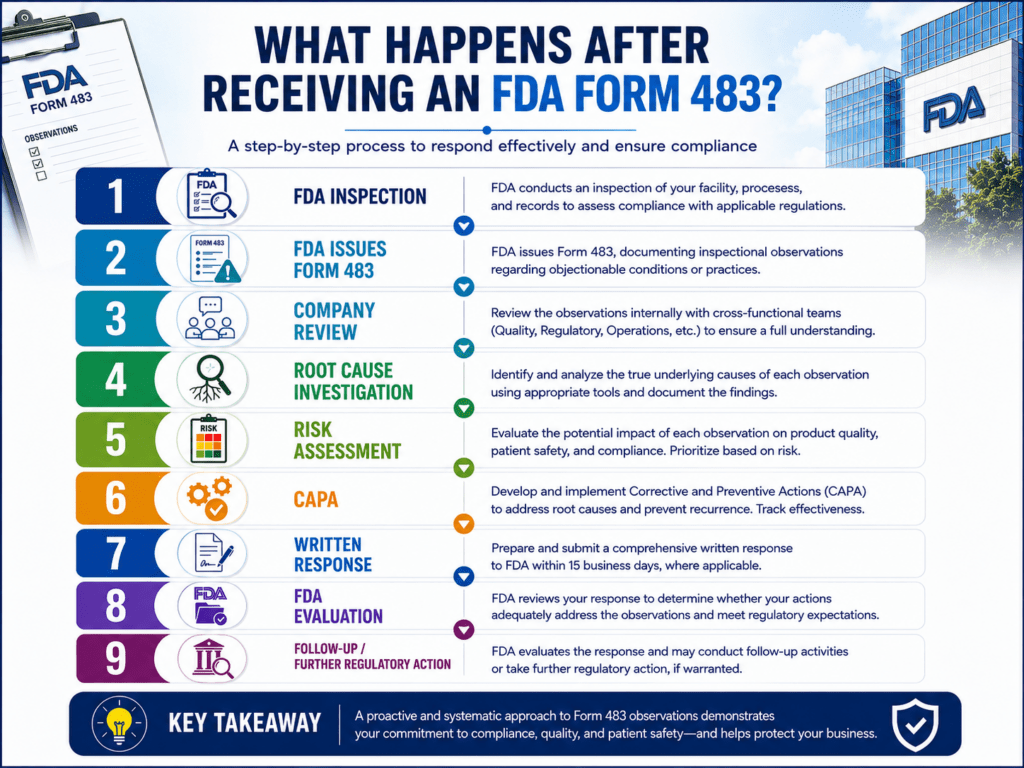
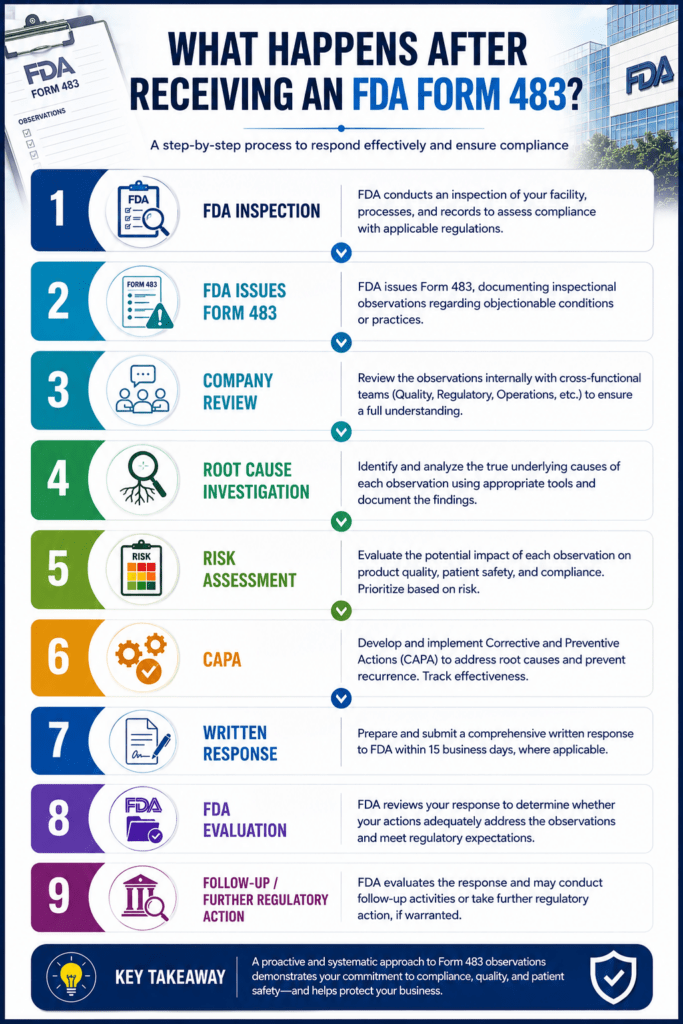
What Happens After Receiving an FDA Form 483?
How to Respond to FDA Form 483 or Warning Letter?
Responding to an FDA Form 483 or Warning Letter requires a timely, structured, and evidence-based approach. Companies should carefully evaluate each observation or violation, determine the underlying root cause, assess potential risks, and develop appropriate corrective and preventive actions (CAPAs).
- Step 1: Evaluate the FDA findings –FDA observations are an opportunity to rectify issues before they can escalate. Review the findings with your team to identify the root cause of all the observations.
- Step 2: Review and Clarify – Start by carefully analyzing the Form 483 or warning letter and ask clarifying questions during the closing discussion of the inspection to ensure that you fully understand the FDA’s concerns. It is important to document the meeting thoroughly to capture any verbal clarifications.
- Step 3: Conduct a Root Cause Investigation – Do not limit the response to correcting the immediate deficiency. Investigate why the issue occurred and determine whether the same underlying weakness could affect other products, processes, facilities, suppliers, or quality systems.
- Step 4: Develop a Risk-Based CAPA Plan – Based on the investigation, establish corrective and preventive actions that address both the immediate deficiency and its underlying cause.
- Step 5: Prepare and Submit the Written Response Within the Applicable Timeframe – For FDA Form 483 responses, FDA’s current guidance recommends that establishments address observations in a written response within 15 business days after the Form 483 is issued. For complex observations that cannot be fully addressed within that period, FDA recommends submitting a CAPA plan and proposed timeframe for the substantive response within the 15-business-day period.
What is a patient-focused risk assessment in a Form 483 response?
An effective FDA response should evaluate the potential impact of each observation on product quality, patient safety, and product availability. A documented patient-focused risk assessment demonstrates that the organisation has assessed the potential consequences of identified deficiencies and prioritised corrective actions based on patient risk. This approach supports transparent regulatory communication while aligning quality improvements with public health objectives.
What Should an FDA Form 483 Response Include?
An FDA Form 483 response should address each observation individually and explain the root cause, risk assessment, corrective actions, preventive actions, implementation timeline, responsible personnel, supporting evidence, and effectiveness verification. A clear and organized response should be drafted to address FDA 483 observations or Warning Letters. A structured approach not only demonstrates your commitment to compliance but also ensures your response is thorough and actionable. Here’s a recommended framework to guide your reply effectively.
- Cover Letter-The cover letter should respectfully acknowledge the FDA observations, reaffirm the organisation’s commitment to compliance, and demonstrate executive management involvement. It should also identify the primary contact responsible for coordinating the response.
- Body of the Response –Address each FDA observation individually by quoting the observation exactly as written. For every observation, include:
- Root cause analysis
- Corrective actions
- Preventive actions
- Implementation timeline
- Supporting evidence
- Status of completion
The response should demonstrate both immediate correction and long-term prevention of recurrence.
- Supporting Attachments – Include updated Standard Operating Procedures (SOPs), revised procedures, employee training records, CAPA documentation, validation reports, risk assessments, and any additional evidence supporting corrective actions. Documentation should be organised and cross-referenced for ease of review.
By following this structured format, you can ensure that your response is professional, thorough, and aligned with the FDA’s expectations, laying the groundwork for a swift resolution and stronger compliance posture.
How to Develop a CAPA Action Plan After an FDA Form 483
A temporary correction may address an immediate deficiency, but it may not prevent recurrence. An effective CAPA action plan should address the underlying root cause, define corrective and preventive actions, assign responsibilities, establish implementation timelines, and include measures to verify effectiveness.
- Root Cause Analysis: Investigate underlying quality system failures rather than immediate symptoms. The investigation should determine why the deficiency occurred and whether similar weaknesses may exist elsewhere within the organisation.
- Corrective Actions: Resolve identified deficiencies. Corrective actions should address the identified deficiency and eliminate the immediate cause of the problem.
- Preventive Actions: Implement systemic improvements to prevent recurrence. Depending on the nature of the observation, this may involve changes to procedures, training, quality controls, processes, or other elements of the pharmaceutical quality system.
- Designing CAPAs That Meet FDA Expectations: Corrective and Preventive Actions should extend beyond immediate corrections and address the underlying causes of non-compliance. A comprehensive CAPA programme should include documented root cause analysis, clearly defined responsibilities, implementation timelines, effectiveness verification, management oversight, and continuous monitoring. FDA expects organisations to demonstrate that implemented CAPAs are sustainable, measurable, and effective in preventing recurrence while strengthening the overall pharmaceutical quality management system.
- Verify CAPA Effectiveness – CAPA should not be considered complete simply because an action has been implemented. Effectiveness checks should determine whether the action actually addressed the underlying problem and reduced the likelihood of recurrence.
How Deep Should an FDA Form 483 Root Cause Investigation Go?
The investigation should extend beyond the immediate observation and determine whether the same underlying deficiency exists elsewhere within the quality system. Depending on the nature of the observation, the assessment may need to consider other products, manufacturing lines, facilities, suppliers, procedures, or quality systems.
FDA expects organisations to investigate beyond the immediate observation and determine the true root cause of non-compliance. Effective investigations should assess whether similar issues exist across other products, manufacturing lines, facilities, suppliers, or quality systems.
Comprehensive investigations help identify systemic weaknesses, reduce the risk of recurrence, and demonstrate a mature pharmaceutical quality system during regulatory review.
What should an FDA Form 483 response checklist include?
An FDA Form 483 response checklist should cover observation review, regulatory assessment, clarification, root cause investigation, risk assessment, CAPA development, action ownership, implementation timelines, supporting evidence, management review, response submission, and CAPA effectiveness verification.
FDA Form 483 Response Checklist
Use this checklist to help structure your response to FDA Form 483 observations and track key response activities from initial review through CAPA effectiveness verification.
Before Preparing the Response
Review every FDA Form 483 observation and understand the specific deficiency identified.
Identify the applicable regulatory requirement associated with each observation.
Clarify the observations where necessary, including points discussed during the inspection close-out meeting.
Determine the scope and potential impact of each observation across relevant products, processes, facilities, suppliers, or quality systems.
Investigation and Risk Assessment
Conduct a documented root cause investigation that addresses the underlying cause rather than only the immediate deficiency.
Perform a patient, product-quality, and compliance risk assessment, where applicable.
Evaluate whether similar deficiencies exist elsewhere within the organisation.
Document the investigation findings and supporting rationale.
CAPA Development
Define corrective actions to address identified deficiencies.
Define preventive actions to reduce the likelihood of recurrence.
Assign responsible personnel for each action.
Establish realistic implementation timelines and milestones.
Define CAPA effectiveness criteria and how effectiveness will be measured.
Response Preparation
Compile objective supporting evidence, such as revised SOPs, training records, investigation reports, validation records, risk assessments, and CAPA documentation, as applicable.
Ensure each FDA observation is addressed individually and clearly.
Conduct quality and management review of the proposed response.
Submit the response within the applicable FDA timeframe.
After CAPA Implementation
Verify CAPA effectiveness using predefined effectiveness criteria.
Monitor implemented actions through appropriate quality-system processes.
Conduct follow-up reviews or internal audits where appropriate.
Document evidence demonstrating sustainable remediation and prevention of recurrence.
Conclusion
Effective responses to FDA Form 483 observations and Warning Letters require more than timely corrective actions—they require a systematic, science-based approach to quality management and regulatory compliance. As FDA expectations continue to evolve, organisations should maintain comprehensive investigations, patient-focused risk assessments, effective CAPA programmes, and robust quality systems that support sustainable compliance.
A well-prepared, evidence-based response not only addresses immediate inspection observations but also strengthens operational excellence, inspection readiness, and long-term product quality.
Read more from our experts on latest updates from FDA: FDA’s First Draft Guidance on Nonclinical Development of Oligonucleotides
How DDReg Can Support FDA Form 483 and Warning Letter Responses
Receiving an FDA Form 483 or Warning Letter requires a structured, evidence-based response and a clear remediation strategy. DDReg provides FDA Regulatory Affairs Services to support pharmaceutical and life sciences companies with FDA inspection readiness, Form 483 and Warning Letter response support, root cause analysis, CAPA remediation, and regulatory compliance.
Frequently Asked Questions (FAQs)
Companies are generally expected to submit a written response within 15 business days, outlining corrective actions, implementation timelines, and supporting evidence.
No. FDA Form 483 contains inspection observations and is not a final enforcement action. A timely, comprehensive, and evidence-based response may prevent further regulatory action.
An effective response should include a documented root cause investigation, patient-focused risk assessment, corrective and preventive actions (CAPA), implementation timelines, effectiveness verification, and supporting documentation demonstrating sustainable compliance.
FDA expects CAPAs to address the underlying root cause of non-compliance, include measurable corrective actions, assign responsibilities, verify effectiveness, and demonstrate that similar issues are unlikely to recur.
A comprehensive root cause investigation helps identify systemic quality issues, supports sustainable corrective actions, reduces the risk of repeat observations, and demonstrates a mature pharmaceutical quality system during regulatory review.