
A global pharmacovigilance system can appear well controlled from headquarters and still develop serious weaknesses at country level. The central safety team may maintain the global database, oversee signal management, prepare aggregate reports and define company-wide procedures. At the same time, local affiliates may be receiving adverse-event reports, interacting with national regulators, monitoring local literature and implementing country-specific safety requirements.
Problems begin when those two parts of the system stop operating as one. A local authority may request additional safety information that is not escalated promptly to the global team. An affiliate may receive an adverse-event report but apply an incorrect internal transfer timeline. Global signal management may identify an emerging concern, but a local team may not receive clear instructions on whether labelling, educational materials or regulatory communication needs to change in its market. None of these problems necessarily reflects a failure of the central pharmacovigilance process itself. They often reflect a failure at the interface between global and local pharmacovigilance services.
For Marketing Authorization Holders (MAHs), effective global pharmacovigilance governance therefore requires more than central control. It requires a system in which local safety information moves upward reliably, global decisions move back down effectively, responsibilities are understood across territories and evidence exists to demonstrate that both directions are working.
Regulatory scope: Pharmacovigilance structures and local requirements vary between jurisdictions. This article uses EU Good Pharmacovigilance Practices as an important governance reference while addressing broader global operating principles. Terms such as QPPV, local PV contact or local safety responsible should therefore be interpreted according to the applicable regulatory framework in each market.
Why Global PV Governance Breaks Down at the Local Level
The central pharmacovigilance function usually has strong visibility over the processes that it directly operates. The difficulty is that patient safety information does not originate only within those central processes. It is generated across markets. A healthcare professional may report an event to an affiliate in Brazil. A local distributor may receive a safety complaint in the Middle East. A national regulatory authority may request information directly from the local MAH representative. A country-specific scientific publication may contain a relevant case that does not appear immediately in global literature searches. The more geographically distributed the organization becomes, the more dependent the global PV system becomes on the quality of its local interfaces.
EMA’s GVP Module II reflects this principle clearly. The PSMF should describe the organizational units and third parties involved in PV activities and identify, on a global basis, the principal sources of safety data, including affiliate offices, medical information sites and relevant third-party arrangements.
A common governance weakness occurs when the global organization designs the process, but the local team is left to interpret how it applies within its own market. That can produce different practices across affiliates even when everyone is technically following the same global pharmacovigilance SOP.
The central-local disconnect usually develops in five ways
- Responsibilities are described too broadly.
A global procedure may say that the affiliate is responsible for “local pharmacovigilance” without defining whether this includes literature surveillance, case follow-up, authority correspondence, local signal escalation, reconciliations or risk-minimization implementation. - Country requirements are not integrated into global processes.
Global SOPs may establish the baseline, but local reporting requirements, national contacts, timelines and documentation expectations may differ. - Safety information moves in only one direction.
Affiliates transfer ICSRs to headquarters, but global teams do not consistently return safety decisions, risk-management services changes or implementation instructions. - Vendor responsibilities create additional interfaces.
A local distributor, CRO or service provider may sit between the affiliate and central safety team, increasing the chance of delayed or incomplete transfer. - Governance is measured by activity rather than outcome.
A company may track whether training was completed without measuring whether safety reports are being transferred correctly.
The quality of the system depends on how effectively information crosses organizational and geographic boundaries.
Global PV vs Local PV: Who Should own What?
Global and local pharmacovigilance should not operate as parallel systems. They should function as different layers of the same safety system.
The precise division of responsibility varies by company structure and jurisdiction, but the governance model should clearly distinguish between centralized oversight and local regulatory execution.
| Activity | Typical Global/Central Responsibility | Typical Local Responsibility |
|---|---|---|
| PV governance | Global framework, policies and quality oversight | Local implementation and escalation |
| Safety database | Global system ownership and configuration | Timely transfer of locally received safety information |
| ICSR processing Services | Central processing, medical review and reporting where centralized | Local intake, source documentation and follow-up support |
| Signal management Services | Integrated signal detection, validation and global benefit-risk assessment | Identification and escalation of local safety observations |
| Literature Monitoring Services | Global database/literature strategy | Country-specific or local-language literature where required |
| Regulatory intelligence | Global oversight of major PV changes | Monitoring national PV requirements and authority expectations |
| Aggregate reports | Global preparation and governance | Local submission/support where required |
| Risk management | Global RMP strategy and safety decisions | Local implementation of applicable risk-minimization measures |
| Authority communication | Global regulatory strategy | Local authority correspondence and escalation |
| Training | Global training framework | Local role-specific and country-specific training |
| Compliance | Global KPI oversight | Local performance, deviations and CAPAs implementation |
Within the EU framework, the QPPV Services must have sufficient authority over the PV system and receive relevant information from across the organization, including information arising from contractual arrangements and procedures operating at every organizational level. GVP Module I also allows national PV contacts to be established where applicable, with the pharmacovigilance reporting relationship connected to the QPPV. This makes QPPV responsibilities especially relevant to global-to-local governance.
The QPPV cannot meaningfully maintain system oversight if important country-level information remains inside affiliates. Similarly, the local team cannot implement global safety decisions correctly if it receives only partial information from headquarters.
Where does Safety Information Gaps Usually Occur?
The most serious global-to-local PV gaps often appear in routine activities rather than exceptional safety crises. A central team may receive most ICSRs correctly while still missing smaller signals of governance weakness.
- Local case intake
A report may first reach,If local personnel are unclear about what constitutes safety information or how quickly it should be transferred, the global database may never receive the case on time.
- Local literature
A global literature programme can cover major scientific databases but still fail to capture certain national journals, local-language publications or publications outside standard indexing. Local responsibilities therefore need to be clearly defined rather than assumed.Local regulatory correspondence
A national authority may send:- A safety information request
- A signal-related question
- A labeling request
- An inspection communication
- A requirement relating to risk minimization
If the correspondence remains with regulatory affairs or a local safety contact without appropriate central escalation, the global team may make decisions using incomplete information.
- Product complaints containing safety information
Quality and pharmacovigilance frequently intersect. A complaint about packaging, contamination, product failure or incorrect administration may also contain an adverse event. If the local quality process and PV process are not connected, clinically relevant information can be separated from the complaint before reaching global safety.
- Third-party arrangements
The more external relationships involved, the more opportunities exist for safety information to be delayed.
Every additional handoff introduces another point at which:- Timelines can be misunderstood
- Data can be incomplete
- Responsibilities can overlap
- Acknowledgment can fail
- Reconciliation can identify problems only much late
Safety Information Exchange Needs More than a Contract
A pharmacovigilance agreement or Safety Data Exchange Agreement can define responsibilities, but the existence of an agreement does not prove that safety information exchange works operationally. A useful governance test is to take one realistic event and follow it through every organization involved.
The MAH retains responsibility for the pharmacovigilance system even when PV activities are outsourced. EMA guidance also expects relevant delegated activities, third parties, products and territories to be appropriately documented. A signed agreement is therefore the governance foundation. Training, operational testing, reconciliation and performance monitoring are what demonstrate that the agreement works.
How Should Safety Signals Move from Local to Global Teams?
Local teams can identify important safety information before it becomes visible in a global database.
This can happen because the local affiliate has:
- Closer contact with healthcare professionals
- Access to local literature
- Visibility over national authority concerns
- Knowledge of product-use patterns
- Awareness of local prescribing practices
- Exposure to country-specific patient populations
A potential safety signal therefore should not have to become statistically visible globally before it can be escalated. GVP Module IX recognizes that signals can arise from a wide variety of data sources, including local, regional and national reporting systems, literature and safety databases.
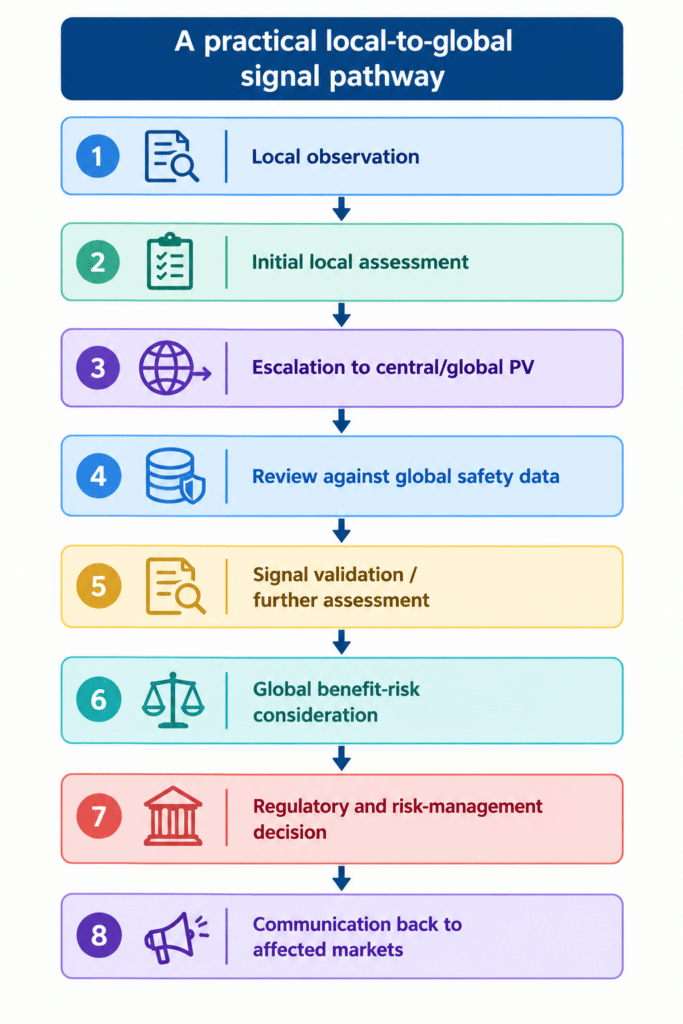
The local team’s job is not necessarily to complete the global signal assessment independently; its critical role is to ensure that potentially meaningful observations are not lost because case numbers appear small locally.
The global team therefore needs both the safety data and the local context. Good global pharmacovigilance governance creates an escalation route for both.
Global Signal Decisions Must Also Travel Back to Local Teams
Information flow cannot stop after the local affiliate sends data to headquarters. The reverse pathway is equally important. Once a global safety team evaluates a signal or makes a benefit-risk decision, affected local teams may need to assess what that decision means in their own jurisdiction.
Depending on the issue and local requirements, implementation could involve:
- Product-information updates
- eCTD Regulatory submissions
- Additional risk-minimization measures
- Healthcare-professional communications
- Updates to educational materials
- Local procedural changes
- New follow-up requirements
- Training
- Changes to local reporting activities
A global decision does not always translate into identical action in every country. One authority may require immediate submission while another may follow a different regulatory pathway. Approved product information may differ. Risk-minimization tools may require local adaptation or authority approval.
How Can Global Teams Ensure Local Decisions Are Implemented?
Global-to-local implementation cycle
This becomes especially important for risk-minimization measures. A global Risk Management Plan (RMP) may establish the overall safety strategy, but local execution can vary by market. Simply distributing global materials does not demonstrate local implementation.
The MAH should be able to identify which markets require a measure, whether local authority approval is needed, when implementation occurred and where the evidence is stored.
| Stage | Governance Control |
|---|---|
| Global safety decision | Formal decision and rationale documented |
| Country applicability assessment | Each market determines whether/how action applies |
| Local owner assigned | Named accountable individual/function |
| Regulatory pathway confirmed | Local requirements and timelines documented |
| Action implemented | Submission, labeling services, communication, RMM or procedure completed |
| Evidence returned | Completion documentation provided centrally |
| Central verification | Global team confirms implementation or escalates delay |
| Closure | Action formally closed and retained for audit/inspection |
Local Safety Reporting Must Be Governed as Part of the Global System
Local safety reporting is sometimes treated primarily as an affiliate responsibility. A local team may understand its national rules well but still operate outside the global compliance framework. Conversely, a central team may understand the global reporting process but lack visibility over local requirements.
The global PV function should maintain visibility over:
- Applicable reporting models
- Local reporting responsibilities
- Deviations or late submissions
- National authority interactions
- Country-specific procedures
- Changes in local regulation
The local team should maintain visibility over:
- Global SOP changes
- Case-processing expectations
- Global product safety developments
- Changes in risk-management strategy
- Global escalation rules
This creates one pharmacovigilance system with local execution rather than a collection of loosely connected country processes.
Reconciliation Is one of the Strongest Global-to-Local Controls
Governance can appear effective until records from two systems are compared. Reconciliation tests whether information that should have moved between teams did.
Depending on the operating model, reconciliation may compare:
- Local affiliate safety logs against the global safety database
- Medical-information records against ICSR records
- Distributor safety reports against affiliate/global records
- Local literature findings against processed cases
- Authority correspondence logs against central regulatory/PV records
- Product complaints against pharmacovigilance cases
Training Should Reflect the Role, Not Just the SOP
Global SOP training is necessary, but it is not always sufficient. A local safety contact may need to understand global signal-escalation rules. A sales representative may need only to recognize a potential adverse event and know where to send it.
A regulatory-affairs colleague may need to understand when authority correspondence must be shared with pharmacovigilance. A distributor may need clear case-transfer and acknowledgment requirements. Training should therefore be role-based and interface-based.
How Should MAHs Measure Global–Local PV Governance?
A governance model cannot be evaluated only through SOP completion and training percentages. Those are useful indicators, but they do not show whether safety information is moving correctly. A stronger global-to-local dashboard combines compliance, quality and implementation metrics.
| Governance Area | Example KPI / Indicator |
|---|---|
| Safety transfer | % local cases transferred within internal timeline |
| ICSR quality | Cases requiring correction due to local intake issues |
| Reconciliation | Unmatched cases identified during reconciliation |
| Local literature | Search completion and late/missed surveillance |
| Authority requests | Requests escalated to global PV within required timeline |
| Signals | Local safety concerns escalated and assessed |
| Global decisions | % country actions implemented by deadline |
| Training | Role-specific training completion and effectiveness |
| Agreements | PVAs/SDEAs current and periodically reviewed |
| Deviations | Recurring global-local interface deviations |
| CAPA | CAPA closure and effectiveness verification |
| Audit | Affiliate/vendor findings and repeat observations |
GVP Module I emphasizes monitoring the effectiveness and performance of the pharmacovigilance system, while GVP Module IV specifically includes affiliate, regional and third-party PV activities within the scope of risk-based audit planning.
Governance Escalation Should be Risk-Based
Not every local deviation requires escalation to the QPPV or global safety governance committee. If everything is escalated, truly significant information can become harder to identify. The MAH should define escalation thresholds.
A Global-to-Local PV Governance Framework for MAHs
A practical governance model can be built around seven connected controls.
- Define the Operating Model
There are the main activites.- Centrally managed
- Locally executed
- Shared
- Outsourced
The model should include products, territories, systems and third parties.
- Map Every Safety-Information Interface
Identify how safety information can move, include ICSRs, signals, literature, regulatory correspondence, RMP actions and safety communications.
- Establish Explicit Accountability
Use a governance matrix or RACI were useful. Shared responsibility without an identified accountable owner frequently creates gaps.
- Standardize Safety Information Exchange
Define:- Transfer timelines
- Acknowledgment
- Minimum data requirements
- Escalation
- Reconciliation
- Deviation handling
The process should apply equally to affiliates and relevant third parties.
- Build Bidirectional Signal Governance
Local teams should be able to escalate observations easily.Global teams should return:
- Assessment outcomes
- Decisions
- Affected markets
- Implementation instructions
- Verify Local Implementation
Do not treat communication as completion. Require evidence that relevant global safety decisions were assessed and implemented locally.
- Measure and Improve the Interface
Use KPIs, audits, deviations, CAPAs and periodic governance reviews to identify where handoffs fail.
| Control | What Good Looks Like |
|---|---|
| Ownership | Global and local responsibilities are unambiguous |
| Safety intake | Local information reaches global PV reliably |
| Local requirements | Country-specific obligations are visible centrally |
| Signals | Local observations can reach global assessment quickly |
| Global decisions | Safety outcomes return to affected markets |
| Implementation | Local actions are tracked to evidence-based closure |
| Third parties | Safety exchange and oversight are controlled |
| Compliance | Interface performance is measured |
| QPPV oversight | Relevant information is available for system oversight |
| Inspection readiness | Decisions and transfers are traceable end to end |
Strong Global Governance Does Not Mean Centralizing Everything
A highly centralized pharmacovigilance organization is not automatically a well-governed one. Neither is a highly decentralized model inherently weak.
The real test is whether the operating model provides visibility, accountability, consistency and traceability. Central teams need enough visibility to understand what is happening across markets. Local teams need enough authority and regulatory knowledge to meet country-specific obligations. Responsibilities need to be consistent enough to prevent gaps but flexible enough to accommodate legitimate national differences. And both sides need evidence showing that safety information and decisions moved through the system as intended.
The strongest global pharmacovigilance governance model therefore does not eliminate local autonomy. It connects local expertise to global oversight. That connection is what allows an MAH to maintain one coherent view of product safety while continuing to meet the realities of multiple regulatory environments.
How DDReg Supports Global-to-Local Pharmacovigilance Governance
Managing pharmacovigilance across multiple markets often requires more than additional resources. It requires a governance structure that connects global oversight with reliable local execution.
DDReg supports pharmaceutical and life-sciences organizations across areas including:
- Global QPPV and local PV support
- Local QPPV/LPPV deployment where applicable
- Pharmacovigilance system and PSMF support
- Local safety reporting
- ICSR processing and reconciliation
- Literature monitoring
- Signal management
- Risk-management implementation
- PV Agreements and safety information exchange
- Affiliate/vendor oversight
- PV audits and inspection readiness
DDReg has also supported a pharmaceutical company’s deployment of local QPPV coverage, including integration of local safety operations with the client’s global PV system, country-specific procedures, escalation and inspection-readiness activities.
A structured Global-to-Local PV Governance Assessment can help MAHs identify where responsibilities, safety-data flows, local implementation or oversight may be creating hidden compliance risk.
Conclusion
A strong global pharmacovigilance system depends on more than central oversight. Local teams must be able to transfer safety reports, regulatory requests and emerging concerns promptly, while global teams must communicate decisions back with clear instructions for each affected market.
For MAHs, the practical test is whether responsibilities are defined, information reaches the right people, and local actions are completed and documented. Regular reconciliation, role-specific training and performance monitoring help reveal gaps at those handoffs. When global oversight and local expertise work as one system, MAHs can respond more consistently to safety issues and demonstrate control across markets.
Frequently Asked Questions
Global pharmacovigilance governance is the framework through which an MAH coordinates safety responsibilities, decision-making, data exchange, oversight and compliance across central PV teams, local affiliates and relevant third parties.
Local teams should escalate relevant safety information according to the MAH's procedures, including ICSRs, potential safety signals, significant authority requests, inspection findings, important local literature, compliance deviations and information that may affect the product's global benefit-risk profile.
MAHs can strengthen safety information exchange by defining clear transfer timelines, minimum data requirements, acknowledgment processes, escalation pathways, reconciliation controls and ownership in PV Agreements, SOPs and operational procedures.
MAHs should combine traditional compliance indicators with interface-specific measures such as local case-transfer timeliness, reconciliation discrepancies, signal escalation, authority-request escalation, implementation of global safety decisions, recurring deviations, CAPA effectiveness and affiliate/vendor audit findings.