

The pharmaceutical industry operates within a highly regulated environment where every medicinal product must meet strict requirements related to safety, efficacy, quality, and regulatory compliance before reaching patients.
Pharmaceutical regulations bring together administrative, technical, and legal requirements that pharmaceutical organizations must follow throughout the product lifecycle. These requirements include regulations, guidelines, procedures, and policies established by regulatory authorities to ensure that medicines supplied to patients meet the required standards. An important way governments protect public health is through regulatory evaluation, which ensures that pharmaceutical products meet established requirements for quality, safety, and effectiveness before receiving market authorization.
Need Expert Regulatory Affairs Support for Your Pharmaceutical Products?
Navigate complex pharmaceutical regulations with DDReg Pharma's support for regulatory strategy, product registration, dossier preparation, submissions, authority interactions, and lifecycle management.
Explore Regulatory Affairs Services →The role of regulatory affairs in pharmaceutical industry is therefore critical because regulatory professionals help companies successfully navigate complex regulatory pathways while ensuring compliance with global health authority expectations. Regulatory Affairs acts as a bridge between pharmaceutical companies and regulatory agencies by supporting product development, clinical research, marketing authorization applications, and post-approval lifecycle management. As pharmaceutical innovation continues to expand across areas such as biologics, biosimilars, advanced therapies, and personalized medicines, the importance of pharmaceutical regulatory affairs continues to increase.
Organizations such as TOPRA (The Organisation for Professionals in Regulatory Affairs) and RAPS (Regulatory Affairs Professionals Society) support regulatory professionals by promoting knowledge sharing, professional development, and best practices within the regulatory community.
Some key responsibilities of regulatory professionals include:
- Staying updated with changes in regulations and guidelines across target markets
- Providing scientific and regulatory advice during product development
- Collecting, reviewing, and evaluating technical and scientific information
- Communicating with regulatory authorities for approvals and lifecycle activities
- Maintaining regulatory documentation and records
What are Regulatory Affairs in the Pharmaceutical Industry?
Regulatory Affairs in the pharmaceutical industry is a specialized function responsible for ensuring that pharmaceutical products comply with regulatory requirements throughout their development, approval, and commercial lifecycle. Regulatory Affairs professionals work closely with research and development, clinical, quality, manufacturing, medical affairs, and commercial teams to ensure that products are developed according to applicable regulatory standards.
The primary objective of regulatory affairs is to ensure that medicines meet regulatory expectations related to:
- Safety
- Quality
- Efficacy
- Compliance
Unlike many other pharmaceutical functions, Regulatory Affairs provides a strategic connection between scientific innovation and regulatory approval. Regulatory professionals interpret regulations, prepare submissions, communicate with authorities, and help companies make informed decisions regarding product development and commercialization.
The function covers multiple activities, including:
- Regulatory strategy development
- Submission planning
- Health authority interactions
- Regulatory documentation
- Comestic Product registration
- Post-approval lifecycle management
In today’s pharmaceutical environment, regulatory affairs is no longer limited to submission preparation. It has become a strategic function that influences development decisions, market access planning, and long-term product success.
Why is Regulatory Affairs Important in Pharma?
The importance of regulatory affairs in pharma comes from its direct impact on patient safety, product quality, and successful market authorization. Before a medicine reaches patients, regulatory authorities evaluate extensive scientific information to determine whether the product meets required standards for safety, efficacy, and quality. Regulatory Affairs professionals ensure that pharmaceutical companies generate, organize, and communicate this information effectively to regulatory agencies.
An effective regulatory affairs function helps pharmaceutical companies:
- Select appropriate regulatory pathways
- Develop compliant submission strategies
- Reduce regulatory risks
- Avoid unnecessary approval delays
- Maintain compliance throughout the product lifecycle
Regulatory Affairs also supports public health by ensuring that only products meeting established regulatory standards receive approval. The role of regulatory affairs is particularly important because pharmaceutical companies operate across multiple global markets, each with different regulatory requirements. Regulatory professionals help organizations understand regional expectations and develop strategies for successful global product registration.
Need Support with CMC Regulatory Requirements?
Strengthen your pharmaceutical submissions with expert CMC support covering technical documentation, manufacturing information, specifications, stability data, quality sections, and regulatory compliance.
Explore CMC Regulatory Services →What Are the Main Responsibilities of Regulatory Affairs?
Regulatory Affairs develops strategies that help determine appropriate regulatory pathways, submission requirements, development plans and market-entry approaches.
Regulatory professionals monitor changes in regulations, guidance, health authority expectations and emerging regulatory trends.
3. Regulatory Submissions
RA teams coordinate regulatory eCTD submissions including CTD/eCTD dossiers, marketing authorization applications and post-approval submissions.
4. Health Authority Interaction
Regulatory professionals communicate with health authorities, respond to questions and coordinate regulatory meetings and commitments.
5. Product Lifecycle Management
After approval, Regulatory Affairs supports variations, renewals, regulatory changes and other lifecycle activities.
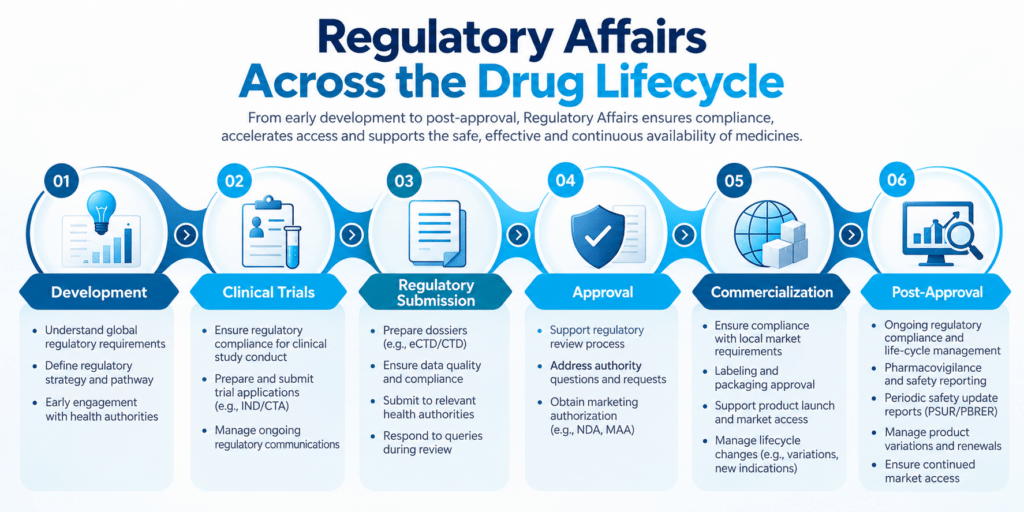
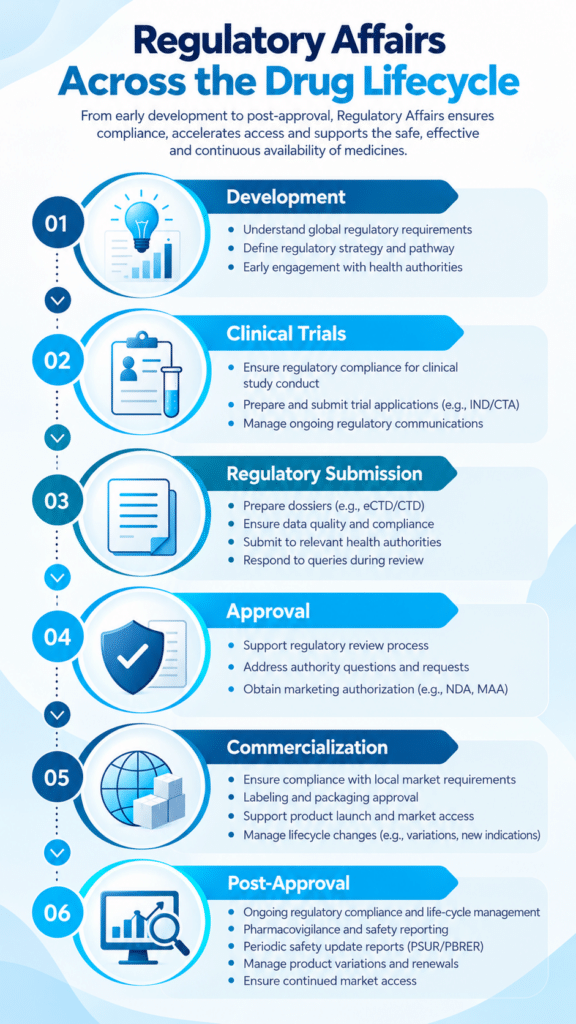
Regulatory Affairs Throughout the Pharmaceutical Product Lifecycle
Pharmaceutical organizations usually have dedicated pharmaceutical regulatory affairs teams or work with external regulatory service providers to support product development and commercialization activities.
Regulatory Affairs involvement begins during the early stages of drug development and continues throughout the entire product lifecycle, from research and clinical development to post-marketing activities. The regulatory function supports companies by ensuring that development programmes are aligned with regulatory expectations and that submissions contain appropriate scientific and technical information.
- Regulatory Affairs During Early Drug Development
During the research and development stage, regulatory affairs teams support the creation of regulatory strategies that guide product development.
This may include:
- Understanding applicable regulatory requirements
- Advising on development pathways
- Supporting clinical development planning
- Identifying regulatory risks
- Establishing submission timelines
During clinical development, regulatory professionals assist in planning studies from Phase I through Phase III and ensure that development activities generate data suitable for regulatory review. Regulatory input during early development is important because delays, incomplete planning, or regulatory deficiencies can negatively impact product approval timelines and commercial opportunities.
Regulatory teams may also support planning activities such as:
- Stability studies
- Exhibit batch requirements
- Manufacturing documentation strategies
- Regulatory submission planning
- Regulatory Affairs Support During Clinical Trials
Regulatory Affairs plays an important role throughout clinical development by ensuring that clinical studies comply with applicable regulatory requirements.
The regulatory team supports:
- Clinical trial application preparation
- Regulatory authority submissions
- Protocol review
- Trial documentation management
- Health authority communication
Depending on the region, regulatory submissions may include applications such as Investigational New Drug (IND) submissions in the United States or Clinical Trial Applications (CTA) in other markets. Regulatory professionals work closely with clinical teams to ensure that trial designs and documentation meet regulatory expectations and support future marketing authorization applications.
What are the Main Responsibilities of Regulatory Affairs?
The responsibilities of Regulatory Affairs extend across the complete pharmaceutical product lifecycle, from early development activities to post-marketing maintenance. Regulatory professionals ensure that pharmaceutical companies comply with applicable regulations while supporting efficient product development and approval strategies.
The key responsibilities of regulatory affairs in pharma include regulatory strategy development, submission management, regulatory intelligence, health authority communication, and lifecycle management.
- Staying Updated with Regulatory Requirements
One of the most important responsibilities of Regulatory Affairs professionals is monitoring changes in regulations, guidelines, and regulatory expectations across different markets. Since pharmaceutical companies operate globally, regulatory teams must continuously evaluate changes from authorities such as:
- US FDA
- European Medicines Agency (EMA)
- UK MHRA
- Health Canada
- Australian TGA
- Other international regulatory agencies
Understanding these changes helps companies modify development strategies, maintain compliance, and avoid regulatory delays.
- Providing Scientific and Regulatory Advice
Regulatory Affairs professionals provide guidance on regulatory expectations and scientific requirements throughout product development.
They support teams by advising on:
- Appropriate development pathways
- Regulatory requirements
- Submission strategies
- Documentation expectations
- Potential regulatory risks
This strategic input helps ensure that product development activities remain aligned with regulatory expectations.
- Collecting, Evaluating, and Managing Scientific Data
Regulatory teams are responsible for reviewing and organizing scientific and technical information generated during pharmaceutical development.
This includes information related to:
- Chemistry, Manufacturing and Controls (CMC)
- Non-clinical studies
- Clinical studies
- Product quality
- Safety information
Regulatory professionals ensure that this information is accurately presented within regulatory submissions.
- Regulatory Submission Preparation and Management
A major responsibility of Regulatory Affairs is preparing and managing regulatory submissions required for product approval.
Regulatory teams support the development of:
- Common Technical Document (CTD) modules
- Electronic submissions (eCTD)
- Marketing authorization applications
- Post-approval regulatory submissions
Regulatory Affairs professionals help ensure that submission documents are complete, scientifically justified, and aligned with regional regulatory requirements.
Need Regulatory Support for Clinical Development?
Support your clinical development programs with regulatory strategy, submission planning, clinical trial applications, regulatory documentation, authority interactions, and compliance support.
Explore Clinical Regulatory Services →How Does Regulatory Affairs Support Drug Approval?
Regulatory Affairs plays a central role in converting scientific development data into regulatory submissions that health authorities can evaluate. The approval of a pharmaceutical product requires extensive documentation demonstrating that the product meets regulatory expectations for quality, safety, and efficacy.
Regulatory teams support drug approval by developing submission strategies that consider:
- Target market requirements
- Regulatory pathways
- Dossier expectations
- Approval timelines
- Post-approval obligations
A strong regulatory strategy helps pharmaceutical companies efficiently navigate complex approval pathways and improve the likelihood of successful authorization.
Role of Regulatory Affairs in Regulatory Submissions and CTD Preparation
Regulatory affairs in pharma teams play an important role in preparing detailed regulatory dossiers using the Common Technical Document (CTD) format. The CTD provides a standardized structure for submitting pharmaceutical information to regulatory authorities.
Regulatory Affairs professionals support the preparation and coordination of CTD modules, including:
Module 1: Administrative Information
Module 1 contains region-specific administrative documentation.
This may include:
- Application forms
- Regulatory declarations
- Product information
- Labelling documents
- Administrative requirements
Module 2: Summaries and Overviews
Module 2 provides summaries of the scientific information included in the submission. Regulatory professionals help ensure that the overall regulatory strategy and scientific rationale are clearly presented.
Module 3: Quality Documentation
Module 3 contains Chemistry, Manufacturing, and Controls (CMC) information.
Regulatory Affairs works closely with CMC teams to ensure that information related to:
- Manufacturing processes
- Product characterization
- Specifications
- Stability
- Quality controls
is appropriately compiled and submitted.
Module 4: Non-Clinical Documentation
Module 4 contains applicable non-clinical study information supporting product evaluation. Regulatory teams ensure that required documentation is appropriately organized and aligned with regulatory expectations.
Module 5: Clinical Documentation
Module 5 includes clinical study information supporting safety and efficacy evaluation. Regulatory professionals coordinate with clinical teams to ensure that clinical information is presented according to regulatory requirements.
Regulatory Affairs and Health Authority Interaction
A key responsibility of Regulatory Affairs is maintaining communication between pharmaceutical companies and regulatory agencies.
Regulatory teams frequently interact with authorities to:
- Obtain regulatory guidance
- Clarify submission expectations
- Respond to questions
- Manage approval commitments
Effective regulatory communication helps ensure that regulatory authorities have the necessary information to evaluate a product
Regulatory Affairs Across Different Pharmaceutical Product Categories
The role of Regulatory Affairs extends across multiple pharmaceutical product categories. Each category presents unique regulatory requirements and challenges.
- Small Molecule Pharmaceutical Products
For conventional chemical medicines, Regulatory Affairs supports:
- New drug submissions
- Generic drug applications
- Manufacturing documentation
- Labelling approvals
- Lifecycle management
Regulatory teams ensure that small molecule products meet applicable regulatory requirements before market authorization.
- Biologics and Biosimilars
Biological products require specialized regulatory strategies because of their complexity.
Regulatory Affairs supports:
- Biologic product submissions
- Biosimilar registration strategies
- Comparability assessments
- Manufacturing changes
- Post-approval lifecycle activities
The regulatory evaluation of biologics requires detailed understanding of product characterization, manufacturing processes, and clinical evidence.
- Vaccines and Advanced Therapies
Regulatory Affairs also supports emerging product categories such as:
- Vaccines
- Cell therapies
- Gene therapies
- Advanced medicinal products
These products often require specialized regulatory approaches due to innovative manufacturing processes and complex scientific considerations.
- Medical Devices and Combination Products
For combination products involving both medicines and devices, Regulatory Affairs helps companies navigate multiple regulatory requirements.
This may involve coordination between pharmaceutical and medical device regulations.
- Over the Counter (OTC) Products
Regulatory Affairs professionals may also support prescription-to-OTC switches by preparing regulatory strategies and submissions required by health authorities.
Regulatory Affairs and Pharmaceutical Commercialization
Regulatory Affairs contributes significantly to successful commercialization by ensuring that products receive appropriate approvals in target markets.
The regulatory team develops submission strategies that consider:
- Regional approval pathways
- Dossier requirements
- Regulatory timelines
- Market-specific requirements
Regulatory Affairs acts as one of the most important milestones in the product lifecycle because it interfaces directly with competent authorities for obtaining marketing authorization.
What is the Difference Between Regulatory Affairs and Quality Assurance?
Regulatory Affairs and Quality Assurance are two essential functions within the pharmaceutical industry. Although both contribute to regulatory compliance and patient safety, their responsibilities and focus areas are different.
While Regulatory Affairs in pharma focuses on regulatory strategy, submissions, approvals, and communication with health authorities, Quality Assurance focuses on ensuring that pharmaceutical products are consistently manufactured according to established quality standards. The two functions work closely together throughout the product lifecycle to ensure that medicines meet regulatory and quality expectations.
Regulatory Affairs | Quality Assurance |
Focuses on regulatory compliance and product approvals | Focuses on quality systems and manufacturing compliance |
Prepares regulatory submissions and dossiers | Establishes and maintains quality management systems |
Communicates with regulatory authorities | Conducts audits and oversees GMP compliance |
Supports product registration and lifecycle management | Ensures consistent product quality and manufacturing standards |
Manages regulatory changes and variations | Manages deviations, CAPA, and quality investigations |
What is the Difference Between Regulatory Affairs and Pharmacovigilance?
Regulatory Affairs and Pharmacovigilance are closely connected functions, but they have different responsibilities within the pharmaceutical product lifecycle. Regulatory Affairs primarily focuses on obtaining and maintaining regulatory approvals, whereas Pharmacovigilance services focuses on monitoring product safety after approval.
Regulatory Affairs | Pharmacovigilance |
Supports product approval and registration | Supports ongoing safety monitoring |
Prepares regulatory submissions | Manages adverse event reporting |
Handles regulatory authority communication | Evaluates safety signals and risks |
Supports lifecycle changes | Develops risk management strategies |
Maintains regulatory compliance | Ensures patient safety after market approval |
Regulatory Affairs teams work closely with Pharmacovigilance departments to ensure that safety information is appropriately communicated to regulatory authorities and incorporated into product documentation when required. Together, these functions help maintain the balance between patient safety, regulatory compliance, and continued product availability.
How Regulatory Intelligence Supports Regulatory Affairs?
Regulatory intelligence has become an important strategic activity within pharmaceutical regulatory affairs services. Regulatory intelligence involves collecting, analysing, and interpreting regulatory information to support better decision-making throughout the product lifecycle.
- Regulatory Affairs teams continuously monitor:
- New regulations and guidelines
- Health authority announcements
- Regulatory policy changes
- Competitor approval strategies
- Emerging regulatory trends
- Importance of Regulatory Intelligence in Pharma
Regulatory intelligence helps pharmaceutical companies make proactive decisions instead of reacting only after regulatory changes occur.
It supports:
a. Better Regulatory Strategy
Regulatory intelligence helps companies understand:
- Which regulatory pathway may be most suitable
- What documentation may be required
- How health authority expectations are evolving
b. Improved Market Planning
Understanding regulatory requirements across different regions helps companies plan global registration strategies more effectively.
c. Reduced Regulatory Risk
Early identification of regulatory changes allows companies to adjust development plans and avoid potential compliance issues. As pharmaceutical regulations continue to evolve globally, regulatory intelligence is becoming an essential component of modern regulatory affairs strategy.
How Technology and AI are Changing Regulatory Affairs
Technology is transforming the way Regulatory Affairs teams manage information, submissions, and regulatory activities. Traditionally, regulatory operations involved extensive manual document preparation, review, and submission management. Today, digital solutions are helping organizations improve efficiency, accuracy, and collaboration.
Modern regulatory teams increasingly use:
- Regulatory Information Management (RIM) systems
- Electronic submission platforms
- Document management systems
- Data analytics tools
- Automated workflow solutions
Role of Artificial Intelligence in Regulatory Affairs
Artificial intelligence is becoming increasingly relevant within regulatory operations.
AI-supported solutions may assist with:
- Regulatory document review
- Information extraction
- Regulatory intelligence analysis
- Document comparison
- Workflow automation
However, regulatory decisions still require expert scientific interpretation and strategic judgement. AI is expected to support regulatory professionals rather than replace the expertise required for regulatory decision-making. The future of regulatory affairs in pharmaceutical industry will likely involve a combination of advanced technology and experienced regulatory professionals working together.
Challenges Faced by Regulatory Affairs Teams
The pharmaceutical industry continues to become more complex, creating new challenges for Regulatory Affairs professionals.
- Increasing Global Regulatory Complexity
Pharmaceutical companies seeking approval in multiple regions must comply with different regulatory requirements.
Regulatory teams must understand variations between:
- US FDA requirements
- EMA requirements
- Health Canada requirements
- Emerging market regulations
Managing multiple regulatory frameworks requires strong regulatory knowledge and effective planning.
- Increasing Complexity of Pharmaceutical Products
The growth of innovative therapies has created new regulatory challenges.
Regulatory teams increasingly support products such as:
- Biologics
- Biosimilars
- Cell and gene therapies
- Advanced therapies
- Combination products
These products often require specialised regulatory strategies because of their scientific complexity.
- Shorter Development Timelines
Pharmaceutical companies are under increasing pressure to accelerate product development while maintaining compliance.
Regulatory Affairs teams must balance:
- Faster submission timelines
- Complete regulatory documentation
- Health authority expectations
Strategic regulatory planning is therefore essential for efficient product approval.
- Changing Regulatory Expectations
Regulations and guidelines continue to evolve as scientific knowledge advances. Regulatory professionals must continuously update their knowledge and adapt strategies to remain compliant.
Future of Regulatory Affairs in Pharma
The future of regulatory affairs in pharma industry is moving beyond traditional submission management toward a more strategic role within pharmaceutical development. Regulatory Affairs professionals are increasingly involved in early development decisions, regulatory strategy planning, global market access, and product lifecycle management.
- Increasing Strategic Importance
Regulatory teams are becoming involved earlier in product development to help companies:
- Select appropriate development pathways
- Identify regulatory risks
- Optimize submission strategies
- Plan global approvals
- Growth of Digital Regulatory Operations
Future regulatory operations will increasingly rely on:
- Digital submission platforms
- Regulatory intelligence systems
- Automated workflows
- Data-driven decision-making
- Expansion of Advanced Therapies
As pharmaceutical innovation advances, Regulatory Affairs will play a critical role in supporting:
- Gene therapies
- Cell therapies
- Personalized medicines
- Complex biologics
These products require specialised regulatory approaches and close interaction with health authorities.
- Increasing Demand for Regulatory Expertise
The growing complexity of pharmaceutical regulations is increasing demand for skilled regulatory professionals and specialised pharmaceutical regulatory affairs services.
Companies with strong regulatory strategies are better positioned to achieve successful approvals and maintain compliance throughout the product lifecycle.
What Skills Are Needed for a Career in Regulatory Affairs?
A career in regulatory affairs in pharma requires a combination of scientific knowledge, regulatory understanding, communication skills, and strategic thinking. Regulatory professionals work at the intersection of science, law, and business. They must understand pharmaceutical development processes while also interpreting complex regulatory requirements across different markets.
- Scientific and Technical Knowledge
Regulatory professionals should have a strong understanding of pharmaceutical sciences, including:
- Drug development processes
- Clinical research
- Manufacturing principles
- Quality requirements
- Regulatory guidelines
This knowledge helps regulatory professionals evaluate scientific information and ensure that submissions meet regulatory expectations.
- Understanding of Global Regulations
Since pharmaceutical companies operate across multiple regions, regulatory professionals must understand international regulatory frameworks.
Important areas of knowledge include:
- ICH guidelines
- FDA regulations
- EMA requirements
- Health Canada regulations
- Regional submission pathways
Continuous learning is essential because regulatory requirements continue to evolve.
- Documentation and Communication Skills
Regulatory Affairs involves preparing and reviewing complex technical documentation.
Professionals must be able to:
- Write clear regulatory documents
- Review scientific information
- Communicate with cross-functional teams
- Respond effectively to regulatory questions
Strong communication skills are essential because regulatory professionals frequently interact with scientists, clinicians, quality teams, and health authorities.
- Project Management Skills
Regulatory submissions involve multiple teams, strict timelines, and large volumes of documentation.
Regulatory professionals must manage:
- Submission schedules
- Regulatory commitments
- Cross-functional coordination
- Approval timelines
Effective project management ensures that regulatory activities remain aligned with business and development objectives.
How DDReg Supports Pharmaceutical Regulatory Affairs
DDReg provides end-to-end pharmaceutical regulatory affairs services to help companies navigate complex regulatory requirements throughout the product lifecycle. Our regulatory experts support regulatory strategy development, submission management, CMC activities, health authority interactions, and post-approval lifecycle management.
With expertise across global markets, DDReg helps pharmaceutical companies achieve regulatory compliance, streamline approval processes, and successfully bring safe and effective products to market.
Our key regulatory support services include:
- Regulatory strategy and consulting
- Regulatory submissions and dossier management
- Global CMC regulatory support
- eCTD publishing and submission management
- Post-approval lifecycle management
- Regulatory intelligence and compliance support
- Medical writing and regulatory documentation
Frequently Asked Questions (FAQs)
The role of regulatory affairs in pharmaceutical industry is to ensure that pharmaceutical products comply with regulatory requirements related to safety, quality, and efficacy throughout their lifecycle.
Regulatory Affairs professionals support product development, clinical trials, regulatory submissions, approvals, and post-marketing activities while maintaining communication with regulatory authorities.
Pharmaceutical regulatory affairs is the function responsible for managing regulatory requirements associated with pharmaceutical products.
It includes regulatory strategy, submission preparation, health authority interactions, product registration, and lifecycle management activities.
A regulatory affairs professional manages activities such as:
- Preparing regulatory submissions
- Developing regulatory strategies
- Reviewing scientific documentation
- Communicating with health authorities
- Managing post-approval regulatory changes
Their role supports successful product approval and continued compliance.
Regulatory Affairs supports drug approval by ensuring that pharmaceutical companies submit complete and scientifically justified information to regulatory authorities.
The function supports:
- Regulatory pathway selection
- CTD dossier preparation
- Submission management
- Regulatory authority communication
- Response to regulatory questions
Regulatory Affairs focuses on regulatory approval, submissions, and interactions with health authorities.
Quality Assurance focuses on maintaining quality systems, GMP compliance, manufacturing controls, and product consistency.
Both functions work together to ensure that pharmaceutical products meet regulatory and quality expectations.
Conclusion
The role of the Regulatory Affairs team is extremely important in the highly regulated pharmaceutical industry to ensure patient safety and successful product commercialization.
As pharmaceutical development continues to advance, regulatory requirements are becoming increasingly complex. Regulatory professionals help companies navigate these requirements by providing strategic guidance, preparing regulatory submissions, communicating with health authorities, and managing product lifecycle activities. Involving regulatory experts throughout all stages of product development helps ensure that pharmaceutical products reaching patients are safe, effective, and of high quality. Regulatory Affairs is therefore not only a compliance function but also a strategic partner that supports innovation, regulatory success, and global market access.