

Entering the Spanish pharmaceutical market requires more than preparing a dossier and waiting for marketing authorisation. Companies must determine which regulatory pathway applies to their medicine, establish a realistic submission plan and understand how regulatory decisions affect subsequent launch activities.
Spain operates within the European Union’s medicines regulatory framework, meaning that the route to market depends on the product’s eligibility, its existing authorisation status and the geographical scope of the proposed launch. The Agencia Española de Medicamentos y Productos Sanitarios (AEMPS) is Spain’s national medicines and medical devices agency and plays a central role in national authorisation procedures and Spain’s participation in European regulatory processes. For companies planning drug registration Spain, the key challenge is connecting these regulatory requirements to practical decisions. A route that suits a Spain-only launch may not be the most appropriate choice for a product intended for several European markets. Similarly, a technically complete application may still face delays if its documentation, response planning and regulatory responsibilities are not properly coordinated.
The most effective approach is to treat registration as a structured market-entry programme. This means selecting the correct procedure, preparing the dossier against the applicable requirements, planning for assessment questions and identifying the activities that must follow authorisation. Understanding these dependencies early helps companies make better decisions before committing resources to a submission.
Planning to Register Your Pharmaceutical Product in Spain?
Navigate Spain's pharmaceutical registration requirements with a clear regulatory strategy. DDReg Pharma supports regulatory pathway assessment, dossier preparation, submission planning, and compliance activities to help pharmaceutical companies prepare for market entry.
Explore Regulatory Affairs Services →AEMPS is not the Only Route to Market in Spain
AEMPS is central to Spain’s medicines regulatory system, but not every medicine entering the country follows an independent national authorisation procedure. The European framework provides several routes, and understanding their differences is essential when planning pharmaceutical registration Spain.
The national procedure is generally relevant when a medicine is intended exclusively for the Spanish market and is eligible for national authorisation. In this pathway, AEMPS evaluates the application and makes the national authorisation decision. For companies targeting several EU Member States, the decentralised procedure (DCP) may allow applications to be assessed through a coordinated process when the medicine has not yet been authorised in the EU and the route is appropriate. One Member State acts as the reference Member State, coordinating the assessment with the participating countries.
The mutual recognition procedure (MRP) applies when a medicine already holds a national authorisation in one EU Member State, and the applicant seeks recognition in additional Member States. The existing authorisation and assessment provide the basis for the subsequent process. The centralised procedure follows a different structure. Where the procedure is mandatory, or where a product is eligible and the route is accepted, the application is assessed by the European Medicines Agency (EMA). Following a positive scientific opinion, the European Commission grants a marketing authorisation valid throughout the EU, including Spain.
What Does AEMPS Actually Assess?
The AEMPS approval process evaluates whether a medicine meets the applicable requirements for quality, safety and efficacy, supported by an appropriate benefit–risk assessment. The evidence must demonstrate that the product can be manufactured consistently, used as proposed and supported by reliable scientific data.
- Quality and manufacturing evidence
The quality assessment covers the active substance, finished product, manufacturing processes, specifications, analytical methods and stability data. These must demonstrate that the medicine consistently meets quality standards throughout its shelf life. Inconsistencies across manufacturing documents, specifications and supporting studies may trigger clarification requests. - Nonclinical and clinical evidence
Nonclinical and clinical data must support the medicine’s safety, efficacy, dosage, proposed indications and target patient population. The evidence must justify the proposed use and demonstrate a favourable overall benefit–risk profile. - Product information and regulatory documentation
The SmPC, package leaflet and labeling services must align with the supporting evidence and applicable requirements. Spanish-language materials must be prepared where required, and all administrative and regulatory documents must meet the selected procedure’s requirements.
For successful AEMPS registration, these elements should be reviewed together. A structured pre-submission review helps identify inconsistencies, resolve information gaps and reduce avoidable assessment questions.
National, DCP, MRP or Centralised: Which Route Should You Choose?
Selecting the appropriate route requires a decision based on product eligibility, authorisation status and intended market coverage. Expected timelines matter, but they should not be the sole basis for choosing a procedure.
| Route | When It May Be Appropriate | Regulatory Outcome |
|---|---|---|
| National procedure | The medicine is eligible for national authorisation, and the application is intended for Spain. | Spanish national marketing authorisation. |
| Decentralised procedure (DCP) | The eligible medicine has not yet been authorised in the EU and authorisation is sought in several Member States. | Coordinated assessment and national authorisations in participating countries. |
| Mutual recognition procedure (MRP) | A medicine already has a national authorisation in one Member State and recognition is sought in others. | Recognition of the existing authorisation in participating countries. |
| Centralised procedure | The medicine falls within the mandatory scope or is eligible and accepted for this route. | A single EU-wide marketing authorisation granted by the European Commission. |
Before making the decision, companies should establish whether the product is eligible for the proposed procedure, whether an existing authorisation changes the available options and whether the target markets can be covered through the intended route. They should also consider the resources required to prepare and maintain the dossier. Applications involving several Member States may require greater coordination of product information, responses and national requirements. A national application, meanwhile, still requires careful planning against the applicable Spanish regulatory framework.
A route-selection assessment should document the rationale for the chosen pathway, the authorities involved, the submission requirements and the dependencies that could affect the planned launch. This creates a clearer basis for internal planning and helps regulatory teams explain why a particular route is appropriate for the product rather than simply following the same process used for a previous submission.
Is Your Pharmaceutical Dossier Ready for Regulatory Review?
Complete and consistent technical documentation is essential for a well-prepared drug registration submission. DDReg Pharma supports CMC documentation, dossier review, and regulatory gap assessment to help identify potential issues before submission.
Explore CMC Regulatory Services →What has Changed in Spain's Registration Process in 2026?
One significant development for national drug registration in Spain is the harmonised assessment timetable introduced by AEMPS for applications for marketing authorisation of human medicines submitted through the national procedure.
The timetable entered into force on 1 November 2025, and AEMPS updated its published guidance on 19 February 2026. Its purpose is to improve the predictability of the assessment process by establishing defined stages and response arrangements. Under the published framework, the assessment period has a maximum duration of 210 calendar days from validation of the application to the final decision, subject to the applicable procedural rules and clock stops. The framework allows up to three rounds of deficiency or clarification requests.
The timetable is particularly relevant to submission planning because it makes response management a defined part of the regulatory programme. Companies must be able to coordinate input from quality, clinical, safety and regulatory teams within the deadlines communicated by the relevant assessment divisions. The rules also establish specific arrangements for response submissions. Responses to validation issues and assessment questions must be submitted through the applicable electronic process using eCTD sequences. Under the published guidance, a request for an extension is available only during the first response round and must follow the specified procedure.
These requirements have practical consequences for companies preparing an application:
- Submission readiness must precede the formal filing.
The timetable should not be used as a reason to submit a dossier with unresolved technical or scientific gaps. A valid application and well-prepared supporting documentation remain essential. - Response ownership must be established in advance.
Companies should determine who will coordinate questions, collect technical input, review proposed responses and approve the final sequence. Without clear responsibilities, internal review can consume valuable response time. - The timeline must be interpreted correctly.
The 210-day period is not a guaranteed end-to-end period from the start of dossier preparation to commercial launch. Preparation, validation-related issues and activities outside the assessment period may affect the overall programme. - The applicable procedure must be confirmed.
The harmonised timetable concerns the national procedure for human medicines. It should not automatically be applied to DCP, MRP or centralised applications, which follow their respective procedural frameworks.
The latest AEMPS guidance on the harmonised national assessment timetable should be checked before filing, particularly where the planned submission depends on specific response or extension arrangements.
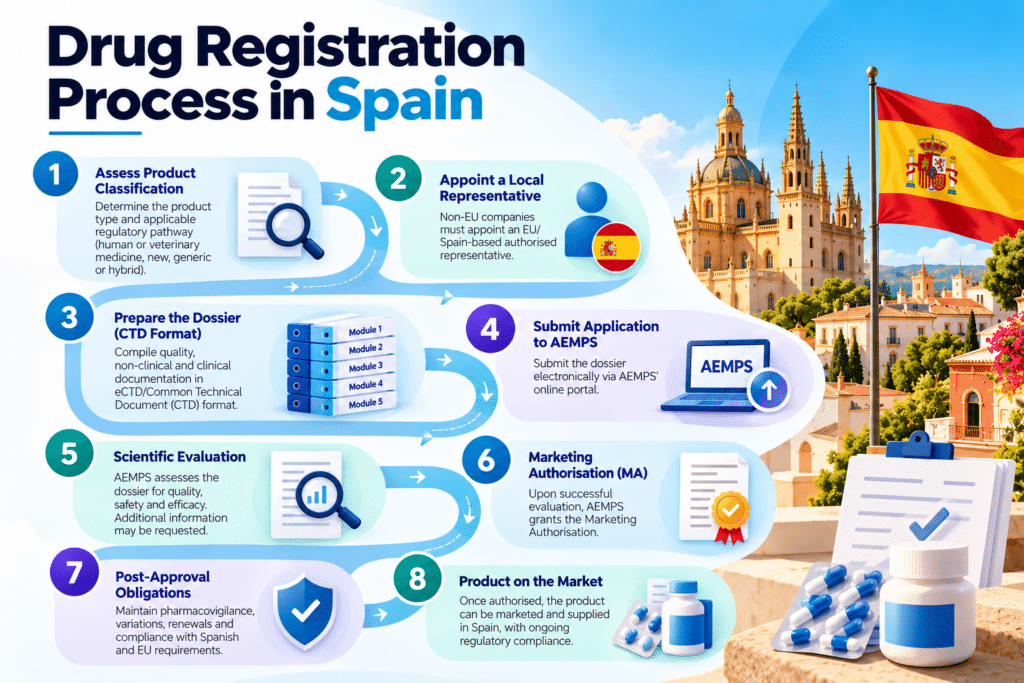
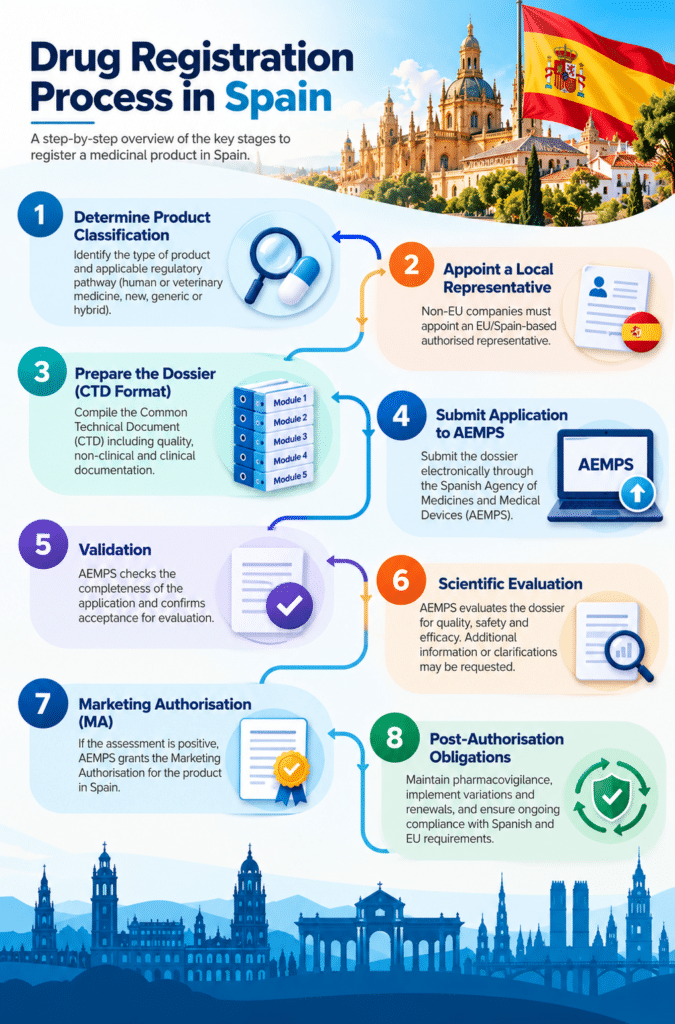
Why Approval Does Not Automatically Mean Commercial Launch
Marketing authorisation establishes that a medicine may be marketed within the scope and conditions of the authorisation. It does not necessarily mean that the product is immediately ready for commercial distribution or that all market-access requirements have been completed. The gap between approval and launch is often a coordination challenge. Regulatory, quality, supply, pharmacovigilance services and commercial teams may operate against different milestones, but their activities need to align around the same product and intended launch date.
- Pricing and reimbursement: Companies seeking public funding or reimbursement in Spain must address the applicable pricing and reimbursement requirements separately from marketing authorisation. The authorisation decision should not be interpreted as confirmation that a final reimbursed price has been established or that every market-access step is complete.
- Labelling and packaging: The approved product information must be reflected in the relevant packaging components and product materials. Companies should coordinate artwork preparation, language requirements and implementation of approved information so that packaging activities do not become an unexpected launch dependency.
- Manufacturing and supply: The product’s supply arrangements must support the planned launch. Manufacturing readiness, applicable quality requirements, batch release arrangements and distribution planning should be considered alongside the regulatory timeline.
- Pharmacovigilance and ongoing compliance: Marketing authorisation holders remain responsible for applicable pharmacovigilance obligations, safety reporting and risk-management requirements. These responsibilities continue throughout the product lifecycle and require appropriate systems, procedures and accountability.
- Commercial and operational readiness: Distribution arrangements, product availability, internal launch approvals and market-access activities should be managed according to the product’s intended commercial model and applicable requirements.
Not every medicine will have the same set of launch dependencies. The appropriate plan depends on the product, its authorisation conditions, its supply model and whether public reimbursement is being sought.
What Should Companies Prepare Before Submitting to AEMPS?
A strong submission begins with a clear understanding of the regulatory pathway and a realistic assessment of dossier readiness. The aim is to identify issues before they become validation problems, assessment questions or delays to the wider market-entry plan.
- Confirm the regulatory pathway
Document the rationale for the chosen procedure, the product’s authorisation status and the intended geographic scope. Confirm the applicable requirements before finalising the submission plan. - Assess the dossier against the requirements
Review the administrative information and relevant CTD modules for completeness, consistency and scientific support. Check that the manufacturing, nonclinical, clinical and product-information sections align with the proposed application. - Verify electronic submission readiness
For an eCTD submission, check the applicable technical validation criteria, sequence structure, document placement and lifecycle requirements. Ensure that the correct electronic format and submission channel are being used for the relevant procedure. - Align the product information
Review the SmPC, package leaflet and labelling against the supporting evidence and applicable requirements. Identify language-related work and product-information dependencies early enough to be incorporated into the project plan. - Prepare the assessment-response process
Establish clear ownership for regulatory correspondence, technical input, document updates and sequence publishing. Agree on internal review and approval arrangements so that responses can be prepared within the applicable deadlines. - Map the approval-to-launch dependencies
Identify activities that need to progress alongside the assessment, including applicable pricing and reimbursement work, packaging, manufacturing and supply readiness, and pharmacovigilance arrangements. - Create a milestone-based project plan
Track submission preparation, validation, assessment, response windows and post-authorisation activities. Assign responsibilities and establish a process for escalating issues that could affect the timeline.
Are Your Drug Labels and Product Information Ready for Spain?
Pharmaceutical market entry involves more than obtaining authorization. Product information, package leaflets, labeling content, and applicable language requirements must also be addressed. Get regulatory labeling support to help align your documentation with the requirements for your target market.
Explore Regulatory Labeling Services →The Spain Regulatory-to-Launch Readiness Framework
A practical market-entry framework should connect regulatory requirements with the decisions and activities that determine launch readiness. The following seven stages provide a structured way to organise the work.
- Route — Establish regulatory eligibility.
Confirm whether the national, DCP, MRP or centralised procedure applies. Document the basis for the decision and identify the participating authorities and relevant procedural requirements. - Prepare — Establish dossier readiness.
Compile the required documentation and review the supporting evidence, product information and administrative materials. Resolve known gaps before the planned submission. - Validate — Confirm technical and document compliance.
Check the applicable electronic submission requirements, dossier structure, technical validation results and consistency of the documentation. Ensure that submission responsibilities are clearly assigned. - Submit — Manage assessment milestones.
Track the application’s progress, coordinate regulatory correspondence and prepare responses to deficiencies or clarification requests. Align internal review processes with the applicable response deadlines. - Authorise — Translate the decision into implementation activities.
Review the final authorisation and its conditions. Confirm the approved product information and identify any regulatory actions required before the intended launch. - Activate —Complete launch dependencies.
Coordinate applicable pricing and reimbursement activities, packaging implementation, supply arrangements, distribution and internal launch readiness. Track outstanding dependencies rather than assuming that approval resolves them automatically. - Maintain — Manage the product lifecycle.
Plan for applicable variations, renewals, pharmacovigilance obligations and ongoing regulatory changes. Maintain appropriate documentation and ownership after the product enters the market.
How DDReg Supports Pharmaceutical Registration in Spain
Spain market entry requires regulatory decisions to be translated into practical submission activities. DDReg’s role is to support pharmaceutical companies in navigating the applicable regulatory requirements, preparing submissions and coordinating relevant regulatory activities in line with the agreed project scope.
DDReg’s existing Spain regulatory services cover areas including regulatory strategy, new product authorisations, regulatory gap analysis, CMC advisory, eCTD publishing and submission, labelling and post-approval lifecycle management.
Conclusion
Successful pharmaceutical market entry in Spain depends on making the right regulatory decisions early and managing the relationship between authorisation, submission readiness and commercial launch.
AEMPS plays a central role in national authorisation and Spain’s participation in European regulatory procedures. However, the correct route depends on the medicine’s eligibility, existing authorisation status and intended market coverage. The 2026 national assessment timetable adds a defined structure for planning national applications, but it does not remove the need for a complete dossier, timely responses and coordinated launch preparation. Companies that treat registration as an integrated programme can identify risks earlier, allocate responsibilities more clearly and manage regulatory milestones alongside supply, market-access and lifecycle requirements.
DDReg’s regulatory affairs services and submission capabilities can support this work where specialist assistance is needed. The objective is to establish a regulatory strategy that fits the product, a submission plan that reflects the applicable requirements and a launch-readiness process that extends beyond the authorisation decision.
Frequently Asked Questions
For eligible human-medicine applications under the national procedure, AEMPS has established a harmonised assessment timetable with a maximum period of 210 calendar days from validation to the final decision, subject to the applicable procedural rules and clock stops. Dossier preparation and activities outside the assessment period must be considered separately.
The national procedure is intended for eligible medicines seeking authorisation for Spain. DCP supports coordinated applications in multiple EU Member States when the medicine has not yet been authorised in the EU and meets the route's requirements. MRP allows an existing national authorisation to be recognised in additional Member States. The appropriate route depends on the product's status and intended markets.
Companies should verify the applicable electronic submission guidance, technical validation criteria, dossier structure, document placement, sequence lifecycle requirements and application documentation. They should also establish clear responsibilities for preparing and approving responses to validation issues and assessment questions.
DDReg provides regulatory affairs capabilities that include regulatory strategy, dossier preparation and review, eCTD publishing and submission, new product authorisation support and lifecycle management. The appropriate scope depends on the product, its regulatory pathway and the company's project requirements.