
Thailand FDA Priority Review is not the straightforward fast track many sponsors expect it to be. It functions as a controlled acceleration mechanism where dossier maturity, therapeutic justification, and submission coherence determine whether the speed advantage is real or illusory.
Consider a sponsor preparing for Southeast Asian expansion with Thailand as the first market. The product addresses a serious unmet need, carries recognized international approvals, and the team is confident it qualifies for expedited review. Then queries arrive early, the timeline stretches, and the competitive launch window quietly narrows.
This outcome is more common than most anticipate. What is referred to here as Priority Review reflects selective accelerated assessment based on therapeutic need, public health relevance, and dossier readiness. The Thailand FDA does not publish a formally designated Priority Review pathway equivalent to the US FDA or EMA frameworks. Applications without a structurally aligned ASEAN Common Technical Dossier (ACTD) or ICH Common Technical Document (ICH CTD) frequently revert to standard assessment intensity due to early clarification cycles. The acceleration exists. Accessing it reliably is the harder part.
An Overview of Thailand FDA's Priority Review Pathways
Thailand’s accelerated assessment model is typically applied selectively, often aligned with public health relevance, unmet medical need positioning, or regulatory prioritization of specific therapeutic categories.
While formal classification exists, operational interpretation varies during evaluation. Submissions labeled under expedited designation are still subject to full scientific scrutiny, particularly in quality and clinical sections.
Commonly observed pathway triggers include:
- Serious or life-threatening indications with limited therapeutic alternatives
- Products with prior approval in reference jurisdictions
- Strong alignment between nonclinical rationale and proposed indication
- Complete ACTD or ICH CTD alignment without structural inconsistencies
However, eligibility alone does not guarantee sustained acceleration. Review patterns indicate that dossier fragmentation frequently neutralizes initial priority designation.
Eligibility Gaps That Delay Priority Assessment
A recurring issue in accelerated submissions is misalignment between eligibility claims and dossier evidence.
Eligibility gaps typically emerge in four operational dimensions:
- Clinical justification mismatch:Indicationpositioning is not fully supported by the pivotal trial design or comparator selection.
- Regulatory precedent misinterpretation:Prior approvals in otherjurisdictions were not adequately bridged to the Thailand population relevance.
- Incomplete administrative synchronization:Minor inconsistencies in labeling, product composition, or dossier metadata trigger validation loops.
- Local licensed importer requirement:All drug applications in Thailand must be filed through aThailand FDA-licensed importer or manufacturer. Direct foreign registration is not permitted under the Thailand drug law. Appointing a licensed local entity is a prerequisite that must be addressed before any submission activity begins.
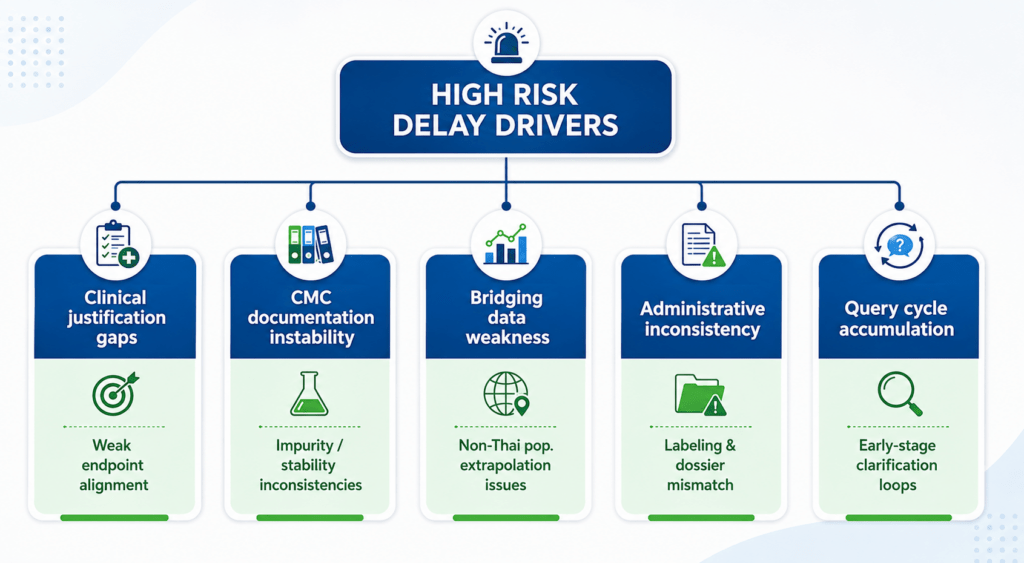
These gaps often result in early-stage query cycles that neutralize expected acceleration advantages.
Hidden Drivers Behind Extended Review Timelines
Even under Thailand FDA expedited drug approval mechanisms, timeline extension is frequently driven by structural dossier weaknesses rather than scientific novelty.
The most persistent contributors include:
- Module 3 quality documentation inconsistencies, particularly impurity justification and stability extrapolation
- Bridging data insufficiency for ethnic or regional applicability
- Variability in clinical endpoint interpretation between the sponsor and the reviewer
- Incomplete responses to initial deficiency notifications
- Over-reliance on foreign approval status without local adaptation logic
Submission behavior suggests that Priority Review status amplifies scrutiny intensity rather than reducing it.
How Thailand FDA Evaluates Expedited Submissions
Evaluation under priority designation is not procedurally separate from standard review in terms of scientific depth. The distinction lies primarily in internal triaging and resource allocation.
Assessment typically follows a layered logic:
- Initial administrative validation
- Scientific screening for completeness
- Early query generation if inconsistencies are detected
- Deep technical review of CMC and clinical modules
- Iterative clarification cycles where needed
In practice, early-stage completeness determines whether acceleration is preserved or effectively downgraded through review friction.
Submission Readiness Controls for Faster Approval
Accelerated approval outcomes are strongly correlated with pre-submission dossier discipline.
A practical readiness control framework includes:
- Structural Consistency Check: Ensure alignment across ACTD or ICH CTD modules,including
- Administrative documentation and Module 1 labeling
- Quality summaries across Module 2
- Manufacturing data in Module 3
- Clinical indication wording throughout
- Bridging Justification Validation: Confirm that foreign data extrapolation is explicitly supported by
- Population relevance rationale
- PK/PD comparability
- Exposure-response alignment
- Query Anticipation Mapping: Pre-identifylikely regulatory questions in
- Impurity profiles
- Stability conditions
- Endpoint selection rationale
- Comparator selection logic
- Administrative Completeness Audit:Validate
- Correct formatting under Thailand submission expectations
- Local labeling compliance
- Product specification consistency
- GMP Clearance Verification:Confirm that
- Overseas manufacturing facilities have obtained or applied for a formal GMP Clearance from the Thailand FDA.
- Internationally recognized GMP certificates from WHO, EMA, or US FDA support the application but do not automatically substitute for Thailand FDA GMP Clearance.
- GMP Clearance status is confirmed before submission to avoid administrative holds.
Submissions failing at these checkpoints typically enter repeated clarification loops, regardless of priority status.
Strategic Considerations for ASEAN Market Entry:
Thailand FDA Priority Review should not be treated in isolation. Within ASEAN regulatory sequencing, Thailand often functions as a reference or synchronization node for regional submissions.
Operational implications include:
- Dependence on Thailand approval timing for parallel ASEAN filings
- Increased value of harmonized ACTD or CTD architecture across markets
- Strategic advantage of synchronized dossier planning across ASEAN authorities
- Reduced redundancy in lifecycle variation management when alignment is achieved early
Submission strategy suggests that fragmented ASEAN dossiers consistently underperform even under expedited pathways.
Thailand FDA Priority Review Timelines: Observed Reality
The Thailand FDA does not publish fixed official timelines for accelerated assessment categories. Any timelines referenced here reflect industry observation and should not be treated as regulatory commitments. Actual review duration depends on dossier completeness, query volume, and the authority’s internal assessment capacity at the time of submission.
Industry observation indicates that variability is primarily driven by:
- Query cycle frequency in early assessment phases
- Completeness of the initial submission package
- Complexity of the therapeutic area
- Degree of reliance on foreign regulatory approvals
Timeline compression occurs only when early review stages proceed without interruption. Once clarification cycles begin, acceleration effects diminish significantly.
Priority Review Risk Map:
Conclusion
Thailand FDA Priority Review functions as a conditional acceleration framework where dossier integrity determines whether timeline advantages are realized or neutralized. Most delays originate not from regulatory capacity constraints but from structural submission deficiencies that trigger iterative review cycles.
At DDReg, our team supports sponsors with submission-readiness assessments, dossier optimization, and strategic regulatory services in Thailand or guidance to improve Priority Review success rates across Thailand and the broader ASEAN region.
Frequently Asked Questions
It is a selective accelerated assessment mechanism based on therapeutic need, public health relevance, and dossier readiness, as observed in industry practice. The Thai FDA does not publish a formally designated Priority Review pathway equivalent to the US FDA or EMA frameworks.
No. Acceleration depends on complete submission, ACTD or ICH CTD alignment, and the absence of early query cycles.
Delays typically arise from gaps in clinical justification, CMC inconsistencies, bridging data issues, missing GMP Clearance for overseas manufacturers, and the absence of a locally licensed importer.