

After many years of research, a biotechnology company is finally granted regulatory approval. However, the joy quickly fades as reimbursement discussions expose gaps in evidence that no one expected. Clinical data may meet regulatory requirements, but Health Technology Assessment (HTA) reviewers often require additional evidence on comparative effectiveness, patient outcomes, real-world performance, and economic value that was not intended during the development of clinical studies. Timelines for launch slip, and pricing negotiations slow down; commercial plans are modified before the product is available to patients.
Problems did not begin during HTA review but rather during dossier creation. An effective HTA Regulatory Strategy helps organizations identify evidence requirements early and align clinical development decisions with future reimbursement expectations.
What Is a Regulatory Dossier Strategy?
A lot of people see the regulatory dossier as a document that is designed to be approved, but that’s only a small part of the purpose.
A well-designed regulatory dossier strategy ensures that the evidence is available before payers or regulators demand it. This requires taking into account clinical, scientific, manufacturing, quality, and other documents that are not only to satisfy the requirements of the regulatory checklist, but also to be able to withstand reimbursement discussions as well as complicated questions about the worth.
The main reason things fall apart is that when they are separated, the regulatory teams gather dossier submissions, whereas HTA documents are usually finished later, causing unnecessary burdens and giving assessment agencies the need to inquire about additional issues that were not needed initially. A single integrated evidence base, created with both audiences in mind, would reduce much of this friction without increasing compliance risk.
How a Regulatory Dossier Strategy Shapes the HTA Outcome
Reimbursement reviewers aren’t looking at efficacy alone. They want to know how the product performs against existing options, what it costs the system, how it affects patients day-to-day, and whether the budget impact is defensible. That’s a broader brief than most regulatory submissions are designed to address.
The teams that handle this well aren’t producing new evidence at the HTA stage. They built the right evidence earlier, and the dossier already reflects it.
Regulatory Dossier Component | HTA Impact |
Clinical trial design | Supports comparative effectiveness evaluation |
Comparator Selection | Provides meaningful comparison with the current standard of care |
Target population definition | Improves patient subgroup assessment |
Endpoint selection | Demonstrates meaningful clinical benefit |
Safety profile | Supports benefit-risk evaluation |
Patient-reported outcomes | Supports quality-of-life assessment |
Quality documentation | Builds confidence in manufacturing consistency |
Real-world evidence planning | Strengthens long-term value assessment |
Why HTA Regulatory Strategy Should Start During Clinical Development
The HTA Regulatory strategy should start during clinical development as the evidence that is available for reimbursement review is mostly determined by decisions made many years prior to the course of trial design. Selection of the endpoint, choice of comparator selection criteria, inclusion criteria, and outcomes of patients’ reports: these choices are either in support of or against future HTA conclusions.
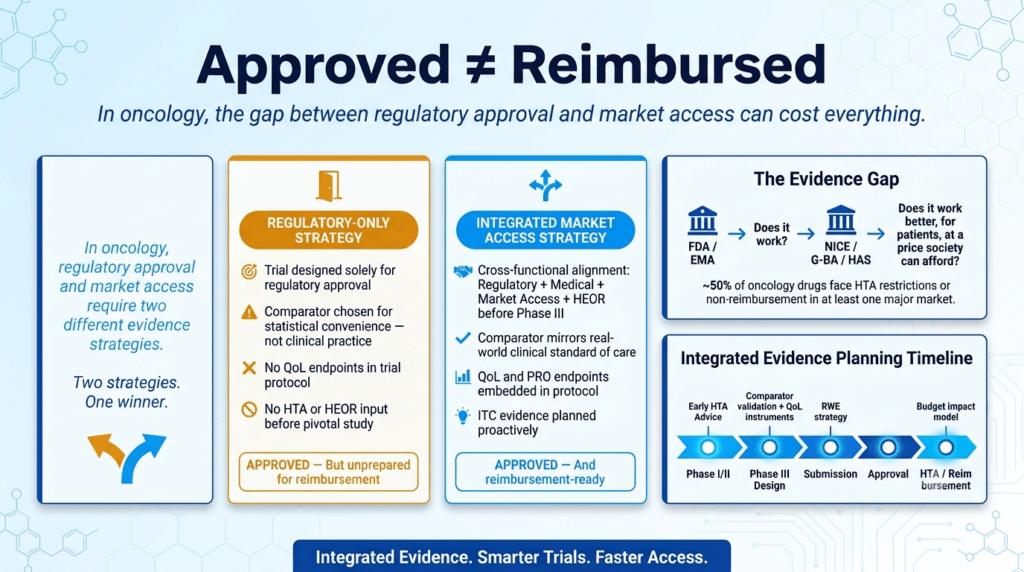
Two hypothetical oncology companies illustrate this well.
Company A designs trials for regulatory approval. After authorization, HTA reviewers request indirect treatment comparisons because the chosen comparator doesn’t reflect routine clinical practice.
Company B involves regulatory, medical, market access, and health economics input before pivotal studies begin. The comparator reflects current treatment standards. Quality-of-life endpoints are built into the protocol.
Both get approved. Only one enters reimbursement negotiations with the right evidence already in hand.
What Makes an HTA-Aligned Dossier Strategy Work
This isn’t a documentation exercise; it’s a cross-functional planning discipline. The factors that consistently matter:
- Early evidence planning: Clinical evidence should satisfy regulators while supporting comparative value assessments.
- Real-world evidence integration: Increasingly important for demonstrating long-term effectiveness and treatment persistence.
- Health economics preparation: Economic models are only as strong as the clinical assumptions behind them .
- Consistent scientific narrative: Regulatory submissions, HTA dossiers, and value communications are read by different people at different stages, but they’re describing the same product. When science shifts between documents, reviewers notice. The story needs to be held across all three.
- Gap assessment: Identifying missing evidence before submission leaves time to address it.
Regulatory and HTA Expectations Are Getting Closer
Healthcare systems have increasingly prioritized value-based decision-making, prompting regulatory agencies to adapt in kind. Joint consultation initiatives, early payer engagement efforts, and expanding patient-centric outcomes all point toward this shift in approach.
Regulators and HTA bodies still have different mandates. Both rely on credible scientific evidence. Organizations that recognize where these demands overlap can build documentation once rather than twice.
Common Mistakes That Undermine Reimbursement
These problems rarely originate during HTA preparation. Most take root much earlier.
Challenge | HTA Consequence |
Limited comparator selection | Weak comparative assessment |
Missing quality-of-life data | Reduced patient value evidence |
Inconsistent clinical messaging | Reviewer concerns about reliability |
Late economic model development | Delayed reimbursement timelines |
Separate regulatory and market access teams | Duplicate work, inconsistent documentation |
What Regulatory Teams Can Do Now
Regulatory affairs professionals have more influence over reimbursement outcomes than is often recognized. Practical actions include:
- Align regulatory and market access planning from early development.
- Identify HTA evidence expectations before pivotal trial design.
- Maintain consistent clinical positioning throughout the product lifecycle.
- Build documentation that supports multiple global submission pathways.
- Review evidence gaps before dossier finalization.
- Encourage collaboration across regulatory, medical, clinical, and health economics functions.
Conclusion
Strong reimbursement outcomes are rarely rescued at the last minute. They’re built into the evidence strategy from the beginning. A well-constructed Regulatory Dossier Strategy creates the scientific foundation that supports both regulatory approval and successful HTA evaluation, reducing evidence gaps, improving submission quality, and accelerating market access.
If your organization wants to build an integrated Regulatory Dossier Strategy that supports global reimbursement objectives, DDReg’s Regulatory Strategy Services can help align your documentation with evolving HTA expectations and long-term market access goals.
Frequently Asked Questions
A regulatory dossier strategy provides a systematic way of planning, developing, and compiling clinical evidence necessary for submissions to regulators. A successful strategy also takes into account HTA requirements, reimbursement expectations, and market access objectives.
A regulatory dossier strategy for HTA ensures that evidence needed for health technology assessment (such as comparative effectiveness, patient-reported outcomes, real-world evidence, and economic value data) is considered early during product development to reduce gaps and facilitate stronger reimbursement discussions.
An HTA regulatory strategy must start early during clinical development, as many HTA requirements depend on early decisions such as comparator selection, endpoint design, patient population definition, and health economics planning. Delays may result in additional evidence requirements or delayed market access.