RaaS stands for Regulatory-as-a-Service and allows pharmaceutical companies to leverage an agile operational model by renting regulatory expertise and technology-enabled workflows on demand. This approach allows firms to enhance their regulatory Affairs (RA) abilities globally without creating large, permanent departments within their internal structures.
What is Regulatory as a Service (RaaS) Pharma?
Regulatory Affairs as a Service (RaaS) models allow life sciences companies to get flexible, specialized, regulatory affairs support for compliance, submissions, and approvals, without the need to build a large, permanent team, using the Regulatory Affairs Service.
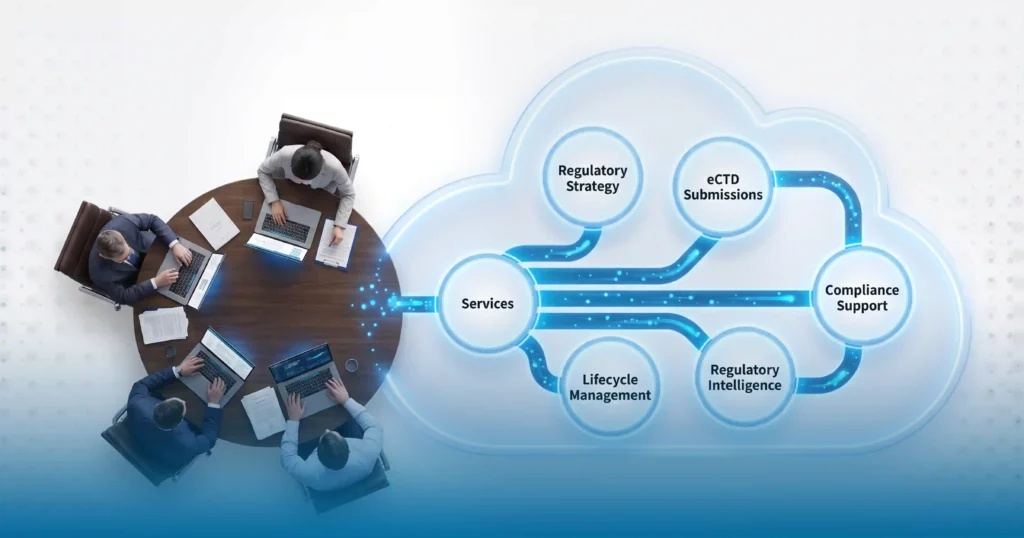
Key Services Included in Regulatory as a Service:
- Regulatory Strategy & Consulting – Creating pathways and plans for approvals.
- Regulatory Submission Management – Handling and organizing the submissions and required paperwork.
- Regulatory Compliance Support – Keeping up with the new, changing, global regulations.
- Global Regulatory Assistance – Helping with approvals for entry into new markets.
- Prodcut Lifecycle Management – Handling the full scope of the changing, ongoing regulatory demands post-approval submission.
Using RaaS (Regulatory Affairs as a Service) means less cost for the clients, faster approvals, and having the necessary expertise on demand.
Need End-to-End Regulatory Affairs Support?
Accelerate global product approvals with DDReg Pharma's comprehensive Regulatory Affairs Services. From regulatory strategy and gap analysis to eCTD submissions, CMC advisory, publishing, lifecycle management, and global market authorizations, our experts help you achieve faster, compliant market access across 120+ countries.
Explore Regulatory Affairs Services →Why Pharma Companies Are Adopting RaaS in 2026
This shift from internal regulatory affairs to RaaS is being driven by several industry demands:
- Flexible Adaptive Scaling: Businesses can quickly increase submissions or gain local approvals in new regions without increasing staff in-house permanently.
- Advanced Technology Integration: RaaS Pharma providers specialize in customized software solutions such as the creation of artificial intelligence-powered Annual Product Quality Reviews (APQRs) and in-silico dossier generation, among others.
- Cost Predictability: This model allows departments to avoid fixed costs by opting for various flexible subscription or project-based cost structures.
- Specialized Knowledge: RaaS provides instantaneous access to niche international regulations (such as those from EMA, USFDA or CDSCO) while eliminating the need for ongoing internal training sessions.
What Does a Regulatory as a Service Provider Deliver?
RaaS (Regulatory as a Service) providers typically act as extensions of internal teams, offering features defined by major service providers for instance:
- Regulatory Information Management (RIM) and IDMP: Provide oversight over huge volumes of data to ensure local authorities meet requirements in compliance.
- Submit eCTD Publishing: Organising multi-regional dossiers, electronic CTD submissions and NDAs electronically
- Medical Writing: Producing safety narratives, clinical summaries and protocol documents as required.
- Post-Marketing Compliance: Achieving post-market compliance requires closely tracking pharmacovigilance and license renewals and providing on-going safety assessments.
Emerging Trends Transforming RaaS (Regulatory Affairs as a Service)
- The Engine of RaaS: Autonomous AI Agents – RaaS platforms increasingly rely on semi-autonomous AI agents as the cornerstone of their services, pulling data directly from client R&D databases, cross-referencing it with updates from local authorities, and flagging any compliance risks before human review is necessary.
- Impact: This set up enables RaaS providers to minimize marginal effort per market by publishing submissions across jurisdictions simultaneously.
- Human Accountability: Human-in-the-loop requirements are strictly enforced; global authorities such as FDA mandate that pharmaceutical sponsors remain fully accountable for validating all AI-drafted submissions submitted for approval.
- Key 2026 Regulatory Triggers Driving Adoption – Pharma companies are turning to RaaS Pharma to manage a flood of global framework updates without needing to retrain all their staff:
- EU Regulatory Reforms: With stricter digital submission standards coming online in 2016, continuous pipeline adjustments must take place for submissions via central submission systems.
- India (CDSCO / IPC): Following the launch of Indian Pharmacopoeia 2026 standards containing blood and blood component metrics for which no comparable metrics exist anywhere else, an immediate need has arisen for compliance expertise at a local level.
- ESG and Data Privacy: Expanded requirements for Environmental, Social and Governance (ESG) tracking in pharmaceutical supply chains combined with strict data privacy laws necessitate real-time compliance monitoring.
- Shift from SaaS to Risk-Sharing Financial Models –RaaS Pharma providers can take on financial risks for pharmaceutical companies.
- Outcome-Based Pricing: Vendors have begun shifting away from charging fixed monthly fees towards offering per dossier, approval or milestone pricing models. In case the agent or system does not produce audit-ready documents, vendors assume any associated operational costs and therefore accept responsibility for covering them themselves.
- Proactive Auditing: RaaS networks employ AI-powered mock digital inspections on company data repositories continuously, transitioning companies from reactive compliance to “always audit-ready” status.
Technology as a Driving Force for RaaS Growth:
The success of RaaS can be directly traced back to its proper integration of artificial intelligence (AI) within regulatory processes. RaaS models rely on supervised AI to assist with tasks like document drafting and summarization as well as consistency reviews, thus decreasing marginal amounts of work that must be accomplished globally to implement a service globally.
Conclusion:
RaaS Pharma is becoming an essential tech strategy for pharmaceutical firms, combining AI with outcome-based pricing to guarantee permanent audit readiness and accelerate therapy launch times while adapting instantly to global regulatory shifts. Learn how you can make this transition by requesting either a vendor checklist or internal business case template from us today.
DDReg Pharma serves as a global life science consulting partner with end-to-end regulatory as a Service (RaaS) capability. Their multijurisdictional compliance pipelines bridge the gap between advanced technology and human expertise.
Frequently Asked Questions (FAQs):
Yes. Modern RaaS platforms feature secure cloud environments with advanced data encryption to protect their client privacy laws such as GDPR while keeping R&D information out of public hands and off the market.
AI agents automate repetitive tasks such as document drafting, data summarisation and cross-referencing local laws; however, a human-in-the-loop framework must still be strictly adhered to; internal or vendor experts validate all outputs produced by AI before sending them off for submission to authorities such as FDA or EMA approval.
RaaS allows your organization to transfer high, fixed internal overhead costs (e.g. salaries and software license fees) into a variable subscription or project-based fee that's easier for budgeting purposes and allows risk sharing finances to ensure successful outcomes only require payment when achieved successfully and compliantly.