
Multi-Market Regulatory submission programs often fail on an industrial scale due to mistaking growth for mere accumulation. Companies tend to overextend themselves across many regions before standardizing their operating models. As growth outpaces infrastructure, simple miscommunications instantly snowball into costly bottlenecks and compliance risks.
Why Multi-Market Regulatory Submission Programs Fail
- Ignoring Local Nuance: Treating different regions, the same can create friction as local regulations vary and customer expectations differ between locations. One size-fits-all approaches inevitably result in more rejected or delayed submissions.
- Patchwork systems: Using different vendors, local submission agencies and digital tools for each region obstruct data aggregation and interfere with overall efficiency.
- Information Silos: Launching across multiple markets at once increases mistakes and overwhelms your team, further compounded by premature scaling. Without an established “pilot market” to test submission processes, early-stage problems quickly escalate into greater ones.
- Translation Trap: One such complication that often arises when localizing complex data can become lost in translation is: Transforming business needs to foreign submission frameworks without following an established process creates unnecessary administrative delays.
How to Multi-Market Regulatory Submission Programs Fix these Failures
To effectively scale an MMS Regulatory submission program, regions cannot be treated as isolated projects. We’ll need to implement a centralized strategy.
- Conceal Unified Platform: Transition your engineering or administrative focus through localized operations to global approaches. Adopt a single software or management system with standard templates so that each region submits requests through one central backend, with only regionalized data being updated locally.
- Start Small and Iterate: Pilot your workflows first in a pilot market to test out how you work best. Fix operational, compliance and language issues locally before rolling the program out globally.
- Establishing Your Core Strategy: Your program’s fundamental structures must remain constant. Standardize 80% of your operational processes, while leaving 20% flexible for adaptation to local market requirements (like Pareto principle).
- Conduct regular audits: Every 18-24 months, conduct hard resets on your GTM architecture to make sure it still aligns with changing regional regulations.
- Global Regulatory Submissions: Requires an agile and data-centric framework to meet launch timelines, which modern Regulatory Submission Services offer through: Technology, Regional Intelligence, and Specialized workflows that facilitate rapid approval across global markets.
Key Challenges in Modern Multi-Market Regulatory Submissions
Navigating today’s global regulatory environment necessitates managing both localized demands and stringent international requirements in an effective way.
- eCTD v4.0 and IDMP Thresholds: Major health authorities such as FDA and EMA require object-oriented XML data architecture; PDF submission is no longer considered viable.
- Automated AI Screening Rejections: Regulatory gateways utilize AI triage systems to screen incoming dossiers. Any metadata mismatch, unmapped field or broken cross-reference will trigger an instantaneous technical rejection and immediate notification.
- Compliance Drift & Version Control: Overseeing different iterations of Module 3 (CMC) across many countries causes fragmented data which hinders post-approval variation cycles and lifecycles.
Recent Updates on Multi-Market Regulatory Submission Services
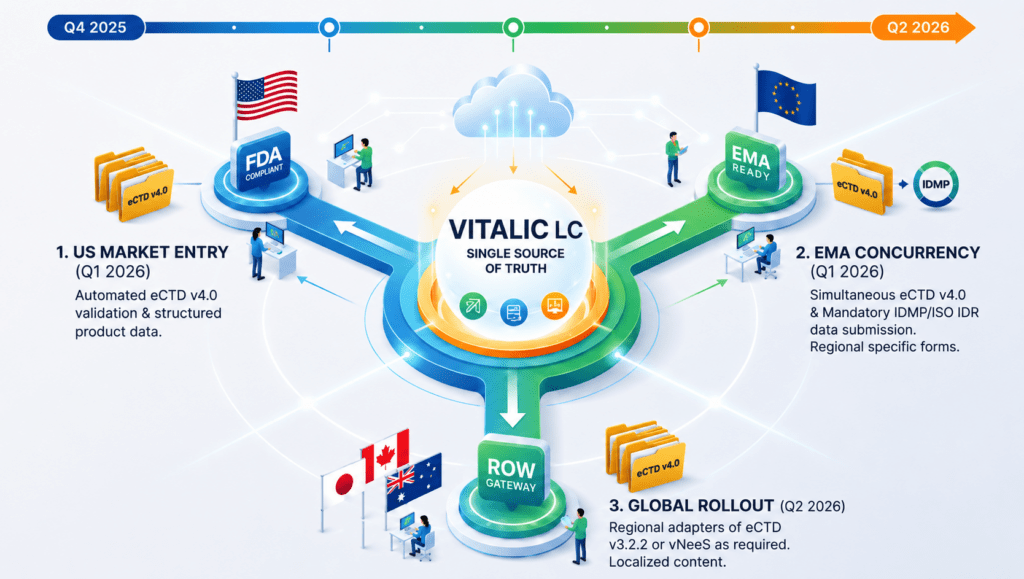
Three Major Trends Reshaping Global Regulatory Submissions in 2026
Life sciences regulatory solutions companies make use of static document-based workflows to interact with dynamic data-driven regulatory authorities. Below is a breakdown shown of three major core updates driving this industry shift.
- AI-Driven Regulator Screening: Regulatory agencies such as US-FDA and EMA now utilize automated AI triage engines to assess dossiers before being seen by human reviewers.
- Problem: Manual, inconsistent formatting that once passed human eyes now triggers instant electronic rejections.
- Theory: Regulators have changed from document reviewers to data validators; AI algorithms use artificial intelligence (AI) algorithms to check data integrity, identify discrepancies across different sections, and instantly flag noncompliance issues in seconds.
- Fix: To be compliant, submissions should undergo pre-submission AI validation internally to make sure their information matches what the regulator expects of them.
- eCTD v4.0 and IDMP Standards: The global mandatory transition to eCTD v4.0 (Electronic Common Technical Document) and IDMP (Identification of Medicinal Products) has brought significant transformational change to regulatory data architecture.
- Two-Way Communication: In contrast with v3.2.2, eCTD v4.0 allows bidirectional communication; regulators can now digitally request specific modifications within an ecosystem.
- Object-Based Architecture: Documents no longer comprise static PDFs but rather are collections of reusable data objects linked by XML metadata.
- The Friction: Companies still using traditional file-sharing or old document management systems cannot support this continuous multi-directional data exchange, leading them into multi-market pipeline stall outs.
- Continuous vs. Static Operating Models: The traditional approach to regulatory compliance was project-based: When regulations changed, task forces were organized, systems updated and the project concluded. But now global regulations change too fast for static project lifecycles to keep up. Modernization no longer stands still, rather it has become an ongoing state. And successful firms have ditched “one and done” IT modernization projects altogether in favor of continuous operating models which update submission software, data mappings and compliance rules in real time as local market requirements evolve.
Conclusion
In 2026, Success with multi-market regulatory submission program lies solely with firms who switch from static documents to continuous, structured data streams. Firms who rely on older, manual project-based workflows will continue to experience instant, automated rejections from AI-powered regulator screens.
Utilizing DDReg’s structured eCTD v4.0 architecture, continuous compliance workflows and VITALIC(LC) Regulatory Affairs Lifecycle Management Platform for life sciences companies to quickly bypass technical, ensure error-free global data alignment and accelerate market approvals.
Frequently Asked Question (FAQs):
Health authorities rely on automated AI triage tools to validate data integrity prior to human review. If your submission contains formatting errors, inconsistent metadata entries or conflicting data between sections, the AI triggers an instant electronic rejection
eCTD v4.0 is the latest electronic submission standard built upon the HL7 V3 RPA message architecture. As opposed to eCTD v3.2.2, this framework facilitates two-way communications between regulator and sponsor, supports easy document reuse, and simplifies life cycle management via a single message framework4.
The Identification of Medicinal Products (IDMP) standards set a universal, structured format for tracking product data such as ingredients, manufacturing sites and packaging requirements across regions like EU and US markets. Submissions must adhere closely with these standards to maintain market access in both regions.