
Nigeria is one of the fastest-growing pharmaceutical markets in Africa, with drug demand rising steadily on the back of population growth, a widening disease burden, and broader healthcare access. This guide provides insight into the import compliance, approval processes, and market access requirements that must be satisfied to register medicines for sale in Nigeria.
Market entry remains tightly managed. NAFDAC regulates every medicinal product entering the country, and its review process is built to keep unsafe products out of circulation. Figuring out exactly what NAFDAC expects, and translating those expectations into a workable timeline, operational decisions, and a realistic sense of when market access is achievable, can be genuinely difficult for companies entering the market.
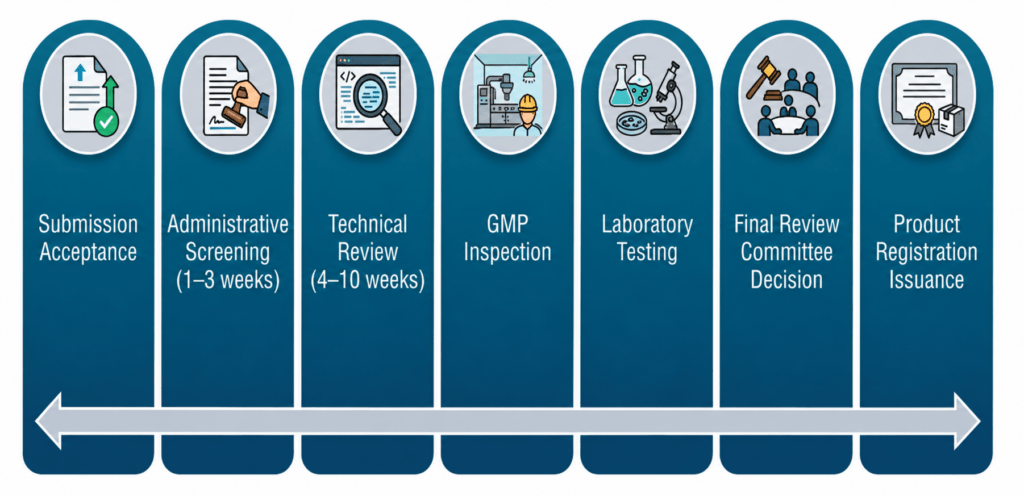
NAFDAC Drug Registration in Nigeria is the regulatory process through which pharmaceutical companies obtain approval from the National Agency for Food and Drug Administration and Control (NAFDAC) to import, manufacture, distribute, and market medicines in Nigeria. The process includes dossier submission, GMP compliance inspection, technical review, laboratory evaluation, and product registration before market authorization is granted.
Understanding NAFDAC Drug Registration in Nigeria
The sequence reads cleanly enough on paper, but putting it into practice against a real product line is where things get complicated.
Pre-submission positioning comes first. This means confirming the product doesn’t sit on the Import Prohibition List or the NAFDAC Ceiling List and checking whether the collaborative registration pathway applies for WHO-prequalified drugs, vaccines, and in vitro diagnostics. Where eligible, this pathway meaningfully shortens review, since NAFDAC builds on the WHO Prequalification Team’s prior assessment instead of repeating it.
Dossier screening clearance follows as its own gate, separate from general document review. An application simply cannot move forward until this clearance is obtained.
Next comes application and dossier upload through the NAPAMS portal, paired with the prescribed fee and a written application letter addressed to the Director-General, attention DR&R Directorate.
After that, the dossier goes through screening for documentary completeness. This covers the Certificate of Incorporation, the Notarized Declaration, the Power of Attorney or Contract Manufacturing Agreement, trademark evidence, the Superintendent Pharmacist license, the Premises Retention License, the Certificate of Pharmaceutical Product, and, where the facility hasn’t been previously assessed, the Letter of Invitation for GMP inspection.
Technical and lab review comes next, covering the Certificate of Analysis and, for generic products, bioequivalence data where it applies.
Facility inspection is scheduled once the invitation letter, and the manufacturer’s and local agent’s details are on file. The process closes with a determination from the Food and Drugs Registration Committee (FDRC), which issues the registration number and the Certificate of Product Registration, valid for five years.
Each stage carries its own way of stalling out, and the failures that show up here tend to be administrative rather than scientific in nature.
NAFDAC Drug Registration Requirements and Guidelines
- Administrative and Legal Requirements: To register a drug in Nigeria, applicants must submit authenticated legal documents, GMP certifications, regulatory authorizations, and supporting quality documentation required by NAFDAC. A few baseline expectations come consistently. The Certificate of Pharmaceutical Product needs authentication by the Nigerian Embassy or High Commission in the country of origin, or by a Commonwealth or ECOWAS mission where no Nigerian embassy exists.
GMP certification of the manufacturing site carries the same authentication requirement. The Power of Attorney granted to the Nigerian agent or representative must be notarized in the country of manufacture. The Notarized Declaration, by contrast, is notarized in Nigeria itself; the two documents are frequently mixed up, given the different jurisdictions involved. Add to this evidence of incorporation for the local importer or distributor, along with a valid Premises Retention License for the facility, which carries its own renewal cycle apart from the Superintendent Pharmacist license.
Administrative gaps tend to trigger early query loops, especially where legal representation doesn’t line up cleanly with import licensing structures. - Quality and Manufacturing Data (CMC Expectations): Technical review leans heavily on API sourcing and control, finished product specifications and stability data, batch manufacturing records and validation protocols, and container closure system integrity. Recurring problems include inconsistent stability of data formats and weak justification for formulation equivalence in generic submissions.
- Labeling and Packaging Compliance: Labeling issues drive a fair share of deficiency escalations. Common problems include labels that don’t align with Nigerian statutory requirements, missing cautionary statements or storage conditions, and artwork that doesn’t match between what was submitted and what’s being sold. These inconsistencies typically force revision cycles that push the NAFDAC drug registration timeline well past initial projections.
- Import and Distribution Controls: Import compliance gets evaluated alongside the core registration review rather than being held back as a separate downstream step. Key areas include having a valid importer license at submission, keeping product listings aligned with the import permit, and maintaining batch traceability documentation. Discrepancies here often create parallel review holds, even while the technical assessment is otherwise moving forward.
NAFDAC Drug Registration in Timeline
The NAFDAC drug approval process runs as a multi-stage regulatory evaluation system governing how medicinal products enter the Nigerian market.
Common Reasons for Delays in NAFDAC Drug Registration
NAFDAC Drug Registration in Nigeria reads as a defined administrative sequence on paper. The day-to-day reality looks more like a layered audit.
The Drug Registration and Regulatory Affairs (DR&R) Directorate checks for completeness before any technical reviewer opens the file. A missing notarization, a lapsed Superintendent Pharmacist license, or a regulatory Certificate of Pharmaceutical Product issued outside the WHO format will all send the application back before substantive review even begins. None of that waiting counts against the official clock.
NAFDAC’s own guidelines are explicit about this: the stretch between a query being raised and a compliant response being filed sits outside the timeline entirely. That single mechanic accounts for more registration delays than any one technical deficiency does.
There’s a harder consequence tucked into this rule, too. Failing to respond to a NAFDAC query within 90 working days doesn’t just pause the clock; it closes the application automatically. Most procedural deficiencies cost time. This one costs the submission itself.
Local Requirements That Commonly Trigger Deficiency Letters
Requirement | Why does it surface in deficiency letters? |
Superintendent Pharmacist license | Annual renewal; frequently expired by submission date |
COPP-WHO format | Generic certificates for free sale are often substituted incorrectly. |
Trademark Class 5 registration | Brand registered under a different class or not yet completed. |
GMP invitation letter detail | Missing local agent contact information delays inspection scheduling |
Bioequivalence/biowaiver data | Omitted or submitted in a non-NAFDAC format for generics |
Label artwork | Submitted before registration number issuance, requiring a reprint |
Submission Checklist for Faster NAFDAC Drug Registration Approval
A proper dossier submission readiness review functions less like a checklist and more like a premortem.
Before filing, track every NAFDAC query against the 90-working-day response deadline. This is the single highest-stakes item on the list, since missing it closes the application rather than simply delaying it.
Confirm the Superintendent Pharmacist license will remain valid across the anticipated review window, not just at submission, since a 240-working-day formal timeline can plausibly outlast a license that was current at filing; this particular risk is an operational inference rather than a stated NAFDAC position, but worth planning around regardless. Check the Premises Retention License on its own terms, since it doesn’t share a renewal cycle with the pharmacist license and gets missed easily when only the latter is tracked. Keep the COPP distinct from any generic free-sale certificate and confirm that both carry out the required authentication.
NAFDAC’s WHO-format requirement is specific, and no substitute document from another jurisdiction satisfies it, while an unauthenticated certificate fails regardless of correct format. Confirm the Notarized Declaration is notarized in Nigeria, not abroad like the Power of Attorney. Draft and submit the GMP Letter of Invitation alongside dossier preparation rather than after submission, since inspection scheduling is often the longest single dependency in the whole sequence. And hold off on printing the final label artwork until the registration number is confirmed.
Conclusion
Across NAFDAC Drug Registration in Nigeria, delays build up at documentary checkpoints and inspection sequencing, not at scientific review. License renewal gaps, dossier format mismatches, authentication gaps, and inspection scheduling dependencies are all identifiable in advance and largely avoidable with disciplined submission readiness.
Companies that treat them as predictable, not incidental, move through the process with fewer query cycles and far less risk of application closure over an unanswered query.
For organizations that need structured regulatory support in Nigeria, choose DDReg for Regulatory affairs Services in Nigeria to manage submissions, approvals, and lifecycle compliance with consistent operational discipline.
Frequently Asked Questions
The time frame for NAFDAC drug registration is mainly impacted by the completeness of the dossier and the cycles of technical and laboratory reviews, Good Manufacturing Practices (GMP) inspections, and queries. The time frame for formal reviews is typically defined. However, the process is often delayed when inspection requests are outstanding, and/or when responses to NAFDAC queries are submitted belatedly.
Important requirements for NAFDAC drug registration include the Certificate of Pharmaceutical Product (COPP) and Good Manufacturing Practices (GMP) Certificates, a notarized Power of Attorney or a Contract Manufacturing Agreement, the Certificate of Incorporation of the local Representative, the Superintendent Pharmacist’s license, Retention License for the Premises, a Product Dossier, the Certificate of Analysis with stability data, the Labelling Artwork, and the documents that pertain to the GMP Inspection, if applicable.
No, foreign pharmaceutical companies are unable to register medicines directly with NAFDAC. Foreign pharmaceutical companies must engage a Registered Nigerian Representative or a local Agent with the authority to undertake the pharmaceutical regulatory processes on their behalf. The local Representative must also meet the NAFDAC stipulations.